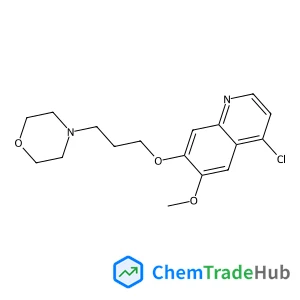
4-(3-((4-Chloro-6-methoxyquinolin-7-yl)oxy)propyl)morpholine
CAS Number:
205448-32-4
Molecular Formula:
C17H21ClN2O3
Xiuchan Xiao, Xiaojun Zeng, Yuan Yuan, Nan Gao, Yanzhi Guo, Xuemei Pu, Menglong Li
G protein coupled receptors (GPCRs) play a crucial role in regulating signal recognition and transduction through their activation. The conformation transition in the activation pathway is of particular importance for their function. However, it has been poorly elucidated due to experimental difficulties in determining the conformations and the time limitation of conventional molecular dynamics (CMD) simulation. Thus, in this work, we employed a targeted molecular dynamic (TMD) simulation to study the activation process from an inactive structure to a fully active one for β2 adrenergic receptor (β2AR). As a reference, 110 ns CMD simulations on wild β2AR and its D130N mutant were also carried out. TMD results show that there is at least an intermediate conformation cluster in the activation process, evidenced by the principal component analysis and the structural and dynamic differences of some important motifs. It is noteworthy that the activation of the ligand binding site lags the G-protein binding site, displaying uncoupled correlation. Comparisons between the CMD and TMD results show that the D130N mutation significantly speeds up ICL2 and key ionic lock to enter into the intermediate state, which to some extent facilitates the activation involved in the NPxxY, DRY region and the separation between TM3 and TM6. However, the contribution from the D130N mutation to the activation of the ligand binding site could not be observed within the scale of 110 ns time. These observations could provide novel insights into previous studies for better understanding of the activation mechanism for β2AR.
Yichun Xu, Chi Song, Yange Zhang, C. S. Liu, B. C. Pan, Zhiguang Wang
DOI: 10.1039/C4CP01224K
Kenneth R. Kort, P. Y. Hung, Patrick D. Lysaght, Wei-Yip Loh, Gennadi Bersuker, Sarbajit Banerjee
DOI: 10.1039/C4CP00111G
Hirokazu Komatsu, Yuki Daimon, Kohsaku Kawakami, Motomu Kanai
DOI: 10.1039/C4CP02255F
Michelle Rasmussen, Shelley D. Minteer
DOI: 10.1039/C4CP02754J
M. Paula Denofrio, Fernando S. García Einschlag, Carlos A. Franca, Reinaldo Pis Diez, Rosa Erra-Balsells, Franco M. Cabrerizo
DOI: 10.1039/C4CP01910E
Pradeep R. Varadwaj, Arpita Varadwaj, Bih-Yaw Jin
DOI: 10.1039/C4CP01775G
Daniel H. Friese, Christof Hättig
DOI: 10.1039/C3CP54338B
Jun Li, Hua Guo
DOI: 10.1039/C4CP00241E
Jung Sang Cho, Jong-Heun Lee, Yun Chan Kang
DOI: 10.1039/C4CP01808G
Tânia Lopes, Luísa Andrade, Florian Le Formal, Michael Gratzel, Kevin Sivula, Adélio Mendes
DOI: 10.1039/C3CP55473B
(5-Sulfamoyl-3-pyridinyl)boronic acid is primarily used in chemical synthesis, p...
Benzyl 2-methyl-2-(methylsulfonyl)-4-pentenoate is typically synthesized via est...
When handling 8-Fluoroquinolin-6-ol (CAS: 209353-22-0), it is important to use p...
1,3-Dibromo-5-(2-methyl-2-propanyl)benzene (CAS: 129316-09-2) is a crystalline c...
Ethyl 7-chloro-4-oxo-1-(1,3-thiazol-2-yl)-1,4-dihydro-1,8-naphthyridine-3-carbox...
When handling Delta-7-Avenasterol (CAS: 23290-26-8), it is important to wear app...
Proper handling involves the use of personal protective equipment such as gloves...
When handling 2-Methyl-2-proanyl 4-[(2-aminophenyl)amino]-1-piperidinecarboxylat...
N-Methyl-4-chlorobenzylamine hydrochloride (CAS: 65542-24-7) is a organic compou...
[2-(Dodecyloxy)ethoxy]acetic acid (CAS: 27306-90-7) is generally considered safe...

Physical Chemistry Chemical Physics (PCCP) is an international journal co-owned by 19 physical chemistry and physics societies from around the world. This journal publishes original, cutting-edge research in physical chemistry, chemical physics and biophysical chemistry. To be suitable for publication in PCCP, articles must include significant innovation and/or insight into physical chemistry; this is the most important criterion that reviewers and Editors will judge against when evaluating submissions. The journal has a broad scope and welcomes contributions spanning experiment, theory, computation and data science. Topical coverage includes spectroscopy, dynamics, kinetics, statistical mechanics, thermodynamics, electrochemistry, catalysis, surface science, quantum mechanics, quantum computing and machine learning. Interdisciplinary research areas such as polymers and soft matter, materials, nanoscience, energy, surfaces/interfaces, and biophysical chemistry are welcomed if they demonstrate significant innovation and/or insight into physical chemistry. Joined experimental/theoretical studies are particularly appreciated when complementary and based on up-to-date approaches.
![4-Fluoro-2-(4-{[(3S,4R)-4-(2-hydroxy-2-propanyl)-3-pyrrolidinyl]amino}-6,7-dimethoxy-2-quinazolinyl)phenol hydrochloride (1:1) structure](https://static.chemtradehub.com/structs/143/1431697-96-9-619c.webp "4-Fluoro-2-(4-{[(3S,4R)-4-(2-hydroxy-2-propanyl)-3-pyrrolidinyl]amino}-6,7-dimethoxy-2-quinazolinyl)phenol hydrochloride (1:1) structure")
![4,10-Dihydroxy-3H-pyrano[3,4,5-kl]xanthen-3-one structure](https://static.chemtradehub.com/structs/125/1259330-61-4-de48.webp "4,10-Dihydroxy-3H-pyrano[3,4,5-kl]xanthen-3-one structure")