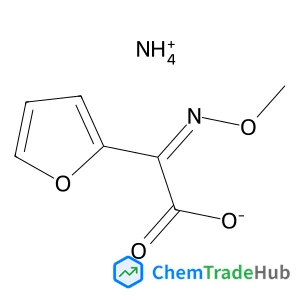
Ammonium (Z)-2-(furan-2-yl)-2-(methoxyimino)acetate
CAS Number:
97148-39-5
Molecular Formula:
C7H10N2O4
Tao Wang, Jianguo Wang, Matthias Beller
The adsorption and co-adsorption of CO and H2 at different coverage on the CdI2-antitype metallic Mo2C(001) surface termination have been systematically computed at the level of periodic density functional theory. Only molecular CO adsorption is possible and the monolayer coverage (1 ML) can have 16CO adsorbed at the top sites. Dissociative H2 adsorption is favored thermodynamically and the monolayer coverage (1 ML) can have 16H adsorbed at the hollow sites. Since CO has much stronger adsorption energy than H2, pre-adsorption of CO is possible. CO pre-adsorption strongly affects atomic hydrogen co-adsorption at a high CO/H2 ratio, while hardly affects that at a low CO/H2 ratio. Under ultra-high vacuum conditions (200 K, 10−12 atm and CO/H2 = 1/1), the most stable adsorbed surface state has CO/H2 = 15/1. Comparison among the metallic terminations of the CdI2-antitype Mo2C(001), eclipsed Mo2C(001) and orthorhombic Mo2C(100) surfaces shows their different CO and hydrogen adsorption as well as activation properties, which reveals that the CdI2-antitype Mo2C(001) surface is least active. These differences come from their surface bonding properties; the CdI2-antitype Mo2C(001) surface is saturated and less metallic, while the eclipsed Mo2C(001) and orthorhombic Mo2C(100) surfaces are unsaturated and more metallic.
Masanori Hosoyamada, Keisuke Okumura, Takayuki Uchihashi, Nobuo Kimizuka
DOI: 10.1039/C8CC01594E
Lan Jia, Yufang Yang, Xiang Liu, Song Chen, Jingxin Zhu
DOI: 10.1039/C9AY01345H
Lixuan Dai, Mingguang Ren, Zihong Li, Li Wang, Weiying Lin
DOI: 10.1039/C9AY01575B
Jiangli Fan, Wen Sun, Fahui Li, Kaoxue Li, Xishi Tai, Xiaojun Peng
DOI: 10.1039/C9CC06040E
DOI: 10.1039/C9AY01589B
Bowen Zhang, Samuel Petcher, Tom Hasell
DOI: 10.1039/C9CC04380B
Shuange Yao, Wei Xiao, Hui Chen, Yong Tang, Qifang Song, Qubo Zheng, Ning Deng
DOI: 10.1039/C9AY01454C
Chirlene Nascimento Botelho, Neuma das Mercês Pereira, Glaura Goulart Silva, Alan Silva de Menezes, Cícero Wellington Brito Bezerra, Flavio Santos Damos, Rita de Cássia Silva Luz
DOI: 10.1039/C9AY01422E
1H-Indazole-6-carbonitrile finds applications in pharmaceuticals, where it serve...
Waste containing Dioctyl (2E)-2-butenedioate (CAS: 2997-85-5) should be collecte...
Sodium [(1,2-benzoxazol-3-ylmethyl)sulfonyl]azanide is primarily used in pharmac...
Dimethyl 4-(4,4,5,5-tetramethyl-1,3,2-dioxaborolan-2-yl)-2,6-pyridinedicarboxyla...
Waste containing 2-Fluoro-6-hydrazinopyridine (CAS: 80714-39-2) should be manage...
6-Formyl-2-pyridinecarboxylic acid is an organic compound with the molecular for...
Research trends for this compound indicate a focus on its potential applications...
9H-Tribenzo[b,d,f]azepine is typically synthesized via a multi-step process invo...
1-Cyclopropyl-7-ethoxy-6-fluoro-8-methoxy-4-oxo-1,4-dihydro-3-quinolinecarboxyli...
Waste containing Methyl 3-oxo-1,2,3,4-tetrahydro-6-quinoxalinecarboxylate (CAS: ...

Physical Chemistry Chemical Physics (PCCP) is an international journal co-owned by 19 physical chemistry and physics societies from around the world. This journal publishes original, cutting-edge research in physical chemistry, chemical physics and biophysical chemistry. To be suitable for publication in PCCP, articles must include significant innovation and/or insight into physical chemistry; this is the most important criterion that reviewers and Editors will judge against when evaluating submissions. The journal has a broad scope and welcomes contributions spanning experiment, theory, computation and data science. Topical coverage includes spectroscopy, dynamics, kinetics, statistical mechanics, thermodynamics, electrochemistry, catalysis, surface science, quantum mechanics, quantum computing and machine learning. Interdisciplinary research areas such as polymers and soft matter, materials, nanoscience, energy, surfaces/interfaces, and biophysical chemistry are welcomed if they demonstrate significant innovation and/or insight into physical chemistry. Joined experimental/theoretical studies are particularly appreciated when complementary and based on up-to-date approaches.
![(1S)-1,5-Anhydro-1-[3-(1-benzothiophen-2-ylmethyl)-4-fluorophenyl]-D-glucitol structure](https://static.chemtradehub.com/structs/761/761423-87-4-dbeb.webp "(1S)-1,5-Anhydro-1-[3-(1-benzothiophen-2-ylmethyl)-4-fluorophenyl]-D-glucitol structure")