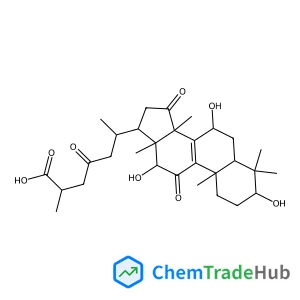
(3beta,7beta,12beta)-3,7,12-Trihydroxy-11,15,23-trioxolanost-8-en-26-oic acid
CAS Number:
98665-22-6
Molecular Formula:
C30H44O8
Veluru Jagadeesh Babu, Sesha Vempati, Seeram Ramakrishna
Hydrogen is an attractive alternative to fossil fuels in terms of environmental and other advantages. Of the various production methods for H2, photocatalysis requires further development so that it can be applied economically on an industrial scale. One- and two-dimensional nanostructures in both pristine and modified forms have shown great potential as catalysts in the generation of H2. We review here recent developments in these nanostructure catalysts and their efficiency in the generation of H2 under UV/visible/simulated solar light. Despite much research effort, many photocatalysts do not yet meet the practical requirements for the generation of H2, such as visible light activity. H2 production is dependent on a variety of parameters and factors. To meet future energy demands, several challenges in H2 production still need to be solved. We address here the factors that influence the efficiency of H2 production and suggest alternatives. The nanostructures are classified based on their morphology and their efficiency is considered with respect to the influencing parameters. We suggest effective ways of engineering catalyst combinations to overcome the current performance barriers.
G. W. Driver, Y. Huang, A. Laaksonen, T. Sparrman, Y.-L. Wang, P.-O. Westlund
DOI: 10.1039/C6CP05801A
Katharine Moore Tibbetts, Xiao-Jiang Feng, Herschel Rabitz
DOI: 10.1039/C6CP06187G
Hua-Bin Sun, Ying-Xian Zhou, Lu-Lu Zhang, Xue-Lin Yang, Xing-Zhong Cao, Hanu Arave, Hui Fang, Gan Liang
DOI: 10.1039/C6CP07760A
L. A. Ferreira, V. N. Uversky, B. Y. Zaslavsky
DOI: 10.1039/C6CP08214A
Z. J. Li, H. Y. Yu, G. Y. Song, J. Zhao, H. Zhang, M. Zhang, A. L. Meng, Q. D. Li
DOI: 10.1039/C6CP07457J
Natasha W. Pettinger, Robert E. A. Williams, Jinquan Chen
DOI: 10.1039/C6CP08227K
K. E. A. Hooper, H. K. H. Lee, M. J. Newman, S. Meroni, J. Baker, T. M. Watson, W. C. Tsoi
DOI: 10.1039/C6CP05123E
Noah M. Johnson, Yuriy Y. Smolin, Daniel Hagaman, Masoud Soroush, Kenneth K. S. Lau, Hai-Feng Ji
DOI: 10.1039/C6CP07853B
A. R. Alian, S. A. Meguid
DOI: 10.1039/C6CP07464B
When handling 4-(2-Furylmethyl)thiomorpholine 1,1-dioxide (CAS: 79206-94-3), it ...
When handling 4-Chloro-N-[2-(4-morpholinyl)ethyl]benzamide (CAS: 71320-77-9), it...
Waste containing this compound (CAS: 62921-74-8) should be handled according to ...
Waste containing (S)-Methyl 2-amino-3-cyclohexylpropanoate should be collected i...
This compound can be synthesized using a multi-step process involving the conjug...
There are several alternatives to (2E)-3-(3,4-Dichlorophenyl)acrylic acid in syn...
Ethyl 6-(2-nitrophenyl)imidazo[2,1-b][1,3]thiazole-3-carboxylate (CAS: 925437-84...
Waste containing 2-(1,3-Thiazol-2-yl)ethanamine (CAS: 18453-07-1) should be coll...
Methyl 5-iodo-2-methylbenzoate can be synthesized through the iodination of meth...
5-Chloro[1,2,4]triazolo[1,5-a]pyridine is commonly synthesized via the condensat...

Physical Chemistry Chemical Physics (PCCP) is an international journal co-owned by 19 physical chemistry and physics societies from around the world. This journal publishes original, cutting-edge research in physical chemistry, chemical physics and biophysical chemistry. To be suitable for publication in PCCP, articles must include significant innovation and/or insight into physical chemistry; this is the most important criterion that reviewers and Editors will judge against when evaluating submissions. The journal has a broad scope and welcomes contributions spanning experiment, theory, computation and data science. Topical coverage includes spectroscopy, dynamics, kinetics, statistical mechanics, thermodynamics, electrochemistry, catalysis, surface science, quantum mechanics, quantum computing and machine learning. Interdisciplinary research areas such as polymers and soft matter, materials, nanoscience, energy, surfaces/interfaces, and biophysical chemistry are welcomed if they demonstrate significant innovation and/or insight into physical chemistry. Joined experimental/theoretical studies are particularly appreciated when complementary and based on up-to-date approaches.