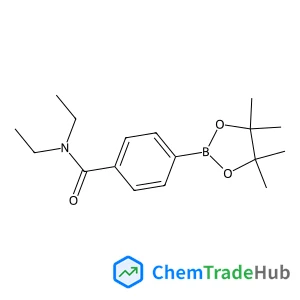
N,N-Diethyl-4-(4,4,5,5-tetramethyl-1,3,2-dioxaborolan-2-yl)benzamide
CAS Number:
325142-99-2
Molecular Formula:
C17H26BNO3
Lijuan Shen, Ruowen Liang, Mingbu Luo, Fenfen Jing, Ling Wu
UiO-66-X (X = H, NH2, NO2, Br) have been successfully synthesized and tested for their photocatalytic activity in water treatment. Results show that electronic effect of the ligand substituents greatly affects the photocatalytic activity of UiO-66. The rates obtained by different substituents are linearly correlated with their Hammett coefficients.
Allen D. Pauric, Ion C. Halalay, Gillian R. Goward
DOI: 10.1039/C5CP05811B
Ewa Patyk, Anna Jenczak, Andrzej Katrusiak
DOI: 10.1039/C6CP01286H
DOI: 10.1039/C5CP07724A
Satoko Hayashi, Yuji Sugibayashi, Waro Nakanishi
DOI: 10.1039/C5CP06062A
T. J. Godfrey, Hui Yu, Michael S. Biddle, Susanne Ullrich
DOI: 10.1039/C5CP02975A
Chunsheng Guo, Yu Zhou, Xin-Qiang Shi, Li-Yong Gan, Hong Jiang
DOI: 10.1039/C6CP01477A
Rebecca A. Ingle, Tolga N. V. Karsili, Gregg J. Dennis, Michael Staniforth, Vasilios G. Stavros, Michael N. R. Ashfold
DOI: 10.1039/C6CP01593J
Xin Zhou, Hao Dong, Ai-Min Ren
DOI: 10.1039/C5CP07260C
Zonghu Han, Meng Wang, Xiangyan Chen, Shaohua Shen
DOI: 10.1039/C6CP00692B
Chao Feng, Carol Beth Post
DOI: 10.1039/C5CP05417F
This compound is mainly used as an intermediate in the synthesis of antipsychoti...
Waste containing 1-(D-Ribofuranosyl)-1,4-dihydro-3-pyridinecarboxamide (CAS: 191...
2-Methyl-2-propanyl 3-bromo-3-(hydroxymethyl)-1-azetidinecarboxylate (CAS: 20079...
N-(4-Chloro-2-pyridinyl)acetamide (CAS: 245056-66-0) is a chemical compound with...
5-Chloro-2-hydroxybenzoic acid, also known as 5-chlorosalicylic acid, is an arom...
When handling 1,1-Dichloro-1-fluoroethane (CAS: 1717-00-6), it is important to u...
Fmoc-(2S,3R)-3-phenylpyrrolidine-2-carboxylic acid is a white crystalline solid ...
4-Amino-5-bromo-2-pyridinecarboxylic acid is primarily used as a precursor in th...
Handling this compound should be done with personal protective equipment (PPE) i...
When handling 8-bromo-2,2-dimethyl-3,4-dihydro-2H-1,4-benzoxazin-3-one, use prop...

Physical Chemistry Chemical Physics (PCCP) is an international journal co-owned by 19 physical chemistry and physics societies from around the world. This journal publishes original, cutting-edge research in physical chemistry, chemical physics and biophysical chemistry. To be suitable for publication in PCCP, articles must include significant innovation and/or insight into physical chemistry; this is the most important criterion that reviewers and Editors will judge against when evaluating submissions. The journal has a broad scope and welcomes contributions spanning experiment, theory, computation and data science. Topical coverage includes spectroscopy, dynamics, kinetics, statistical mechanics, thermodynamics, electrochemistry, catalysis, surface science, quantum mechanics, quantum computing and machine learning. Interdisciplinary research areas such as polymers and soft matter, materials, nanoscience, energy, surfaces/interfaces, and biophysical chemistry are welcomed if they demonstrate significant innovation and/or insight into physical chemistry. Joined experimental/theoretical studies are particularly appreciated when complementary and based on up-to-date approaches.
![tert-Butyl N-[(2-chloropyridin-4-yl)methyl]carbamate structure](https://static.chemtradehub.com/structs/916/916210-27-0-9f95.webp "tert-Butyl N-[(2-chloropyridin-4-yl)methyl]carbamate structure")