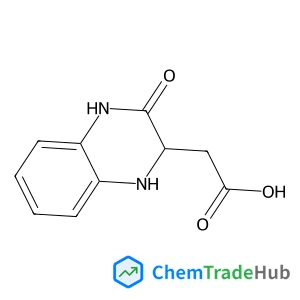
(3-Oxo-1,2,3,4-tetrahydro-2-quinoxalinyl)acetic acid
CAS Number:
136584-14-0
Molecular Formula:
C10H10N2O3
Raman Kamboj, Pankaj Bharmoria, Vinay Chauhan, Gurbir Singh, Arvind Kumar, Sukhprit Singh, Tejwant Singh Kang
Amide-functionalized surface active ionic liquids (SAILs), 1-methyl-1-dodecyl piperidinium chloride, [C12APip][Cl]; 1-methyl-1-dodecyl pyrrolidinium chloride, [C12APyrr][Cl]; 1-methyl-3-dodecyl imidazolium chloride, [C12Amim][Cl], and 1-methyl-1-dodecyl morpholinium chloride, [C12AMorph][Cl], have been synthesized, characterized and investigated for thermal stability, and micellization behavior in aqueous medium. The introduction of an amide moiety in the alkyl chain decreased the thermal stability of the functionalized SAILs compared to non-functionalized SAILs bearing a simple alkyl chain. A variety of state of the art techniques, viz. tensiometry, conductometry, steady-state fluorescence, isothermal titration calorimetry (ITC), dynamic light scattering (DLS) and atomic force microscopy (AFM), have been employed to investigate the micellization behavior. Amide-functionalized SAILs have shown much lower critical micelle concentration, cmc, and better surface active properties as compared to homologous non-functionalized SAILs. Steady-state fluorescence has provided information about cmc, aggregation number (Nagg) and polarity of the cybotactic region of the micelles, whereas ITC has provided insights into the thermodynamics of micellization. Furthermore, the size and shape of the micelles have been investigated using DLS and AFM techniques.
Christina Clare Fisher
DOI: 10.1039/C5CP07100C
Joen J. Hermans, Annelies van Loon, Piet D. Iedema
DOI: 10.1039/C6CP00487C
Chunwang Peng, Yun Xie, Jian Zhou
DOI: 10.1039/C6CP00170J
N. F. Khusnun, S. Triwahyono, N. W. C. Jusoh
DOI: 10.1039/C5CP08068A
J. Hyodo, H. Schraknepper, K. Tominaga
DOI: 10.1039/C5CP07192E
Rebecca A. Ingle, Tolga N. V. Karsili, Gregg J. Dennis, Michael Staniforth, Vasilios G. Stavros, Michael N. R. Ashfold
DOI: 10.1039/C6CP01593J
Feifan Wang, Feixue Zou, Xinxin Yu, Zhenyu Feng, Na Du, Yaohua Zhong
DOI: 10.1039/C6CP00800C
Chengmin Ji, Shenhui Li, Feng Deng, Sijie Liu, Muhammad Adnan Asghar, Zhihua Sun, Maochun Hong, Junhua Luo
DOI: 10.1039/C6CP01073C
Niki Vergadou, Jörg-Rüdiger Hill
DOI: 10.1039/C5CP05892A
This compound is mainly used as an intermediate in the synthesis of antipsychoti...
Waste containing 1-(D-Ribofuranosyl)-1,4-dihydro-3-pyridinecarboxamide (CAS: 191...
2-Methyl-2-propanyl 3-bromo-3-(hydroxymethyl)-1-azetidinecarboxylate (CAS: 20079...
N-(4-Chloro-2-pyridinyl)acetamide (CAS: 245056-66-0) is a chemical compound with...
5-Chloro-2-hydroxybenzoic acid, also known as 5-chlorosalicylic acid, is an arom...
When handling 1,1-Dichloro-1-fluoroethane (CAS: 1717-00-6), it is important to u...
Fmoc-(2S,3R)-3-phenylpyrrolidine-2-carboxylic acid is a white crystalline solid ...
4-Amino-5-bromo-2-pyridinecarboxylic acid is primarily used as a precursor in th...
Handling this compound should be done with personal protective equipment (PPE) i...
When handling 8-bromo-2,2-dimethyl-3,4-dihydro-2H-1,4-benzoxazin-3-one, use prop...

Physical Chemistry Chemical Physics (PCCP) is an international journal co-owned by 19 physical chemistry and physics societies from around the world. This journal publishes original, cutting-edge research in physical chemistry, chemical physics and biophysical chemistry. To be suitable for publication in PCCP, articles must include significant innovation and/or insight into physical chemistry; this is the most important criterion that reviewers and Editors will judge against when evaluating submissions. The journal has a broad scope and welcomes contributions spanning experiment, theory, computation and data science. Topical coverage includes spectroscopy, dynamics, kinetics, statistical mechanics, thermodynamics, electrochemistry, catalysis, surface science, quantum mechanics, quantum computing and machine learning. Interdisciplinary research areas such as polymers and soft matter, materials, nanoscience, energy, surfaces/interfaces, and biophysical chemistry are welcomed if they demonstrate significant innovation and/or insight into physical chemistry. Joined experimental/theoretical studies are particularly appreciated when complementary and based on up-to-date approaches.
![tert-Butyl N-[(2-chloropyridin-4-yl)methyl]carbamate structure](https://static.chemtradehub.com/structs/916/916210-27-0-9f95.webp "tert-Butyl N-[(2-chloropyridin-4-yl)methyl]carbamate structure")