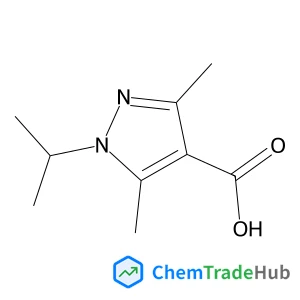
1-isopropyl-3,5-dimethyl-1H-pyrazole-4-carboxylic acid
CAS Number:
1007542-01-9
Molecular Formula:
C9H14N2O2
Kanako Sekimoto, Motoshi Sakakura, Takatomo Kawamukai, Hiroshi Hike, Teruhisa Shiota, Fumihiko Usui, Yasuhiko Bando, Mitsuo Takayama
Herein it is shown that a combination of direct analysis in real time (DART) with a corona discharge system consisting of only a needle electrode easily improves DART ionization efficiency. Positive and negative DC corona discharges led to a formation of abundant excited helium atoms as well as the reactant ions H3O+(H2O)n and O2˙− in the DART analyte ionization area. These phenomena resulted in an increase in the absolute intensities of (de)protonated analytes by a factor of 2–20 over conventional DART. The other analyte ions detected in this corona–DART system (i.e., molecular ions, fragment ions, oxygenated (de)protonated analytes, dehydrogenated deprotonated analytes, and negative ion adducts) were quite similar to those obtained from DART alone. This indicates a lack of side reactions due to the corona discharge. The change in the relative intensities of individual analyte-related ions due to the combination of a corona discharge system with DART suggests that there is no effect of the abundant excited helium in the analyte ionization area on the fragmentation processes or enhancement of oxidation due to hydroxyl radicals HO˙. Furthermore, it was found that the corona–DART combination can be applied to the highly sensitive analysis of n-alkanes, in which the alkanes are ionized as positive ions via hydride abstraction and oxidation, independent of the type of alkane or the mass spectrometer used.
Mikael Isaksson, Nils Norlin, Per-Olof Westlund, Lennart B.-Å. Johansson
DOI: 10.1039/B614817D
Susanne Ullrich, Thomas Schultz, Marek Z. Zgierski, Albert Stolow
DOI: 10.1039/B316324E
Martin Losada, Yunjie Xu
DOI: 10.1039/B703368K
L. Bonnet, P. Larrégaray, J.-C. Rayez
DOI: 10.1039/B700906B
Chr. Plützer, K. Kleinermanns
DOI: 10.1039/B316433K
Marco Schmeer, Thomas Seipp, Uwe Pliquett, Sergej Kakorin, Eberhard Neumann
DOI: 10.1039/B411037D
Weicheng Wu, Zili Wu, Zhaochi Feng, Pinliang Ying, Can Li
DOI: 10.1039/B414360B
P. G. Etchegoin, M. Meyer, E. C. Le Ru
DOI: 10.1039/B704013J
Sandra Gromelski, Gerald Brezesinski
DOI: 10.1039/B410865E
When handling 2-Chloro-1,2-bis(4-methylphenyl)ethanone (CAS: 71193-32-3), it is ...
4-Ethoxy-3-(5-methyl-4-oxo-7-propyl-1,4-dihydroimidazo[5,1-f][1,2,4]triazin-2-yl...
Methyl 3-Oxo-4-Androsten-17-Carboxylate (CAS: 2681-55-2) should be stored in a c...
(R)-3-Amino-4-(3-hexylphenylamino)-4-oxobutylphosphonic acid is primarily used i...
2-Methyl-2-propanyl 3-amino-3-carbamoyl-1-azetidinecarboxylate (CAS: 1254120-14-...
There are alternative reagents that can be used in synthesis instead of (E)-4-(t...
[2-(3-Chlorophenyl)-1,3-thiazol-4-yl]methanol (CAS: 121202-20-8) is a crystallin...
The market and research trends for Methyl (2S)-[(4S)-2,2-dimethyl-1,3-dioxolan-4...
The market for 1-Bromo-2-isocyanatoethane (CAS: 42865-19-0) is driven by its use...
4-Nitro-D-phenylalanine hydrochloride (CAS: 147065-06-3) is primarily used in re...

Analyst publishes analytical and bioanalytical research that reports premier fundamental discoveries and inventions, and the applications of those discoveries, unconfined by traditional discipline barriers.