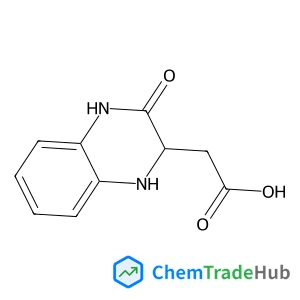
(3-Oxo-1,2,3,4-tetrahydro-2-quinoxalinyl)acetic acid
CAS Number:
136584-14-0
Molecular Formula:
C10H10N2O3
Enyan Guo, Longwei Yin
We report on high-performance dye-sensitized solar cells (DSSCs) based on nitrogen doped anatase TiO2–CuxO core–shell mesoporous hybrids synthesized through a facile and controlled combined sol–gel and hydrothermal process in the presence of hexadecylamine as the structure-directing agent. The matching of band edges between CuxO and TiO2 to form a semiconductor heterojunction plays an important role in effective separation of light induced electrons and holes, providing a promising photoanode for DSSCs because of its wide absorption spectrum, high electron injection efficiency, and fast electron transference. DSSCs based on the mesoporous TiO2–CuxO core–shell hybrids show a high short-circuit current density of 9.60 mA cm−2 and a conversion efficiency of 3.86% under one sun illumination. While DSSCs based on the N-doped mesoporous TiO2–CuxO hybrids exhibit the higher short-circuit current density of 13.24 mA cm−2 and a conversion efficiency of 4.57% under one sun illumination. In comparison with un-doped TiO2–CuxO hybrids, the doping of nitrogen into the lattice of TiO2 can extend the light absorption in the ultraviolet range to the visible light region and effectively decrease the recombination rate of photo-generated electrons and holes. The presented N-doped mesoporous TiO2–CuxO hybrids as photoanodes could find potential applications for high performance DSSCs.
Maurício J. Piotrowski, Juarez L. F. Da Silva
DOI: 10.1039/C7CP02240A
Sung-Sik Lee, Soojin Park, Jae-ung Lee, Jun-Hyeok Kim, Dongkyung Yoon, Sungyul Lee, Han Bin Oh
DOI: 10.1039/C7CP01085K
Andrea Pescaglini, Davide Cammi, Carsten Ronning, Daniela Iacopino
DOI: 10.1039/C7CP01356F
Xiaodong Wu, Yangyang Han, Xinxing Zhang, Canhui Lu
DOI: 10.1039/C7CP02293J
Cory M. Widdifield, Sten O. Nilsson Lill, Anders Broo, Maria Lindkvist, Anna Pettersen, Anna Svensk Ankarberg, Peter Aldred, Staffan Schantz, Lyndon Emsley
DOI: 10.1039/C7CP02349A
Nerea Epelde-Elezcano, Ruth Prieto-Montero, Virginia Martínez-Martínez, María J. Ortiz, Alejandro Prieto-Castañeda, Eduardo Peña-Cabrera, José L. Belmonte-Vázquez, Iñigo López-Arbeloa, Ross Brown, Sylvie Lacombe
DOI: 10.1039/C7CP01333G
Cédric Bomme, Evgeny Savelyev, Hui Xiong, Rajesh Kushawaha, Rebecca Boll, Kasra Amini, Timur Osipov, David Kilcoyne, Artem Rudenko, Nora Berrah, Daniel Rolles
DOI: 10.1039/C7CP01379E
Andrea Basagni, Agnese Marcelli, Andrea Alessi, Stefano Zanardi, Roberto Fusco, Mario Salvalaggio, Laura Bussotti
DOI: 10.1039/C6CP08721C
Patrick R. Batista, Renan V. Viesser, Cláudio F. Tormena, Roberto Rittner, Paulo R. de Oliveira
DOI: 10.1039/C7CP03572A
This compound is mainly used as an intermediate in the synthesis of antipsychoti...
Waste containing 1-(D-Ribofuranosyl)-1,4-dihydro-3-pyridinecarboxamide (CAS: 191...
2-Methyl-2-propanyl 3-bromo-3-(hydroxymethyl)-1-azetidinecarboxylate (CAS: 20079...
N-(4-Chloro-2-pyridinyl)acetamide (CAS: 245056-66-0) is a chemical compound with...
5-Chloro-2-hydroxybenzoic acid, also known as 5-chlorosalicylic acid, is an arom...
When handling 1,1-Dichloro-1-fluoroethane (CAS: 1717-00-6), it is important to u...
Fmoc-(2S,3R)-3-phenylpyrrolidine-2-carboxylic acid is a white crystalline solid ...
4-Amino-5-bromo-2-pyridinecarboxylic acid is primarily used as a precursor in th...
Handling this compound should be done with personal protective equipment (PPE) i...
When handling 8-bromo-2,2-dimethyl-3,4-dihydro-2H-1,4-benzoxazin-3-one, use prop...

Physical Chemistry Chemical Physics (PCCP) is an international journal co-owned by 19 physical chemistry and physics societies from around the world. This journal publishes original, cutting-edge research in physical chemistry, chemical physics and biophysical chemistry. To be suitable for publication in PCCP, articles must include significant innovation and/or insight into physical chemistry; this is the most important criterion that reviewers and Editors will judge against when evaluating submissions. The journal has a broad scope and welcomes contributions spanning experiment, theory, computation and data science. Topical coverage includes spectroscopy, dynamics, kinetics, statistical mechanics, thermodynamics, electrochemistry, catalysis, surface science, quantum mechanics, quantum computing and machine learning. Interdisciplinary research areas such as polymers and soft matter, materials, nanoscience, energy, surfaces/interfaces, and biophysical chemistry are welcomed if they demonstrate significant innovation and/or insight into physical chemistry. Joined experimental/theoretical studies are particularly appreciated when complementary and based on up-to-date approaches.