












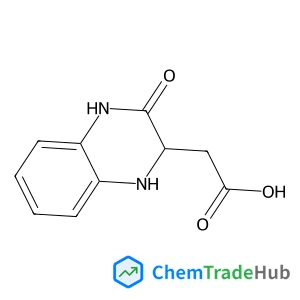
(3-Oxo-1,2,3,4-tetrahydro-2-quinoxalinyl)acetic acid
CAS Number:
136584-14-0
Molecular Formula:
C10H10N2O3
M. Sanchez-Martinez, R. Crehuet
We present a method based on the maximum entropy principle that can re-weight an ensemble of protein structures based on data from residual dipolar couplings (RDCs). The RDCs of intrinsically disordered proteins (IDPs) provide information on the secondary structure elements present in an ensemble; however even two sets of RDCs are not enough to fully determine the distribution of conformations, and the force field used to generate the structures has a pervasive influence on the refined ensemble. Two physics-based coarse-grained force fields, Profasi and Campari, are able to predict the secondary structure elements present in an IDP, but even after including the RDC data, the re-weighted ensembles differ between both force fields. Thus the spread of IDP ensembles highlights the need for better force fields. We distribute our algorithm in an open-source Python code.
Andrea Pescaglini, Davide Cammi, Carsten Ronning, Daniela Iacopino
DOI: 10.1039/C7CP01356F
Rui Shi, Hu-Jun Qian, Zhong-Yuan Lu
DOI: 10.1039/C7CP01905J
George F. Harrington, Andrea Cavallaro, Stephen J. Skinner
DOI: 10.1039/C7CP02017A
Shigeki Yamamoto, Petr Bouř
DOI: 10.1039/C7CP01556A
Yu-dong Fu, Baochang Wang, Yue Teng, Xiao-shuo Zhu, Xiao-xue Feng, Mu-fu Yan, Weiwei Sun
DOI: 10.1039/C7CP01375B
R. Grüber, J. Aranda, A. Bellili, I. Tuñón, E. Dumont
DOI: 10.1039/C6CP07966K
Xinyu Wang, Jingchao Zhang, Yue Chen, Paddy K. L. Chan
DOI: 10.1039/C7CP01958K
DOI: 10.1039/C7CP02344H
D. Lamoen
DOI: 10.1039/C7CP02033C
Haiping Gao, Mingsheng Tan, Liangbin Rong, Zhiyong Wang, Junjun Peng, Xianbo Jin
DOI: 10.1039/C7CP90125A
This compound is mainly used as an intermediate in the synthesis of antipsychoti...
Waste containing 1-(D-Ribofuranosyl)-1,4-dihydro-3-pyridinecarboxamide (CAS: 191...
2-Methyl-2-propanyl 3-bromo-3-(hydroxymethyl)-1-azetidinecarboxylate (CAS: 20079...
N-(4-Chloro-2-pyridinyl)acetamide (CAS: 245056-66-0) is a chemical compound with...
5-Chloro-2-hydroxybenzoic acid, also known as 5-chlorosalicylic acid, is an arom...
When handling 1,1-Dichloro-1-fluoroethane (CAS: 1717-00-6), it is important to u...
Fmoc-(2S,3R)-3-phenylpyrrolidine-2-carboxylic acid is a white crystalline solid ...
4-Amino-5-bromo-2-pyridinecarboxylic acid is primarily used as a precursor in th...
Handling this compound should be done with personal protective equipment (PPE) i...
When handling 8-bromo-2,2-dimethyl-3,4-dihydro-2H-1,4-benzoxazin-3-one, use prop...

Physical Chemistry Chemical Physics (PCCP) is an international journal co-owned by 19 physical chemistry and physics societies from around the world. This journal publishes original, cutting-edge research in physical chemistry, chemical physics and biophysical chemistry. To be suitable for publication in PCCP, articles must include significant innovation and/or insight into physical chemistry; this is the most important criterion that reviewers and Editors will judge against when evaluating submissions. The journal has a broad scope and welcomes contributions spanning experiment, theory, computation and data science. Topical coverage includes spectroscopy, dynamics, kinetics, statistical mechanics, thermodynamics, electrochemistry, catalysis, surface science, quantum mechanics, quantum computing and machine learning. Interdisciplinary research areas such as polymers and soft matter, materials, nanoscience, energy, surfaces/interfaces, and biophysical chemistry are welcomed if they demonstrate significant innovation and/or insight into physical chemistry. Joined experimental/theoretical studies are particularly appreciated when complementary and based on up-to-date approaches.
![6-Benzyl-4,5,6,7-tetrahydro-1H-pyrazolo[3,4-c]pyridin-3(2H)-one structure](https://static.chemtradehub.com/structs/909/909187-64-0-f54f.webp "6-Benzyl-4,5,6,7-tetrahydro-1H-pyrazolo[3,4-c]pyridin-3(2H)-one structure")





