












First-principles study of native point defects in LiNi1/3Co1/3Mn1/3O2 and Li2MnO3
Literature Information
Publication Date
2014-06-27
DOI
10.1039/C4CP02098G
Impact Factor
3.676
Authors
View Original
Abstract
We have studied native point defects in the layered oxides of LiNi1/3Co1/3Mn1/3O2 and Li2MnO3, the promising cathode materials for rechargeable Li-ion batteries for the application of high lithium capacity, by performing first-principles calculations. Through the calculations of formation energies for native point defects in LiNi1/3Co1/3Mn1/3O2, it was found that the Ni vacancy and the LiNi antisite are the most dominant defects, which shows a good agreement with previous experiments. Contrary to the previous experimental analysis, however, the NiLi antisite defect is not dominant, even though both Ni and Li ions have a similar ionic radius. In Li2MnO3, the LiMn antisite defect is dominant under the O-rich and Mn-poor condition. In contrast, the MnLi antisite, the Li vacancy in the Li layer, and the oxygen vacancy are dominant at the chemical potential of the boundary in equilibrium with Li2O. To enhance the migration of Li ions for achieving high power, the experimental syntheses of LiNi1/3Co1/3Mn1/3O2 under the Ni-rich condition and Li2MnO3 under O-rich and Mn-poor condition were suggested. For Li2MnO3 suffering from poor electronic conductivity, it was found that the electronic conductivity can be increased by p- and n-type extrinsic doping under the O-rich and Mn-poor condition and the chemical potential of the boundary coexisting with Li2O, respectively, without losing the Li ion conductivity.
Related Literature
Renewable camphor-derived hydroperoxide: synthesis and use in the asymmetric epoxidation of allylic alcohols
Alessandra Lattanzi, Patrizia Iannece, Assunta Vicinanza, Arrigo Scettri
2003-05-16
Communication
DOI: 10.1039/B303904H
Investigation of the early stages in soraphen A biosynthesis
Alison M. Hill, Betty L. Thompson, Jonathan P. Harris, Roger Segret
2003-05-19
Communication
DOI: 10.1039/B303542P
Induction of optical activity in oligosilanes within the internal cavity of cyclodextrins
Takanobu Sanji, Akihiko Yoshiwara, Hideki Sakurai, Masato Tanaka
2003-05-21
Communication
DOI: 10.1039/B303771A
Notable deuterium effect on the electron transfer rate of myoglobin
Yasuhiro Mie, Chiho Yamada, Tadayuki Uno, Saburo Neya, Fumio Mizutani, Katsuhiko Nishiyama, Isao Taniguchi
2004-11-17
Communication
DOI: 10.1039/B413100B
Surface modification of a layered alkali titanate with organosilanes
Yusuke Ide, Makoto Ogawa
2003-04-29
Communication
DOI: 10.1039/B301222K
Preparation, X-ray structure and reactivity of a stable glycosyl iodide
Jamie Bickley, Jennifer A. Cottrell, John R. Ferguson, Robert A. Field, John R. Harding, David L. Hughes, K. P. Ravindanathan Kartha, Jayne L. Law, Feodor Scheinmann, Andrew V. Stachulski
2003-05-01
Communication
DOI: 10.1039/B302629A
Synthesis of a novel axially chiral amphiphile and study on its assembly behavior in two and three dimensions
Jun Lu, Shi-Zhao Kang, Sai-Long Xu, Qing-Dao Zeng, Chen Wang, Li-Jun Wan, Chun-Li Bai
2003-05-20
Communication
DOI: 10.1039/B302572A
The two-step chemical vapor deposition of Pd(allyl)Cp as an atom-efficient route to synthesize highly dispersed palladium nanoparticles on carbon nanofibers
Changhai Liang, Wei Xia, Hamideh Soltani-Ahmadi, Oliver Schlüter, Roland A. Fischer, Martin Muhler
2004-11-23
Communication
DOI: 10.1039/B412150C
You might also like
Compound Q&A
What are the main uses of (3.beta.)-3-Hydroxy-N,N-dimethyl-chol-5-en-24-amide (CAS: 79066-03-8)?
(3.beta.)-3-Hydroxy-N,N-dimethyl-chol-5-en-24-amide (CAS: 79066-03-8) is primari...
79066-03-8(3.beta.)-3-Hydroxy-...
Compound Q&A
What regulatory guidelines apply to 5-(aminomethyl)-2-methoxyphenol (CAS: 89702-89-6)?
5-(Aminomethyl)-2-methoxyphenol (CAS: 89702-89-6) is classified under GHS as a s...
89702-89-65-(aminomethyl)-2-me...
Compound Q&A
What is Thieno[2,3-c]pyridin-7(6H)-one (CAS: 28981-13-7)?
Thieno[2,3-c]pyridin-7(6H)-one (CAS: 28981-13-7) is a heterocyclic organic compo...
28981-13-7Thieno[2,3-c]pyridin...
Compound Q&A
Is 1-[(6-Methoxy-3-pyridinyl)methyl]-4-piperidinamine dihydrochloride (CAS: 1185311-28-7) safe?
1-[(6-Methoxy-3-pyridinyl)methyl]-4-piperidinamine dihydrochloride is generally ...
1185311-28-71-[(6-Methoxy-3-pyri...
Compound Q&A
What regulatory guidelines apply to [(2E)-3-Phenyl-2-propen-1-yl]phosphonic acid (CAS: 146404-58-2)?
[(2E)-3-Phenyl-2-propen-1-yl]phosphonic acid (CAS: 146404-58-2) is regulated und...
146404-58-2[(2E)-3-Phenyl-2-pro...
Compound Q&A
What regulatory guidelines apply to 6-Bromo-7-methoxyquinoline (CAS: 1620515-86-7)?
6-Bromo-7-methoxyquinoline (CAS: 1620515-86-7) falls under the scope of the Glob...
1620515-86-76-Bromo-7-methoxyqui...
Compound Q&A
What industries use (2R)-1-(1-Benzofuran-2-yl)-N-propyl-2-pentanamine (CAS: 260550-89-8)?
This compound is primarily used in the pharmaceutical industry for the developme...
260550-89-8(2R)-1-(1-Benzofuran...
Compound Q&A
What are the main uses of 1-Ethyl-7-[2-methyl-6-(4H-1,2,4-triazol-3-yl)-3-pyridinyl]-3,5-dihydropyrazino[2,3-b]pyrazin-2(1H)-one (CAS: 1228013-15-7)?
1-Ethyl-7-[2-methyl-6-(4H-1,2,4-triazol-3-yl)-3-pyridinyl]-3,5-dihydropyrazino[2...
1228013-15-71-Ethyl-7-[2-methyl-...
Compound Q&A
Are there alternatives to {5-(Acryloylamino)-2-[(dimethylamino)methyl]phenyl}boronic acid (CAS: 1217500-78-1) in synthesis?
Alternative reagents such as 2-[(dimethylamino)methyl]phenylboronic acid or rela...
1217500-78-1{5-(Acryloylamino)-2...
Compound Q&A
What is 3-(Piperidin-4-yloxy)pyridine (CAS: 310881-48-2)?
3-(Piperidin-4-yloxy)pyridine (CAS: 310881-48-2) is an organic compound with the...
310881-48-23-(Piperidin-4-yloxy...
Source Journal
Physical Chemistry Chemical Physics

CiteScore:
5.5
Self-citation Rate:
10.3%
Articles per Year:
3036
Physical Chemistry Chemical Physics (PCCP) is an international journal co-owned by 19 physical chemistry and physics societies from around the world. This journal publishes original, cutting-edge research in physical chemistry, chemical physics and biophysical chemistry. To be suitable for publication in PCCP, articles must include significant innovation and/or insight into physical chemistry; this is the most important criterion that reviewers and Editors will judge against when evaluating submissions. The journal has a broad scope and welcomes contributions spanning experiment, theory, computation and data science. Topical coverage includes spectroscopy, dynamics, kinetics, statistical mechanics, thermodynamics, electrochemistry, catalysis, surface science, quantum mechanics, quantum computing and machine learning. Interdisciplinary research areas such as polymers and soft matter, materials, nanoscience, energy, surfaces/interfaces, and biophysical chemistry are welcomed if they demonstrate significant innovation and/or insight into physical chemistry. Joined experimental/theoretical studies are particularly appreciated when complementary and based on up-to-date approaches.
Recommended Compounds
![Bis(N,N''-dimethylpiperazine)tetra[copper(I) iodide] structure](https://static.chemtradehub.com/structs/140/1401708-91-5-2b86.webp "Bis(N,N''-dimethylpiperazine)tetra[copper(I) iodide] structure")
Bis(N,N''-dimethylpiperazine)tetra[copper(I) iodide]
CAS Number:
1401708-91-5
Molecular Formula:
C12H28Cu4I4N4
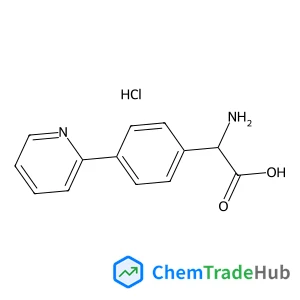
2-Amino-2-(4-(pyridin-2-YL)phenyl)acetic acid hydrochloride
CAS Number:
1135818-89-1
Molecular Formula:
C13H13ClN2O2
Recommended Suppliers







Disclaimer
This page provides academic journal information for reference and research purposes only. We are not affiliated with any journal publishers and do not handle publication submissions. For publication-related inquiries, please contact the respective journal publishers directly.
If you notice any inaccuracies in the information displayed, please contact us at support@chemtradehub.com. We will promptly review and address your concerns.