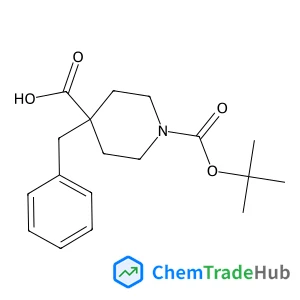
4-Benzyl-1-(tert-butoxycarbonyl)piperidine-4-carboxylic acid
CAS Number:
170838-87-6
Molecular Formula:
C18H25NO4
Eric Duverger, Tijani Gharbi, Eric Delabrousse, Fabien Picaud
Full DFT-D2 calculations were carried out to study the interactions between single wall (10,10) boron nitride nanotubes (BNNTs) and different molecules, such as azomethine (C2H5N) and an anticancer agent (Pt(IV) complex) linked to an amino-derivative chain. The geometry of the (10,10) BNNT-azomethine and the BNNT-amino derivative system was optimised by considering different molecular configurations on the inner and outer surfaces of the nanotube. Simulation results showed that the most stable physisorption state for both molecules was located inside the nanotube in a parallel configuration. We showed also that the molecular chemisorption was possible only when the azomethine was present above two adjacent B and N atoms of a hexagon. The attachment of an azomethine plus a subsequent drug did not perturb the cycloaddition process. Moreover, all theoretical results showed that the therapeutic agent complex was not affected when it was attached onto BNNTs.
J. Kłos, S. D. Le Picard
DOI: 10.1039/C7CP05092E
Baofu Qiao, Kenneth C. Littrell, Ross J. Ellis
DOI: 10.1039/C8CP00600H
Michael Zwolak
DOI: 10.1039/C7CP07924A
Arathi P. J., Seemesh Bhaskar, Rajendra Kumar Reddy G., Suresh Kumar P., Ramanathan V.
DOI: 10.1039/C8CP90037J
H. Tarábková, Z. Zelinger, P. Janda
DOI: 10.1039/C7CP08018B
Hao Wu, David Reens, Tim Langen, Yuval Shagam, Daniela Fontecha, Jun Ye
DOI: 10.1039/C8CP00962G
Joseph Czekner, Craig A. Taatjes, David L. Osborn, Giovanni Meloni
DOI: 10.1039/C7CP08221E
Wiktor Zierkiewicz, Mariusz Michalczyk, Steve Scheiner
DOI: 10.1039/C7CP08048D
Takumi Tokuda, Takahiro Uchida, Kazuya Sonoda, Bogdan A. Marekha, Abdenacer Idrissi, Takashi Tokushima, Hiroyuki Sakurai, Masahiro Kawano, Koichiro Sadakane, Hiroki Iwase
DOI: 10.1039/C8CP00963E
This compound is mainly used as an intermediate in the synthesis of antipsychoti...
Waste containing 1-(D-Ribofuranosyl)-1,4-dihydro-3-pyridinecarboxamide (CAS: 191...
2-Methyl-2-propanyl 3-bromo-3-(hydroxymethyl)-1-azetidinecarboxylate (CAS: 20079...
N-(4-Chloro-2-pyridinyl)acetamide (CAS: 245056-66-0) is a chemical compound with...
5-Chloro-2-hydroxybenzoic acid, also known as 5-chlorosalicylic acid, is an arom...
When handling 1,1-Dichloro-1-fluoroethane (CAS: 1717-00-6), it is important to u...
Fmoc-(2S,3R)-3-phenylpyrrolidine-2-carboxylic acid is a white crystalline solid ...
4-Amino-5-bromo-2-pyridinecarboxylic acid is primarily used as a precursor in th...
Handling this compound should be done with personal protective equipment (PPE) i...
When handling 8-bromo-2,2-dimethyl-3,4-dihydro-2H-1,4-benzoxazin-3-one, use prop...

Physical Chemistry Chemical Physics (PCCP) is an international journal co-owned by 19 physical chemistry and physics societies from around the world. This journal publishes original, cutting-edge research in physical chemistry, chemical physics and biophysical chemistry. To be suitable for publication in PCCP, articles must include significant innovation and/or insight into physical chemistry; this is the most important criterion that reviewers and Editors will judge against when evaluating submissions. The journal has a broad scope and welcomes contributions spanning experiment, theory, computation and data science. Topical coverage includes spectroscopy, dynamics, kinetics, statistical mechanics, thermodynamics, electrochemistry, catalysis, surface science, quantum mechanics, quantum computing and machine learning. Interdisciplinary research areas such as polymers and soft matter, materials, nanoscience, energy, surfaces/interfaces, and biophysical chemistry are welcomed if they demonstrate significant innovation and/or insight into physical chemistry. Joined experimental/theoretical studies are particularly appreciated when complementary and based on up-to-date approaches.