



Are hot charge transfer states the primary cause of efficient free-charge generation in polymer:fullerene organic photovoltaic devices? A kinetic Monte Carlo study
Literature Information
Publication Date
2014-06-19
DOI
10.1039/C4CP01626B
Impact Factor
3.676
Authors
Matthew L. Jones, Reesha Dyer, Nigel Clarke, Chris Groves
View Original
Abstract
Kinetic Monte Carlo simulations are used to examine the effect of high-energy, ‘hot’ delocalised charge transfer (HCT) states for donor:acceptor and mixed:aggregate blends, the latter relating to polymer:fullerene photovoltaic devices. Increased fullerene aggregation is shown to enhance charge generation and short-circuit device current – largely due to the increased production of HCT states at the aggregate interface. However, the instances where HCT states are predicted to give internal quantum efficiencies in the region of 50% do not correspond to HCT delocalisation or electron mobility measured in experiments. These data therefore suggest that HCT states are not the primary cause of high quantum efficiencies in some polymer:fullerene OPVs. Instead it is argued that HCT states are responsible for the fast charge generation seen in spectroscopy, but that regional variation in energy levels are the cause of long-term, efficient free-charge generation.
Recommended Journals

Journal of Asian Natural Products Research

Atomization and Sprays

Biocatalysis and Biotransformation

Acta Metallurgica Sinica-English Letters

Critical Reviews in Solid State and Materials Sciences

Topics in Catalysis

NDT & E International

Heteroatom Chemistry

Bioorganic & Medicinal Chemistry

Bioorganic & Medicinal Chemistry Letters
Related Literature
Chemical profiling of cerebrospinal fluid by multiple reaction monitoring mass spectrometry‡
Christina R. Ferreira, Karen E. Yannell, Brit Mollenhauer, Ryan D. Espy, Fernanda B. Cordeiro, Z. Ouyang, R. G. Cooks
2016-08-05
Communication
DOI: 10.1039/C6AN01618A
Integrated on-chip mass spectrometry reaction monitoring in microfluidic devices containing porous polymer monolithic columns
C. Dietze, S. Schulze, S. Ohla, K. Gilmore, P. H. Seeberger, D. Belder
2016-06-29
Paper
DOI: 10.1039/C6AN01467D
Where is it and how much? Mapping and quantifying elements in single cells
Emil Malucelli, Andrea Notargiacomo, Alessandra Gianoncelli, Lucia Merolle, Azzurra Sargenti, Concettina Cappadone
2016-07-12
Critical Review
DOI: 10.1039/C6AN01091A
An electrochemical biosensor for rapid detection of E. coli O157:H7 with highly efficient bi-functional glucose oxidase-polydopamine nanocomposites and Prussian blue modified screen-printed interdigitated electrodes
Meng Xu, Ronghui Wang
2016-06-15
Paper
DOI: 10.1039/C6AN00873A
Boronic acid based imprinted electrochemical sensor for rutin recognition and detection
Chunlei Wang, Qi Wang, Min Zhong, Xianwen Kan
2016-07-18
Paper
DOI: 10.1039/C6AN01294A
Nanoporous gold leaf as a signal amplification agent for the detection of VOCs with a quartz crystal microbalance
Lu Zhang, Yuan Liu, Han Song, Bintong Huang
2016-05-31
Paper
DOI: 10.1039/C6AN00556J
A “chemical nose” biosensor for detecting proteins in complex mixtures
2016-07-15
Paper
DOI: 10.1039/C6AN00729E
MIR-biospectroscopy coupled with chemometrics in cancer studies
Laurinda F. S. Siqueira, Kássio M. G. Lima
2016-07-07
Critical Review
DOI: 10.1039/C6AN01247G
You might also like
Compound Q&A
What precautions should be taken when handling 2-Chloro-1,2-bis(4-methylphenyl)ethanone (CAS: 71193-32-3)?
When handling 2-Chloro-1,2-bis(4-methylphenyl)ethanone (CAS: 71193-32-3), it is ...
71193-32-32-Chloro-1,2-bis(4-m...
Compound Q&A
What industries use 4-Ethoxy-3-(5-methyl-4-oxo-7-propyl-1,4-dihydroimidazo[5,1-f][1,2,4]triazin-2-yl)benzenesulfonyl chloride (CAS: 224789-26-8)?
4-Ethoxy-3-(5-methyl-4-oxo-7-propyl-1,4-dihydroimidazo[5,1-f][1,2,4]triazin-2-yl...
224789-26-84-Ethoxy-3-(5-methyl...
Compound Q&A
How should Methyl 3-Oxo-4-Androsten-17-Carboxylate (CAS: 2681-55-2) be stored?
Methyl 3-Oxo-4-Androsten-17-Carboxylate (CAS: 2681-55-2) should be stored in a c...
2681-55-2Methyl 3-Oxo-4-Andro...
Compound Q&A
What are the main uses of (R)-3-Amino-4-(3-hexylphenylamino)-4-oxobutylphosphonic acid (CAS: 909725-61-7)?
(R)-3-Amino-4-(3-hexylphenylamino)-4-oxobutylphosphonic acid is primarily used i...
909725-61-7(R)-3-Amino-4-(3-hex...
Compound Q&A
What regulatory guidelines apply to 2-Methyl-2-propanyl 3-amino-3-carbamoyl-1-azetidinecarboxylate (CAS: 1254120-14-3)?
2-Methyl-2-propanyl 3-amino-3-carbamoyl-1-azetidinecarboxylate (CAS: 1254120-14-...
1254120-14-32-Methyl-2-propanyl ...
Compound Q&A
Are there alternatives to (E)-4-(tert-Butoxy)-4-oxobut-2-enoic acid (CAS: 135355-96-3) in synthesis?
There are alternative reagents that can be used in synthesis instead of (E)-4-(t...
135355-96-3(E)-4-(tert-Butoxy)-...
Compound Q&A
What are the physical and chemical properties of [2-(3-Chlorophenyl)-1,3-thiazol-4-yl]methanol (CAS: 121202-20-8)?
[2-(3-Chlorophenyl)-1,3-thiazol-4-yl]methanol (CAS: 121202-20-8) is a crystallin...
121202-20-8[2-(3-Chlorophenyl)-...
Compound Q&A
What is the market or research trend for Methyl (2S)-[(4S)-2,2-dimethyl-1,3-dioxolan-4-yl]{[(4-methylphenyl)sulfonyl]oxy}acetate (CAS: 166249-17-8)?
The market and research trends for Methyl (2S)-[(4S)-2,2-dimethyl-1,3-dioxolan-4...
166249-17-8Methyl (2S)-[(4S)-2,...
Compound Q&A
What is the market or research trend for 1-Bromo-2-isocyanatoethane (CAS: 42865-19-0)?
The market for 1-Bromo-2-isocyanatoethane (CAS: 42865-19-0) is driven by its use...
42865-19-01-Bromo-2-isocyanato...
Compound Q&A
What are the main uses of 4-Nitro-D-phenylalanine hydrochloride (CAS: 147065-06-3)?
4-Nitro-D-phenylalanine hydrochloride (CAS: 147065-06-3) is primarily used in re...
147065-06-34-Nitro-D-phenylalan...
Source Journal
Physical Chemistry Chemical Physics

CiteScore:
5.5
Self-citation Rate:
10.3%
Articles per Year:
3036
Physical Chemistry Chemical Physics (PCCP) is an international journal co-owned by 19 physical chemistry and physics societies from around the world. This journal publishes original, cutting-edge research in physical chemistry, chemical physics and biophysical chemistry. To be suitable for publication in PCCP, articles must include significant innovation and/or insight into physical chemistry; this is the most important criterion that reviewers and Editors will judge against when evaluating submissions. The journal has a broad scope and welcomes contributions spanning experiment, theory, computation and data science. Topical coverage includes spectroscopy, dynamics, kinetics, statistical mechanics, thermodynamics, electrochemistry, catalysis, surface science, quantum mechanics, quantum computing and machine learning. Interdisciplinary research areas such as polymers and soft matter, materials, nanoscience, energy, surfaces/interfaces, and biophysical chemistry are welcomed if they demonstrate significant innovation and/or insight into physical chemistry. Joined experimental/theoretical studies are particularly appreciated when complementary and based on up-to-date approaches.
Recommended Compounds
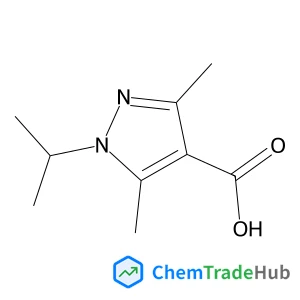
1-isopropyl-3,5-dimethyl-1H-pyrazole-4-carboxylic acid
CAS Number:
1007542-01-9
Molecular Formula:
C9H14N2O2
Recommended Suppliers





Disclaimer
This page provides academic journal information for reference and research purposes only. We are not affiliated with any journal publishers and do not handle publication submissions. For publication-related inquiries, please contact the respective journal publishers directly.
If you notice any inaccuracies in the information displayed, please contact us at support@chemtradehub.com. We will promptly review and address your concerns.