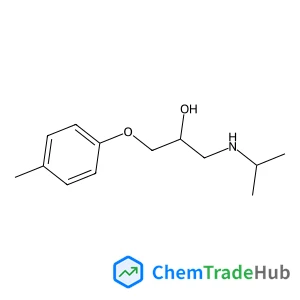
1-(4-Methylphenoxy)-3-(propan-2-ylamino)propan-2-ol
CAS Number:
5790-46-5
Molecular Formula:
C13H21NO2
Meng Xu, Ronghui Wang
The presence of pathogenic bacteria in foods has always been a great threat to the wellbeing of people and the revenue of food manufacturers. Therefore, the demand for advanced detection methods that can sensitively and rapidly detect these pathogens has been of great importance. This study reports an electrochemical biosensor for rapid detection of E. coli O157:H7 with the integration of bifunctional glucose oxidase (GOx)–polydopamine (PDA) based polymeric nanocomposites (PMNCs) and Prussian blue (PB) modified screen-printed interdigitated microelectrodes (SP-IDMEs). The core–shell magnetic beads (MBs)–GOx@PDA PMNCs were first synthesized by the self-polymerization of dopamine (DA). Gold nanoparticles (AuNPs) were dispersed on the surface of PMNCs through biochemical synthesis to achieve further highly efficient adsorption of antibodies (ABs) and GOx. The final product ABs/GOxext/AuNPs/MBs–GOx@PDA PMNCs served as the carrier to separate target bacteria from food matrices as well as the amplifier for electrochemical measurement. The unbound PMNCs were separated by a filtration step and transferred into glucose solution to allow the enzymatic reaction to occur. The change of the current response was measured with an electrochemical detector using PB-modified SP-IDMEs. The constructed biosensor has been proven to be able to detect E. coli O157:H7 with the detection limit of 102 cfu ml−1. The bifunctional PMNCs contain a high load of enzyme and can optimally utilize the binding sites on bacterial cells, which efficiently amplify the signals for measurement. The biosensor in this study exhibited good specificity, reproducibility, and stability and is expected to have a great impact on applications in the detection of foodborne pathogens.

Helvetica Chimica Acta

Journal of Physics and Chemistry of Solids

Nature

Planta Medica

Proceedings of the National Academy of Sciences of the United States of America

Russian Chemical Reviews

Kinetics and Catalysis

Organic Preparations and Procedures International

Journal of Medicinal Chemistry

Journal of Organometallic Chemistry
M. A. Strehle, P. Rösch, R. Petry, A. Hauck, R. Thull, W. Kiefer, J. Popp
DOI: 10.1039/B406524G
M. Majtyka
DOI: 10.1039/B616575C
Michael Wormit, Andreas Dreuw
DOI: 10.1039/B703028B
Bård Buttingsrud, Bjørn K. Alsberg, Per-Olof Åstrand
DOI: 10.1039/B617470A
Marco Schmeer, Thomas Seipp, Uwe Pliquett, Sergej Kakorin, Eberhard Neumann
DOI: 10.1039/B411037D
Peter Fratzl, Ingo Burgert, Himadri S. Gupta
DOI: 10.1039/B411986J
Veronica M. Rodriguez-Betancourtt, Detlef Nattland
DOI: 10.1039/B414757J
When handling 2-Chloro-1,2-bis(4-methylphenyl)ethanone (CAS: 71193-32-3), it is ...
4-Ethoxy-3-(5-methyl-4-oxo-7-propyl-1,4-dihydroimidazo[5,1-f][1,2,4]triazin-2-yl...
Methyl 3-Oxo-4-Androsten-17-Carboxylate (CAS: 2681-55-2) should be stored in a c...
(R)-3-Amino-4-(3-hexylphenylamino)-4-oxobutylphosphonic acid is primarily used i...
2-Methyl-2-propanyl 3-amino-3-carbamoyl-1-azetidinecarboxylate (CAS: 1254120-14-...
There are alternative reagents that can be used in synthesis instead of (E)-4-(t...
[2-(3-Chlorophenyl)-1,3-thiazol-4-yl]methanol (CAS: 121202-20-8) is a crystallin...
The market and research trends for Methyl (2S)-[(4S)-2,2-dimethyl-1,3-dioxolan-4...
The market for 1-Bromo-2-isocyanatoethane (CAS: 42865-19-0) is driven by its use...
4-Nitro-D-phenylalanine hydrochloride (CAS: 147065-06-3) is primarily used in re...

Analyst publishes analytical and bioanalytical research that reports premier fundamental discoveries and inventions, and the applications of those discoveries, unconfined by traditional discipline barriers.