













Where is it and how much? Mapping and quantifying elements in single cells
Literature Information
Publication Date
2016-07-12
DOI
10.1039/C6AN01091A
Impact Factor
4.616
Authors
Emil Malucelli, Andrea Notargiacomo, Alessandra Gianoncelli, Lucia Merolle, Azzurra Sargenti, Concettina Cappadone
View Original
Abstract
The biological function of a chemical element in cells not only requires the determination of its intracellular quantity, but also the spatial distribution of its concentration. Different strategies can be employed to quantify and map the intracellular concentration of elements in single cells. The assessment of the intracellular elemental concentration, which is the relevant information, requires the measurement of cell volume. This challenging and demanding task requires combining different techniques allowing gathering of both morphological and compositional information on the same cell. Moreover, the need to analyse samples more similar to their natural state requires complex hardware equipment, and supplementary efforts in preparation protocols. Nevertheless, the response to the question: “where is it and how much?” is worth all these efforts. This review aims at providing an insight into the recent and most advanced techniques and strategies for quantifying and mapping chemical elements in single cells. We describe and discuss indirect detection techniques (label based) which make use of fluorescent dyes, and direct ones (label free), such as particle induced X-ray emission, proton backscattering spectrometry, scanning transmission ion spectrometry, nano-secondary ion mass spectrometry, X-ray fluorescence microscopy, complemented by X-ray imaging.
Related Literature
The hydrogenation of 1,3-pentadiene over an alumina-supported palladiumcatalyst: an FTIR study
Elaine Opara, David T. Lundie, Timothy Lear, Iain W. Sutherland, Stewart F. Parker, David Lennon
2004-11-11
Paper
DOI: 10.1039/B413178A
Adsorption of DNA to zwitterionic DMPE monolayers mediated by magnesium ions
Sandra Gromelski, Gerald Brezesinski
2004-11-11
Paper
DOI: 10.1039/B410865E
Quantitative prediction of the absorption maxima of azobenzene dyes from bond lengths and critical points in the electron density
Bård Buttingsrud, Bjørn K. Alsberg, Per-Olof Åstrand
2007-02-26
Paper
DOI: 10.1039/B617470A
Resonant infrared multiphoton dissociation spectroscopy of gas-phase protonated peptides. Experiments and Car–Parrinello dynamics at 300 K‡
D. C. Marinica, J. Lemaire
2007-03-26
Invited Article
DOI: 10.1039/B618094A
Real time quantitative Raman spectroscopy of supported metal oxidecatalysts without the need of an internal standard
S. J. Tinnemans, M. H. F. Kox, T. A. Nijhuis, T. Visser, B. M. Weckhuysen
2004-11-18
Paper
DOI: 10.1039/B414427A
A crossed molecular beam study on the formation of hexenediynyl radicals (H2CCCCCCH; C6H3 (X2A′)) via reactions of tricarbon molecules, C3(X1Σg+), with allene (H2CCCH2; X1A1) and methylacetylene (CH3CCH; X1A1)
Ying Guo, Xibin Gu, Fangtong Zhang, Alexander M. Mebel, Ralf I. Kaiser
2007-02-15
Paper
DOI: 10.1039/B618179A
Conformers of the peptides glycine-tryptophan, tryptophan-glycine and tryptophan-glycine-glycine as revealed by double resonance laser spectroscopy
I. Hünig, K. Kleinermanns
2004-02-27
Paper
DOI: 10.1039/B316295H
Phase field modeling of CH4hydrate conversion into CO2 hydrate in the presence of liquid CO2
B. Kvamme
2007-04-27
Paper
DOI: 10.1039/B700423K
Theory of scanning electrochemical microscopy (SECM) as a probe of surface conductivity
Anna L. Whitworth, Daniel Mandler, Patrick R. Unwin
2004-09-28
Review Article
DOI: 10.1039/B407397E
Direct quantum dynamics using variational multi-configuration Gaussian wavepackets. Implementation details and test case
B. Lasorne, M. A. Robb, G. A. Worth
2007-05-04
Paper
DOI: 10.1039/B700297A
You might also like
Compound Q&A
What precautions should be taken when handling 2-Chloro-1,2-bis(4-methylphenyl)ethanone (CAS: 71193-32-3)?
When handling 2-Chloro-1,2-bis(4-methylphenyl)ethanone (CAS: 71193-32-3), it is ...
71193-32-32-Chloro-1,2-bis(4-m...
Compound Q&A
What industries use 4-Ethoxy-3-(5-methyl-4-oxo-7-propyl-1,4-dihydroimidazo[5,1-f][1,2,4]triazin-2-yl)benzenesulfonyl chloride (CAS: 224789-26-8)?
4-Ethoxy-3-(5-methyl-4-oxo-7-propyl-1,4-dihydroimidazo[5,1-f][1,2,4]triazin-2-yl...
224789-26-84-Ethoxy-3-(5-methyl...
Compound Q&A
How should Methyl 3-Oxo-4-Androsten-17-Carboxylate (CAS: 2681-55-2) be stored?
Methyl 3-Oxo-4-Androsten-17-Carboxylate (CAS: 2681-55-2) should be stored in a c...
2681-55-2Methyl 3-Oxo-4-Andro...
Compound Q&A
What are the main uses of (R)-3-Amino-4-(3-hexylphenylamino)-4-oxobutylphosphonic acid (CAS: 909725-61-7)?
(R)-3-Amino-4-(3-hexylphenylamino)-4-oxobutylphosphonic acid is primarily used i...
909725-61-7(R)-3-Amino-4-(3-hex...
Compound Q&A
What regulatory guidelines apply to 2-Methyl-2-propanyl 3-amino-3-carbamoyl-1-azetidinecarboxylate (CAS: 1254120-14-3)?
2-Methyl-2-propanyl 3-amino-3-carbamoyl-1-azetidinecarboxylate (CAS: 1254120-14-...
1254120-14-32-Methyl-2-propanyl ...
Compound Q&A
Are there alternatives to (E)-4-(tert-Butoxy)-4-oxobut-2-enoic acid (CAS: 135355-96-3) in synthesis?
There are alternative reagents that can be used in synthesis instead of (E)-4-(t...
135355-96-3(E)-4-(tert-Butoxy)-...
Compound Q&A
What are the physical and chemical properties of [2-(3-Chlorophenyl)-1,3-thiazol-4-yl]methanol (CAS: 121202-20-8)?
[2-(3-Chlorophenyl)-1,3-thiazol-4-yl]methanol (CAS: 121202-20-8) is a crystallin...
121202-20-8[2-(3-Chlorophenyl)-...
Compound Q&A
What is the market or research trend for Methyl (2S)-[(4S)-2,2-dimethyl-1,3-dioxolan-4-yl]{[(4-methylphenyl)sulfonyl]oxy}acetate (CAS: 166249-17-8)?
The market and research trends for Methyl (2S)-[(4S)-2,2-dimethyl-1,3-dioxolan-4...
166249-17-8Methyl (2S)-[(4S)-2,...
Compound Q&A
What is the market or research trend for 1-Bromo-2-isocyanatoethane (CAS: 42865-19-0)?
The market for 1-Bromo-2-isocyanatoethane (CAS: 42865-19-0) is driven by its use...
42865-19-01-Bromo-2-isocyanato...
Compound Q&A
What are the main uses of 4-Nitro-D-phenylalanine hydrochloride (CAS: 147065-06-3)?
4-Nitro-D-phenylalanine hydrochloride (CAS: 147065-06-3) is primarily used in re...
147065-06-34-Nitro-D-phenylalan...
Source Journal
Analyst

CiteScore:
7.8
Self-citation Rate:
5.6%
Articles per Year:
653
Analyst publishes analytical and bioanalytical research that reports premier fundamental discoveries and inventions, and the applications of those discoveries, unconfined by traditional discipline barriers.
Recommended Compounds
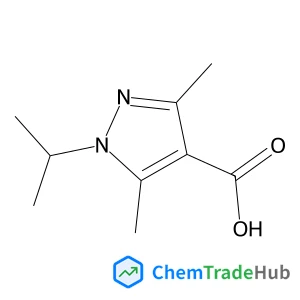
1-isopropyl-3,5-dimethyl-1H-pyrazole-4-carboxylic acid
CAS Number:
1007542-01-9
Molecular Formula:
C9H14N2O2

Recommended Suppliers






Disclaimer
This page provides academic journal information for reference and research purposes only. We are not affiliated with any journal publishers and do not handle publication submissions. For publication-related inquiries, please contact the respective journal publishers directly.
If you notice any inaccuracies in the information displayed, please contact us at support@chemtradehub.com. We will promptly review and address your concerns.