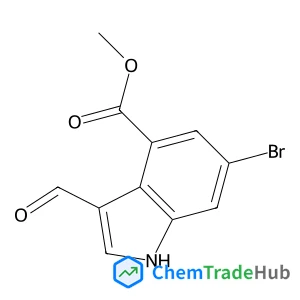
methyl 6-bromo-3-formyl-1H-indole-4-carboxylate
CAS Number:
1353636-63-1
Molecular Formula:
C11H8BrNO3
Andreas Stegmüller, Phil Rosenow, Ralf Tonner
The gas phase decomposition reactions of precursor molecules relevant for metal–organic vapour phase epitaxy (MOVPE) of semiconductor thin films are investigated by computational methods on the density-functional level as well as on the ab initio (MP2, CCSD(T)) level. A comprehensive reaction catalogue of uni- and bimolecular reactions is presented for triethylgallium (TEG) as well as for tert-butylphosphine (TBP) containing thermodynamic data together with transition state energies. From these energies it can be concluded that TEG is decomposed in the gas phase under MOVPE conditions (T = 400–675 °C, p = 0.05 atm) to GaH3via a series of β-hydride elimination reactions. For elevated temperatures, further decomposition to GaH is thermodynamically accessible. In the case of TBP, the original precursor molecule will be most abundant since all reaction channels exhibit either large barriers or unfavorable thermodynamics. Dispersion-corrected density functional calculations (PBE-D3) provide an accurate description of the reactions investigated in comparison to high level CCSD(T) calculations serving as benchmark values.

Bioorganic & Medicinal Chemistry

Polycyclic Aromatic Compounds

Journal of Chemical Sciences

Topics in Catalysis

Chinese Journal of Chemistry

Atomization and Sprays

Bioorganic & Medicinal Chemistry Letters

Heteroatom Chemistry

Herald of the Russian Academy of Sciences

Journal of the Indian Institute of Science
Yi He, Danjun Wu, Zhenghua Li, Koen Robeyns, Luc Van Meervelt
DOI: 10.1039/C9OB01299K
Anton S. Abel, Andrey V. Cheprakov, Vitaly A. Roznyatovsky, Franck Denat, Alla Bessmertnykh-Lemeune
DOI: 10.1039/C9OB00259F
Kentaro Harada, Ryo Sekiya, Takeshi Maehara, Takeharu Haino
DOI: 10.1039/C9OB00388F
Chun-Lan Xie, Jin-Mei Xia, Cui-Ping Xing, Zhu-Hua Luo, Zongze Shao, Xiao-Jun Yan, Shan He, Xian-Wen Yang
DOI: 10.1039/C9OB01159E
DOI: 10.1039/C9OB00338J
Yuta Nakagawa, Ryuta Sekiguchi, Jun Kawakami, Shunji Ito
DOI: 10.1039/C9OB00763F
Yulia V. Nelyubina, Alexey Yu. Sukhorukov, Sema L. Ioffe, Andrey A. Tabolin
DOI: 10.1039/C9OB01005J
Samantha L. Pilicer, Michele Mancinelli, Andrea Mazzanti, Christian Wolf
DOI: 10.1039/C9OB01265F
Alexandra Pastor, Arnaud Machelart, Xue Li, Nicolas Willand, Alain Baulard, Priscille Brodin, Ruxandra Gref, Didier Desmaële
DOI: 10.1039/C9OB00680J
(3.beta.)-3-Hydroxy-N,N-dimethyl-chol-5-en-24-amide (CAS: 79066-03-8) is primari...
5-(Aminomethyl)-2-methoxyphenol (CAS: 89702-89-6) is classified under GHS as a s...
Thieno[2,3-c]pyridin-7(6H)-one (CAS: 28981-13-7) is a heterocyclic organic compo...
1-[(6-Methoxy-3-pyridinyl)methyl]-4-piperidinamine dihydrochloride is generally ...
[(2E)-3-Phenyl-2-propen-1-yl]phosphonic acid (CAS: 146404-58-2) is regulated und...
6-Bromo-7-methoxyquinoline (CAS: 1620515-86-7) falls under the scope of the Glob...
This compound is primarily used in the pharmaceutical industry for the developme...
1-Ethyl-7-[2-methyl-6-(4H-1,2,4-triazol-3-yl)-3-pyridinyl]-3,5-dihydropyrazino[2...
Alternative reagents such as 2-[(dimethylamino)methyl]phenylboronic acid or rela...
3-(Piperidin-4-yloxy)pyridine (CAS: 310881-48-2) is an organic compound with the...

Physical Chemistry Chemical Physics (PCCP) is an international journal co-owned by 19 physical chemistry and physics societies from around the world. This journal publishes original, cutting-edge research in physical chemistry, chemical physics and biophysical chemistry. To be suitable for publication in PCCP, articles must include significant innovation and/or insight into physical chemistry; this is the most important criterion that reviewers and Editors will judge against when evaluating submissions. The journal has a broad scope and welcomes contributions spanning experiment, theory, computation and data science. Topical coverage includes spectroscopy, dynamics, kinetics, statistical mechanics, thermodynamics, electrochemistry, catalysis, surface science, quantum mechanics, quantum computing and machine learning. Interdisciplinary research areas such as polymers and soft matter, materials, nanoscience, energy, surfaces/interfaces, and biophysical chemistry are welcomed if they demonstrate significant innovation and/or insight into physical chemistry. Joined experimental/theoretical studies are particularly appreciated when complementary and based on up-to-date approaches.
![Bis(N,N''-dimethylpiperazine)tetra[copper(I) iodide] structure](https://static.chemtradehub.com/structs/140/1401708-91-5-2b86.webp "Bis(N,N''-dimethylpiperazine)tetra[copper(I) iodide] structure")
![Ethanone, 1-[4-chloro-2-(methylthio)-5-pyrimidinyl]- structure](https://static.chemtradehub.com/structs/661/66116-82-3-863e.webp "Ethanone, 1-[4-chloro-2-(methylthio)-5-pyrimidinyl]- structure")