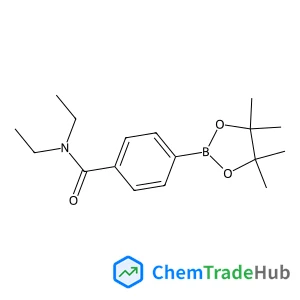
N,N-Diethyl-4-(4,4,5,5-tetramethyl-1,3,2-dioxaborolan-2-yl)benzamide
CAS Number:
325142-99-2
Molecular Formula:
C17H26BNO3
Martin Neukom, Dorothea Scheunemann, Emre Erdem, Stefan Weber, Holger Borchert
We present a significant efficiency enhancement of hybrid bulk heterojunction solar cells by utilizing CdSe quantum dots attached to reduced graphene oxide (rGO) as the electron accepting phase, blended with the PCPDTBT polymer. The quantum dot attachment to rGO was achieved following a self-assembly approach, recently developed, using thiolated reduced graphene oxide (TrGO) to form a TrGO–CdSe nanocomposite. Therefore, we are able to obtain TrGO–CdSe quantum dot/PCPDTBT bulk-heterojunction hybrid solar cells with power conversion efficiencies of up to 4.2%, compared with up to 3% for CdSe quantum dot/PCPDTBT devices. The improvement is mainly due to an increase of the open-circuit voltage from 0.55 V to 0.72 V. We found evidence for a significant change in the heterojunction donor–acceptor blend nanomorphology, observable by a more vertical alignment of the TrGO-quantum dot nanocomposites in the z-direction and a different nanophase separation in the x–y direction compared to the quantum dot only containing device. Moreover, an improved charge extraction and trap state reduction were observed for TrGO containing hybrid solar cells.
Bo Kong, Xin-You An, Ti-Xian Zeng, Jihua Zhang
DOI: 10.1039/C9CP06094D
Abida Sultana, Jintana Meesungnoen, Jean-Paul Jay-Gerin
DOI: 10.1039/D0CP00601G
Akane Kawafuchi, Shoichi Kutsumizu, Yuki Kawase, Issei Tokiwa, Taro Udagawa, Yohei Miwa
DOI: 10.1039/C9CP06831G
Andika Asyuda, Xianglong Wan, Michael Zharnikov
DOI: 10.1039/D0CP01740J
Kayoung Yun, Ho-Seok Nam, Seungchul Kim
DOI: 10.1039/C9CP06967D
Guilherme Ribeiro Portugal, Jeverson Teodoro Arantes
DOI: 10.1039/C9CP06769H
Björn Kriete, Carolien J. Feenstra, Maxim S. Pshenichnikov
DOI: 10.1039/D0CP01734E
Andreas Mauracher, Patrik Španěl
DOI: 10.1039/D0CP00297F
Yanan Tang, Weiguang Chen, Yi Li, Renyi Li, Yaqiang Ma, Xianqi Dai
DOI: 10.1039/D0CP00722F
This compound is mainly used as an intermediate in the synthesis of antipsychoti...
Waste containing 1-(D-Ribofuranosyl)-1,4-dihydro-3-pyridinecarboxamide (CAS: 191...
2-Methyl-2-propanyl 3-bromo-3-(hydroxymethyl)-1-azetidinecarboxylate (CAS: 20079...
N-(4-Chloro-2-pyridinyl)acetamide (CAS: 245056-66-0) is a chemical compound with...
5-Chloro-2-hydroxybenzoic acid, also known as 5-chlorosalicylic acid, is an arom...
When handling 1,1-Dichloro-1-fluoroethane (CAS: 1717-00-6), it is important to u...
Fmoc-(2S,3R)-3-phenylpyrrolidine-2-carboxylic acid is a white crystalline solid ...
4-Amino-5-bromo-2-pyridinecarboxylic acid is primarily used as a precursor in th...
Handling this compound should be done with personal protective equipment (PPE) i...
When handling 8-bromo-2,2-dimethyl-3,4-dihydro-2H-1,4-benzoxazin-3-one, use prop...

Physical Chemistry Chemical Physics (PCCP) is an international journal co-owned by 19 physical chemistry and physics societies from around the world. This journal publishes original, cutting-edge research in physical chemistry, chemical physics and biophysical chemistry. To be suitable for publication in PCCP, articles must include significant innovation and/or insight into physical chemistry; this is the most important criterion that reviewers and Editors will judge against when evaluating submissions. The journal has a broad scope and welcomes contributions spanning experiment, theory, computation and data science. Topical coverage includes spectroscopy, dynamics, kinetics, statistical mechanics, thermodynamics, electrochemistry, catalysis, surface science, quantum mechanics, quantum computing and machine learning. Interdisciplinary research areas such as polymers and soft matter, materials, nanoscience, energy, surfaces/interfaces, and biophysical chemistry are welcomed if they demonstrate significant innovation and/or insight into physical chemistry. Joined experimental/theoretical studies are particularly appreciated when complementary and based on up-to-date approaches.