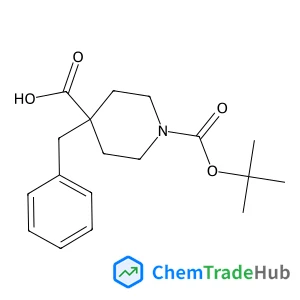
4-Benzyl-1-(tert-butoxycarbonyl)piperidine-4-carboxylic acid
CAS Number:
170838-87-6
Molecular Formula:
C18H25NO4
R. Reichert, Z. Jusys, R. J. Behm
Aiming at a better understanding of the impact of reaction intermediates and reactive side products on electrocatalytic reactions under conditions characteristic for technical applications, i.e., at high reactant conversions, we have investigated the electrooxidation of methanol on a Pt film electrode in mixtures containing defined concentrations of the reaction intermediates formaldehyde or formic acid. Employing simultaneous in situ infrared spectroscopy and online mass spectrometry in parallel to voltammetric measurements, we examined the effects of the latter molecules on the adlayer build-up and composition and on the formation of volatile reaction products CO2 and methylformate, as well as on the overall reaction rate. To assess the individual contributions of each component, we used isotope labeling techniques, where one of the two C1 components in the mixtures of methanol with either formaldehyde or formic acid was 13C-labeled. The data reveal pronounced effects of the additional components formaldehyde and formic acid on the reaction, although their concentration was much lower (10%) than that of the main reactant methanol. Most important, the overall Faradaic current responses and the amounts of CO2 formed upon oxidation of the mixtures are always lower than the sums of the contributions from the individual components, indicative of a non-additive behavior of both Faradaic current and CO2 formation in the mixtures. Mechanistic reasons and consequences for reactions in a technical reactor, with high reactant conversion, are discussed.
Dylan K. Smith, Jena McCollum, Michelle L. Pantoya
DOI: 10.1039/C5CP06998J
Bo Liu, Feng Xu, Xinghua Zhang, Dadong Yan, Dan Lu
DOI: 10.1039/C5CP04872A
S. Mahlik, A. Lazarowska, J. Ueda, S. Tanabe, M. Grinberg
DOI: 10.1039/C5CP07732J
M. Furlani, I. Albinsson, J. L. Ratnasekera, B.-E. Mellander
DOI: 10.1039/C6CP00013D
Christophe Garagnon, Valerie Serradeil
DOI: 10.1039/C6CP00972G
Phil Rosenow
DOI: 10.1039/C5CP06619K
Anatolii N. Rykov, Olga E. Grikina, Leonid S. Khaikin
DOI: 10.1039/C5CP07719B
Avanish Mishra, Pooja Srivastava, Hiroshi Mizuseki, Kwang-Ryeol Lee, Abhishek K. Singh
DOI: 10.1039/C5CP07609A
Fei Xie, Martin Turesson, Clifford E. Woodward, Kitty van Gruijthuijsen, Anna Stradner, Jan Forsman
DOI: 10.1039/C5CP07814H
This compound is mainly used as an intermediate in the synthesis of antipsychoti...
Waste containing 1-(D-Ribofuranosyl)-1,4-dihydro-3-pyridinecarboxamide (CAS: 191...
2-Methyl-2-propanyl 3-bromo-3-(hydroxymethyl)-1-azetidinecarboxylate (CAS: 20079...
N-(4-Chloro-2-pyridinyl)acetamide (CAS: 245056-66-0) is a chemical compound with...
5-Chloro-2-hydroxybenzoic acid, also known as 5-chlorosalicylic acid, is an arom...
When handling 1,1-Dichloro-1-fluoroethane (CAS: 1717-00-6), it is important to u...
Fmoc-(2S,3R)-3-phenylpyrrolidine-2-carboxylic acid is a white crystalline solid ...
4-Amino-5-bromo-2-pyridinecarboxylic acid is primarily used as a precursor in th...
Handling this compound should be done with personal protective equipment (PPE) i...
When handling 8-bromo-2,2-dimethyl-3,4-dihydro-2H-1,4-benzoxazin-3-one, use prop...

Physical Chemistry Chemical Physics (PCCP) is an international journal co-owned by 19 physical chemistry and physics societies from around the world. This journal publishes original, cutting-edge research in physical chemistry, chemical physics and biophysical chemistry. To be suitable for publication in PCCP, articles must include significant innovation and/or insight into physical chemistry; this is the most important criterion that reviewers and Editors will judge against when evaluating submissions. The journal has a broad scope and welcomes contributions spanning experiment, theory, computation and data science. Topical coverage includes spectroscopy, dynamics, kinetics, statistical mechanics, thermodynamics, electrochemistry, catalysis, surface science, quantum mechanics, quantum computing and machine learning. Interdisciplinary research areas such as polymers and soft matter, materials, nanoscience, energy, surfaces/interfaces, and biophysical chemistry are welcomed if they demonstrate significant innovation and/or insight into physical chemistry. Joined experimental/theoretical studies are particularly appreciated when complementary and based on up-to-date approaches.
![4-Chloro-3-(trifluoromethyl)-1H-pyrrolo[2,3-b]pyridine structure](https://static.chemtradehub.com/structs/869/869335-75-1-a9d0.webp "4-Chloro-3-(trifluoromethyl)-1H-pyrrolo[2,3-b]pyridine structure")
![5-Methyl-4,5,6,7-tetrahydropyrazolo[1,5-a]pyrazin-2-amine structure](https://static.chemtradehub.com/structs/122/1227210-33-4-8d64.webp "5-Methyl-4,5,6,7-tetrahydropyrazolo[1,5-a]pyrazin-2-amine structure")