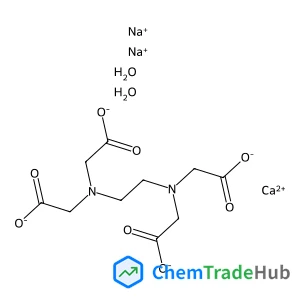
EthylenediaminetetraaceticacidcalciumDisodiumsalthydrate
CAS Number:
23411-34-9
Molecular Formula:
C10H16CaN2Na2O10
Jiahua Zhang, Zhendong Hao, Xia Zhang, Guohui Pan, Yongshi Luo, Shaozhe Lü, Haifeng Zhao
The Pr3+ and Yb3+ codoped β-NaLuF4 hexagonal nanoplates with a size of 250 nm × 110 nm were synthesized by a solvothermal process. X-Ray diffraction and scanning electron microscopy were used to characterize the crystal structure and morphology of the materials. The visible and near infrared spectra as well as the decay curves of Pr3+:3P0 level were used to demonstrate the energy transfer from Pr3+ ions to Yb3+ ions. The downconversion phenomenon has been observed under the direct excitation of the 3P2 level of Pr3+. According to the analysis of the dependence of the initial transfer rate upon Yb3+ ion concentration, it indicates that the ET from Pr3+ ions to Yb3+ ions is only by a two-step ET process when the Yb3+ concentration is very low; however, with the increase of the Yb3+ concentration, a cooperative ET process occurs and gradually increases; when the Yb3+ ion concentration increases to 20 mol%, the ET from Pr3+ ions to Yb3+ ions occurs only by the cooperative ET process. When the doping concentration of Yb3+ ions reaches 20 mol% at a fixed concentration of Pr3+ ions (1 mol%), the theoretical quantum efficiency is 192.2%, close to the limit of 200%. The current research has great potential in improving the conversion efficiency of silicon solar cells.
Chinh Q. Nguyen, Adekunle Adeogun, Mohammad Afzaal, Mohammad A. Malik, Paul O'Brien
DOI: 10.1039/B603197H
Ruibiao Fu, Shengchang Xiang, Shengmin Hu, Longsheng Wang, Yaming Li, Xihe Huang, Xintao Wu
DOI: 10.1039/B509695B
Rong Chen, Man Ho So, Jun Yang, Feng Deng, Chi-Ming Che, Hongzhe Sun
DOI: 10.1039/B601764A
Vincent Gandon, Corinne Aubert, Max Malacria
DOI: 10.1039/B517696B
Christopher J. Tonzola, Jessica M. Hancock, Amit Babel, Samson A. Jenekhe
DOI: 10.1039/B509322H
Yangying Chen, Chuang Wang, Hongyang Liu, Jieshan Qiu, Xinhe Bao
DOI: 10.1039/B509595F
Onome Ugono, K. Travis Holman
DOI: 10.1039/B604148E
1H-Indazole-6-carbonitrile finds applications in pharmaceuticals, where it serve...
Waste containing Dioctyl (2E)-2-butenedioate (CAS: 2997-85-5) should be collecte...
Sodium [(1,2-benzoxazol-3-ylmethyl)sulfonyl]azanide is primarily used in pharmac...
Dimethyl 4-(4,4,5,5-tetramethyl-1,3,2-dioxaborolan-2-yl)-2,6-pyridinedicarboxyla...
Waste containing 2-Fluoro-6-hydrazinopyridine (CAS: 80714-39-2) should be manage...
6-Formyl-2-pyridinecarboxylic acid is an organic compound with the molecular for...
Research trends for this compound indicate a focus on its potential applications...
9H-Tribenzo[b,d,f]azepine is typically synthesized via a multi-step process invo...
1-Cyclopropyl-7-ethoxy-6-fluoro-8-methoxy-4-oxo-1,4-dihydro-3-quinolinecarboxyli...
Waste containing Methyl 3-oxo-1,2,3,4-tetrahydro-6-quinoxalinecarboxylate (CAS: ...

Physical Chemistry Chemical Physics (PCCP) is an international journal co-owned by 19 physical chemistry and physics societies from around the world. This journal publishes original, cutting-edge research in physical chemistry, chemical physics and biophysical chemistry. To be suitable for publication in PCCP, articles must include significant innovation and/or insight into physical chemistry; this is the most important criterion that reviewers and Editors will judge against when evaluating submissions. The journal has a broad scope and welcomes contributions spanning experiment, theory, computation and data science. Topical coverage includes spectroscopy, dynamics, kinetics, statistical mechanics, thermodynamics, electrochemistry, catalysis, surface science, quantum mechanics, quantum computing and machine learning. Interdisciplinary research areas such as polymers and soft matter, materials, nanoscience, energy, surfaces/interfaces, and biophysical chemistry are welcomed if they demonstrate significant innovation and/or insight into physical chemistry. Joined experimental/theoretical studies are particularly appreciated when complementary and based on up-to-date approaches.
![N-[(9H-Fluoren-9-ylmethoxy)carbonyl]serine structure](https://static.chemtradehub.com/structs/737/73724-45-5-b0dc.webp "N-[(9H-Fluoren-9-ylmethoxy)carbonyl]serine structure")