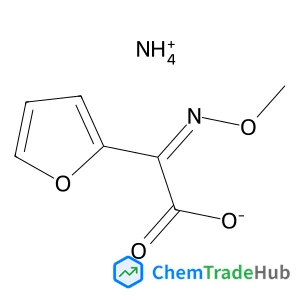
Ammonium (Z)-2-(furan-2-yl)-2-(methoxyimino)acetate
CAS Number:
97148-39-5
Molecular Formula:
C7H10N2O4
Ruibiao Fu, Shengchang Xiang, Shengmin Hu, Longsheng Wang, Yaming Li, Xihe Huang, Xintao Wu
A 1D zinc coordination polymer with bright green fluorescence, [Zn(4,4′-bipy)(H2O)4][Zn(4,4′-bipy)1.5(L)(H2O)2]2(L)·6H2O (L = 4,4′-bis(2-sulfonatostyryl)biphenyl), has been designed, hydrothermally synthesized and characterized; the interesting structure consists of three types of infinite chain: a neutral sandwich-like chain, ionic and cationic chains.
Ruhamah Yunis, Anthony F. Hollenkamp, Craig Forsyth, Cara M. Doherty, Danah Al-Masri, Jennifer M. Pringle
DOI: 10.1039/C9CP01740B
Shenghong Ju, Bin Wen, Yuwen Zhang, Roderick Melnik
DOI: 10.1039/C9CP01029G
Marianna Ambrico, Paola Manini, Paolo F. Ambrico, Teresa Ligonzo, Giuseppe Casamassima, Paola Franchi, Luca Valgimigli, Andrea Mezzetta, Cinzia Chiappe, Marco d'Ischia
DOI: 10.1039/C9CP01545K
Adrian M. Gardner, Khezar H. Saeed, Alexander J. Cowan
DOI: 10.1039/C9CP02225B
Yuri S. Djikaev, Eli Ruckenstein
DOI: 10.1039/C9CP01386E
Chuan Du, Dong Feng, Chaolang Chen, Jiadao Wang
DOI: 10.1039/C9CP01856E
Shaoxian Zheng, Jibin Pu, Junhui Sun, Liang-Feng Huang, Liping Wang, Qunji Xue
DOI: 10.1039/C8CP07533F
DOI: 10.1039/C8CP07573E
Jinlong He, Lin Zhang, Ling Liu
DOI: 10.1039/C9CP01585J
1H-Indazole-6-carbonitrile finds applications in pharmaceuticals, where it serve...
Waste containing Dioctyl (2E)-2-butenedioate (CAS: 2997-85-5) should be collecte...
Sodium [(1,2-benzoxazol-3-ylmethyl)sulfonyl]azanide is primarily used in pharmac...
Dimethyl 4-(4,4,5,5-tetramethyl-1,3,2-dioxaborolan-2-yl)-2,6-pyridinedicarboxyla...
Waste containing 2-Fluoro-6-hydrazinopyridine (CAS: 80714-39-2) should be manage...
6-Formyl-2-pyridinecarboxylic acid is an organic compound with the molecular for...
Research trends for this compound indicate a focus on its potential applications...
9H-Tribenzo[b,d,f]azepine is typically synthesized via a multi-step process invo...
1-Cyclopropyl-7-ethoxy-6-fluoro-8-methoxy-4-oxo-1,4-dihydro-3-quinolinecarboxyli...
Waste containing Methyl 3-oxo-1,2,3,4-tetrahydro-6-quinoxalinecarboxylate (CAS: ...

ChemComm publishes urgent research which is of outstanding significance and interest to experts in the field, while also appealing to the journal’s broad chemistry readership. Our communication format is ideally suited to short, urgent studies that are of such importance that they require accelerated publication. Our scope covers all topics in chemistry, and research at the interface of chemistry and other disciplines (such as materials science, nanoscience, physics, engineering and biology) where there is a significant novelty in the chemistry aspects. Major topic areas covered include: Analytical Chemistry Catalysis Chemical Biology and medicinal chemistry Computational Chemistry and Machine Learning Energy and sustainable chemistry Environmental Chemistry Green Chemistry Inorganic Chemistry Materials Chemistry Nanoscience Organic Chemistry Physical Chemistry Polymer Chemistry Supramolecular Chemistry