












Adsorbate induced vacancy formation on silver surfaces
Literature Information
Publication Date
2014-03-25
DOI
10.1039/C4CP00778F
Impact Factor
3.676
Authors
Tulio C. R. Rocha, Axel Knop-Gericke, Catherine Stampfl, Robert Schlögl, Simone Piccinin
View Original
Abstract
The energy required to form and remove vacancies on metal surfaces mediates the rate of mass transport during a wide range of processes. These energies are known to be sensitive to environmental conditions. Here, we use electronic structure density functional theory calculations to show that the surface vacancy formation energy of silver changes markedly in the presence of adsorbed and dissolved oxygen. We found that adsorbed atomic oxygen can reduce the surface vacancy formation energy of the Ag(111) surface by more than 30%, whereas surface vacancy formation becomes exothermic in the presence of pure subsurface oxygen. We went on to show that the total directionality of the topologically defined bond paths can be used to understand these changes. The resulting structure–property relationship was used to predict the behavior of silver in different atmospheres. We show that the surface vacancy formation energy decreases when electronegative elements are adsorbed on the surface, but that it can increase when electropositive elements are adsorbed.
Related Literature
An unprecedented intramolecular to intermolecular mechanistic switch in 1,1-diaminoazines leading to differential product formation during the I2-induced tandem oxidative transformation
Deepika Kathuria, Pankaj Gupta, Sumit S. Chourasiya, Subash C. Sahoo, Uwe Beifuss, Asit K. Chakraborti, Prasad V. Bharatam
2019-04-01
Paper
DOI: 10.1039/C9OB00610A
Improvement of the versatility of an arabinofuranosidase against galactofuranose for the synthesis of galactofuranoconjugates
Quentin Pavic, Aline Pillot, Olivier Tasseau, Laurent Legentil, Sylvain Tranchimand
2019-06-24
Paper
DOI: 10.1039/C9OB01162E
Planarized B,N-phenylated dibenzoazaborine with a carbazole substructure: electronic impact of the structural constraint
Mikinori Ando, Mika Sakai, Naoki Ando, Masato Hirai
2019-05-14
Communication
DOI: 10.1039/C9OB00934E
Autocatalyzed three-component cyclization of polyfluoroalkyl-3-oxo esters, methyl ketones and alkyl amines: a novel approach to 3-alkylamino-5-hydroxy-5-polyfluoroalkylcyclohex-2-en-1-ones
Marina V. Goryaeva, Svetlana O. Kushch, Olga G. Khudina, Yanina V. Burgart, Yulia S. Kudyakova, Marina A. Ezhikova, Mikhail I. Kodess, Pavel A. Slepukhin, Lilya Sh. Sadretdinova, Natalya P. Evstigneeva, Natalya A. Gerasimova, Victor I. Saloutin
2019-03-26
Paper
DOI: 10.1039/C9OB00293F
Arginine mimetic appended peptide-based probes for fluorescence turn-on detection of 14-3-3 proteins
Debabrata Maity, Alba Gigante, Pedro A. Sánchez-Murcia, Eline Sijbesma, Mao Li, David Bier, Stefanie Mosel, Shirley Knauer, Carsten Schmuck
2019-04-02
Paper
DOI: 10.1039/C9OB00620F
The cubane paradigm in bioactive molecule discovery: further scope, limitations and the cyclooctatetraene complement‡
Sevan D. Houston, Tyler Fahrenhorst-Jones, Hui Xing, Benjamin A. Chalmers, Melissa L. Sykes, Jeanette E. Stok, Clementina Farfan Soto, Jed M. Burns, Paul V. Bernhardt, James J. De Voss, Glen M. Boyle, Maree T. Smith, John Tsanaktsidis, G. Paul Savage, Vicky M. Avery, Craig M. Williams
2019-06-26
Paper
DOI: 10.1039/C9OB01238A
Antinociceptive activity of thiazole-containing cyclized DAMGO and Leu-(Met) enkephalin analogs
Hannah M. Harris, Shainnel O. Eans, Michelle L. Ganno, Jennifer C. Davis, Colette T. Dooley, Jay P. McLaughlin, Adel Nefzi
2019-05-09
Paper
DOI: 10.1039/C9OB00882A
Dehydroamino acids: chemical multi-tools for late-stage diversification
Jonathan W. Bogart, Albert A. Bowers
2019-02-27
Review Article
DOI: 10.1039/C8OB03155J
Design of S–S bond containing maleimide-conjugated closo-dodecaborate (SSMID): identification of unique modification sites on albumin and investigation of intracellular uptake
Shinichi Sato, Hiroya Asami, Tomoko Hasegawa, Jun-Ya Kohno, Hiroyuki Nakamura
2019-04-03
Communication
DOI: 10.1039/C9OB00584F
You might also like
Compound Q&A
What are the main uses of (3.beta.)-3-Hydroxy-N,N-dimethyl-chol-5-en-24-amide (CAS: 79066-03-8)?
(3.beta.)-3-Hydroxy-N,N-dimethyl-chol-5-en-24-amide (CAS: 79066-03-8) is primari...
79066-03-8(3.beta.)-3-Hydroxy-...
Compound Q&A
What regulatory guidelines apply to 5-(aminomethyl)-2-methoxyphenol (CAS: 89702-89-6)?
5-(Aminomethyl)-2-methoxyphenol (CAS: 89702-89-6) is classified under GHS as a s...
89702-89-65-(aminomethyl)-2-me...
Compound Q&A
What is Thieno[2,3-c]pyridin-7(6H)-one (CAS: 28981-13-7)?
Thieno[2,3-c]pyridin-7(6H)-one (CAS: 28981-13-7) is a heterocyclic organic compo...
28981-13-7Thieno[2,3-c]pyridin...
Compound Q&A
Is 1-[(6-Methoxy-3-pyridinyl)methyl]-4-piperidinamine dihydrochloride (CAS: 1185311-28-7) safe?
1-[(6-Methoxy-3-pyridinyl)methyl]-4-piperidinamine dihydrochloride is generally ...
1185311-28-71-[(6-Methoxy-3-pyri...
Compound Q&A
What regulatory guidelines apply to [(2E)-3-Phenyl-2-propen-1-yl]phosphonic acid (CAS: 146404-58-2)?
[(2E)-3-Phenyl-2-propen-1-yl]phosphonic acid (CAS: 146404-58-2) is regulated und...
146404-58-2[(2E)-3-Phenyl-2-pro...
Compound Q&A
What regulatory guidelines apply to 6-Bromo-7-methoxyquinoline (CAS: 1620515-86-7)?
6-Bromo-7-methoxyquinoline (CAS: 1620515-86-7) falls under the scope of the Glob...
1620515-86-76-Bromo-7-methoxyqui...
Compound Q&A
What industries use (2R)-1-(1-Benzofuran-2-yl)-N-propyl-2-pentanamine (CAS: 260550-89-8)?
This compound is primarily used in the pharmaceutical industry for the developme...
260550-89-8(2R)-1-(1-Benzofuran...
Compound Q&A
What are the main uses of 1-Ethyl-7-[2-methyl-6-(4H-1,2,4-triazol-3-yl)-3-pyridinyl]-3,5-dihydropyrazino[2,3-b]pyrazin-2(1H)-one (CAS: 1228013-15-7)?
1-Ethyl-7-[2-methyl-6-(4H-1,2,4-triazol-3-yl)-3-pyridinyl]-3,5-dihydropyrazino[2...
1228013-15-71-Ethyl-7-[2-methyl-...
Compound Q&A
Are there alternatives to {5-(Acryloylamino)-2-[(dimethylamino)methyl]phenyl}boronic acid (CAS: 1217500-78-1) in synthesis?
Alternative reagents such as 2-[(dimethylamino)methyl]phenylboronic acid or rela...
1217500-78-1{5-(Acryloylamino)-2...
Compound Q&A
What is 3-(Piperidin-4-yloxy)pyridine (CAS: 310881-48-2)?
3-(Piperidin-4-yloxy)pyridine (CAS: 310881-48-2) is an organic compound with the...
310881-48-23-(Piperidin-4-yloxy...
Source Journal
Physical Chemistry Chemical Physics

CiteScore:
5.5
Self-citation Rate:
10.3%
Articles per Year:
3036
Physical Chemistry Chemical Physics (PCCP) is an international journal co-owned by 19 physical chemistry and physics societies from around the world. This journal publishes original, cutting-edge research in physical chemistry, chemical physics and biophysical chemistry. To be suitable for publication in PCCP, articles must include significant innovation and/or insight into physical chemistry; this is the most important criterion that reviewers and Editors will judge against when evaluating submissions. The journal has a broad scope and welcomes contributions spanning experiment, theory, computation and data science. Topical coverage includes spectroscopy, dynamics, kinetics, statistical mechanics, thermodynamics, electrochemistry, catalysis, surface science, quantum mechanics, quantum computing and machine learning. Interdisciplinary research areas such as polymers and soft matter, materials, nanoscience, energy, surfaces/interfaces, and biophysical chemistry are welcomed if they demonstrate significant innovation and/or insight into physical chemistry. Joined experimental/theoretical studies are particularly appreciated when complementary and based on up-to-date approaches.
Recommended Compounds
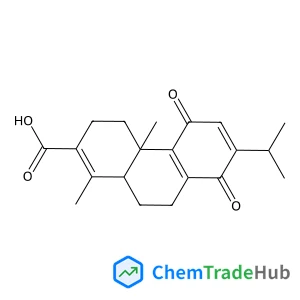
(4aS,10aS)-7-Isopropyl-1,4a-dimethyl-5,8-dioxo-3,4,4a,5,8,9,10,10a-octahydro-2-phenanthrenecarboxylic acid
CAS Number:
142950-86-5
Molecular Formula:
C20H24O4
Recommended Suppliers






Disclaimer
This page provides academic journal information for reference and research purposes only. We are not affiliated with any journal publishers and do not handle publication submissions. For publication-related inquiries, please contact the respective journal publishers directly.
If you notice any inaccuracies in the information displayed, please contact us at support@chemtradehub.com. We will promptly review and address your concerns.