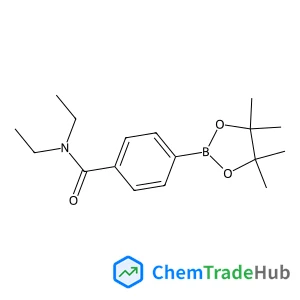
N,N-Diethyl-4-(4,4,5,5-tetramethyl-1,3,2-dioxaborolan-2-yl)benzamide
CAS Number:
325142-99-2
Molecular Formula:
C17H26BNO3
The electrocatalytic activities of various types of h-BN, i.e., spin coated BN nanotubes (BNNTs) and BN nanosheets (BNNSs) and sputter deposited BN, on Au electrodes as well as those of BNNS modified glassy carbon (GC) and Pt electrodes for the oxygen reduction reaction (ORR) were examined in O2 saturated 0.5 M H2SO4 solution based on the theoretical prediction that monolayered BN on a metal substrate may act as an electrocatalyst for ORR even though bulk BN is an insulator with a wide band gap. The overpotential for ORR at Au electrodes was reduced by ca. 100, ca. 270, and ca. 150 mV by spin coating of the dispersion of BNNT and liquid exfoliated BNNS, and sputter deposition of BN, respectively, proving the theoretical prediction. On the other hand, no change in the overpotential was observed at the glassy carbon electrode with BNNS modification and the overpotential even increased at the Pt electrode, suggesting that the interaction between BN and Au plays an important role in BN becoming ORR active.
Tao Xu, Wenliang Wang, Shiwei Yin, Yun Wang
DOI: 10.1039/C7CP01534H
Weijia Huang, Danxing Zheng, Changxing Xia, Lejun Feng, Li Dong, Peixue Jiang
DOI: 10.1039/C7CP01757J
Patrick R. Batista, Renan V. Viesser, Cláudio F. Tormena, Roberto Rittner, Paulo R. de Oliveira
DOI: 10.1039/C7CP03572A
Aurellia Galliot, Adrià Gil, Maria José Calhorda
DOI: 10.1039/C7CP00532F
J. C. Everts, S. Samin, N. A. Elbers, J. E. S. van der Hoeven, A. van Blaaderen, R. van Roij
DOI: 10.1039/C7CP01935A
Cédric Bomme, Evgeny Savelyev, Hui Xiong, Rajesh Kushawaha, Rebecca Boll, Kasra Amini, Timur Osipov, David Kilcoyne, Artem Rudenko, Nora Berrah, Daniel Rolles
DOI: 10.1039/C7CP01379E
Maurício J. Piotrowski, Juarez L. F. Da Silva
DOI: 10.1039/C7CP02240A
Keitel Cervantes-Salguero, Ibuki Kawamata, Shin-ichiro M. Nomura, Satoshi Murata
DOI: 10.1039/C7CP02214J
Sung-Sik Lee, Soojin Park, Jae-ung Lee, Jun-Hyeok Kim, Dongkyung Yoon, Sungyul Lee, Han Bin Oh
DOI: 10.1039/C7CP01085K
This compound is mainly used as an intermediate in the synthesis of antipsychoti...
Waste containing 1-(D-Ribofuranosyl)-1,4-dihydro-3-pyridinecarboxamide (CAS: 191...
2-Methyl-2-propanyl 3-bromo-3-(hydroxymethyl)-1-azetidinecarboxylate (CAS: 20079...
N-(4-Chloro-2-pyridinyl)acetamide (CAS: 245056-66-0) is a chemical compound with...
5-Chloro-2-hydroxybenzoic acid, also known as 5-chlorosalicylic acid, is an arom...
When handling 1,1-Dichloro-1-fluoroethane (CAS: 1717-00-6), it is important to u...
Fmoc-(2S,3R)-3-phenylpyrrolidine-2-carboxylic acid is a white crystalline solid ...
4-Amino-5-bromo-2-pyridinecarboxylic acid is primarily used as a precursor in th...
Handling this compound should be done with personal protective equipment (PPE) i...
When handling 8-bromo-2,2-dimethyl-3,4-dihydro-2H-1,4-benzoxazin-3-one, use prop...

Physical Chemistry Chemical Physics (PCCP) is an international journal co-owned by 19 physical chemistry and physics societies from around the world. This journal publishes original, cutting-edge research in physical chemistry, chemical physics and biophysical chemistry. To be suitable for publication in PCCP, articles must include significant innovation and/or insight into physical chemistry; this is the most important criterion that reviewers and Editors will judge against when evaluating submissions. The journal has a broad scope and welcomes contributions spanning experiment, theory, computation and data science. Topical coverage includes spectroscopy, dynamics, kinetics, statistical mechanics, thermodynamics, electrochemistry, catalysis, surface science, quantum mechanics, quantum computing and machine learning. Interdisciplinary research areas such as polymers and soft matter, materials, nanoscience, energy, surfaces/interfaces, and biophysical chemistry are welcomed if they demonstrate significant innovation and/or insight into physical chemistry. Joined experimental/theoretical studies are particularly appreciated when complementary and based on up-to-date approaches.
![tert-Butyl N-[(2-chloropyridin-4-yl)methyl]carbamate structure](https://static.chemtradehub.com/structs/916/916210-27-0-9f95.webp "tert-Butyl N-[(2-chloropyridin-4-yl)methyl]carbamate structure")