Trichloro(3,3,4,4,5,5,6,6,7,7,8,8,8-tridecafluorooctyl)silane
CAS Number:
78560-45-9
Molecular Formula:
C8H4Cl3F13Si
Sk. Asif Ikbal, Sanfaori Brahma, Sankar Prasad Rath
A clear rationalization of the origin of chirality transfer from an optically active diol guest to an achiral Mg(II)bisporphyrin host in a series of 1 : 2 host–guest supramolecular complexes has been reported here that has so far remained the most outstanding issue for the chirogenic process.
S. S. Sarangi, S. G. Raju, S. Balasubramanian
DOI: 10.1039/C0CP01272F
Vacharaporn Soonsin, Bei P. Luo, Ulrich K. Krieger, Claudia Marcolli, Thomas Peter, Thomas Koop
DOI: 10.1039/C0CP01273D
S. Auluck, I. V. Kityk
DOI: 10.1039/C0CP01601B
Miguel González, Amaia Saracibar, Ernesto Garcia
DOI: 10.1039/C0CP01188F
Dat Tien Hoang, Selim Alayoglu, Zhi Liu
DOI: 10.1039/C0CP01858A
Ilia Valov, Bjoern Luerssen, Eva Mutoro, Luca Gregoratti, Roger A. De Souza, Thomas Bredow, Sebastian Günther, Alexei Barinov, Pavel Dudin, Manfred Martin, Jürgen Janek
DOI: 10.1039/C0CP01024C
R. M. Lynden-Bell, N. Giovambattista, P. G. Debenedetti, T. Head-Gordon, P. J. Rossky
DOI: 10.1039/C0CP01701A
Ilkeun Lee, Manuel A. Albiter, Qiao Zhang, Jianping Ge, Yadong Yin, Francisco Zaera
DOI: 10.1039/C0CP01688H
1H-Indazole-6-carbonitrile finds applications in pharmaceuticals, where it serve...
Waste containing Dioctyl (2E)-2-butenedioate (CAS: 2997-85-5) should be collecte...
Sodium [(1,2-benzoxazol-3-ylmethyl)sulfonyl]azanide is primarily used in pharmac...
Dimethyl 4-(4,4,5,5-tetramethyl-1,3,2-dioxaborolan-2-yl)-2,6-pyridinedicarboxyla...
Waste containing 2-Fluoro-6-hydrazinopyridine (CAS: 80714-39-2) should be manage...
6-Formyl-2-pyridinecarboxylic acid is an organic compound with the molecular for...
Research trends for this compound indicate a focus on its potential applications...
9H-Tribenzo[b,d,f]azepine is typically synthesized via a multi-step process invo...
1-Cyclopropyl-7-ethoxy-6-fluoro-8-methoxy-4-oxo-1,4-dihydro-3-quinolinecarboxyli...
Waste containing Methyl 3-oxo-1,2,3,4-tetrahydro-6-quinoxalinecarboxylate (CAS: ...

ChemComm publishes urgent research which is of outstanding significance and interest to experts in the field, while also appealing to the journal’s broad chemistry readership. Our communication format is ideally suited to short, urgent studies that are of such importance that they require accelerated publication. Our scope covers all topics in chemistry, and research at the interface of chemistry and other disciplines (such as materials science, nanoscience, physics, engineering and biology) where there is a significant novelty in the chemistry aspects. Major topic areas covered include: Analytical Chemistry Catalysis Chemical Biology and medicinal chemistry Computational Chemistry and Machine Learning Energy and sustainable chemistry Environmental Chemistry Green Chemistry Inorganic Chemistry Materials Chemistry Nanoscience Organic Chemistry Physical Chemistry Polymer Chemistry Supramolecular Chemistry
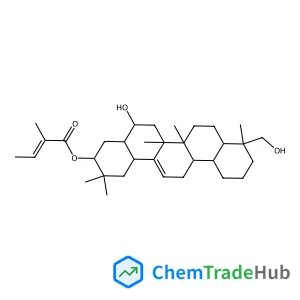
![(1S)-1,5-Anhydro-1-[3-(1-benzothiophen-2-ylmethyl)-4-fluorophenyl]-D-glucitol structure](https://static.chemtradehub.com/structs/761/761423-87-4-dbeb.webp "(1S)-1,5-Anhydro-1-[3-(1-benzothiophen-2-ylmethyl)-4-fluorophenyl]-D-glucitol structure")
![Sodium 3-[(E)-(4-anilinophenyl)diazenyl]benzenesulfonate structure](https://static.chemtradehub.com/structs/587/587-98-4-035f.webp "Sodium 3-[(E)-(4-anilinophenyl)diazenyl]benzenesulfonate structure")