













Poly(amidoamine) modified graphene oxide as an efficient adsorbent for heavy metal ions
Literature Information
Publication Date
2013-01-11
DOI
10.1039/C3PY21128B
Impact Factor
5.582
Authors
Yang Yuan, Guanghui Zhang, Yang Li, Guoliang Zhang, Fengbao Zhang, Xiaobin Fan
View Original
Abstract
Poly(amidoamine) modified graphene oxide was prepared via a grafting-from method and characterized by Fourier transform infrared spectroscopy (FT-IR), X-ray photoelectron spectroscopy (XPS), scanning electron microscopy (SEM) and atomic force microscopy (AFM). Evaluation of its adsorption capacity for heavy metal ions demonstrated that the poly(amidoamine) modified graphene oxide had superior adsorption ability towards heavy metal ions such as Cu2+, Zn2+, Fe3+, Pb2+ and Cr3+.
Related Literature
Liquid–liquid equilibria in polystyrene solutions: the general pressure dependence
Paper
DOI: 10.1039/A902824B
Investigation of partial oxidation of copper deposited on pyrolytic boron nitride
Paper
DOI: 10.1039/A903548F
A Grand Canonical Monte Carlo study of argon adsorption/condensation in mesoporous silica glasses
Roland J.-M. Pellenq, Bernard Rousseau, Pierre E. Levitz
2001-03-08
Paper
DOI: 10.1039/B008961N
Two-dimensional diffraction from enantiopure and racemic monolayers of [Ru(bpy)3]2+ intercalated into synthetic fluorohectorite
Josef Breu, Alexander Stoll, Kurt G. Lange, Thomas Probst
2001-03-08
Communication
DOI: 10.1039/B009939M
Equilibrium and out-of-equilibrium (hysteretic) behavior of fluids in disordered porous materials: Theoretical predictions
2001-03-02
Paper
DOI: 10.1039/B008636N
Predicting the binding energies of H-bonded complexes: A comparative DFT study
Paper
DOI: 10.1039/A904357H
Water-tolerant catalysis by Mo–Zr mixed oxides calcined at high temperatures
Paper
DOI: 10.1039/A905352B
You might also like
Compound Q&A
What are the main uses of 4-Nitrophenyl phosphate disodium salt hexahydrate (CAS: 333338-18-4)?
4-Nitrophenyl phosphate disodium salt hexahydrate is primarily used as a substra...
333338-18-44-Nitrophenyl phosph...
Compound Q&A
What are the main uses of 2-(Trifluoromethyl)-1,3-oxazole-4-carboxylic Acid (CAS: 1060816-01-4)?
2-(Trifluoromethyl)-1,3-oxazole-4-carboxylic Acid (CAS: 1060816-01-4) is widely ...
1060816-01-42-(Trifluoromethyl)-...
Compound Q&A
How should 2-Fluoro-4-biphenylcarboxylic acid (CAS: 137045-30-8) be stored?
2-Fluoro-4-biphenylcarboxylic acid should be stored in a cool, dry place at room...
137045-30-82-Fluoro-4-biphenylc...
Compound Q&A
What industries use Prednisolone-21-Carboxylic Acid (CAS: 61549-70-0)?
Prednisolone-21-Carboxylic Acid is primarily used in the pharmaceutical industry...
61549-70-0Prednisolone-21-Carb...
Compound Q&A
How should 4-(Hydrazinomethyl)-1,2,3-benzenetriol (CAS: 3614-72-0) be stored?
4-(Hydrazinomethyl)-1,2,3-benzenetriol (CAS: 3614-72-0) should be stored in a co...
3614-72-04-(Hydrazinomethyl)-...
Compound Q&A
What industries use 4-Amino-1-methyl-1H-pyrazole-5-carboxylic acid hydrochloride (CAS: 92534-70-8)?
4-Amino-1-methyl-1H-pyrazole-5-carboxylic acid hydrochloride (CAS: 92534-70-8) i...
92534-70-84-Amino-1-methyl-1H-...
Compound Q&A
What regulatory guidelines apply to dehydropachymic acid (CAS: 77012-31-8)?
Dehydropachymic acid (CAS: 77012-31-8) is regulated by various agencies. It fall...
77012-31-8Dehydropachymic acid
Compound Q&A
What is the market or research trend for 6-[(2,2-Dimethylpropanoyl)amino]nicotinic acid (CAS: 898561-66-5)?
The market and research trends for 6-[(2,2-Dimethylpropanoyl)amino]nicotinic aci...
898561-66-56-[(2,2-Dimethylprop...
Compound Q&A
How should 1,10-Phenanthroline-2,9-dicarbaldehyde (CAS: 57709-62-3) be stored?
1,10-Phenanthroline-2,9-dicarbaldehyde should be stored in a cool, dry place awa...
57709-62-31,10-Phenanthroline-...
Compound Q&A
How is 5-Carbamoyl-11-oxo-10,11-dihydro-5H-dibenzo[b,f]azepin-10-yl acetate (CAS: 113952-21-9) typically synthesized?
5-Carbamoyl-11-oxo-10,11-dihydro-5H-dibenzo[b,f]azepin-10-yl acetate can be synt...
113952-21-95-Carbamoyl-11-oxo-1...
Source Journal
Polymer Chemistry

CiteScore:
8.6
Self-citation Rate:
7.3%
Articles per Year:
457
Polymer Chemistry welcomes submissions in all areas of polymer science that have a strong focus on macromolecular chemistry. Manuscripts may cover a broad range of fields, yet no direct application focus is required.
Recommended Compounds



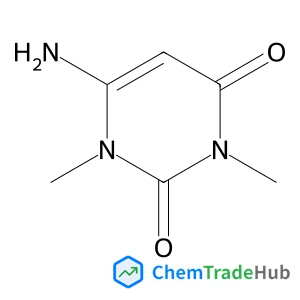
6-amino-1,3-dimethyl-1,2,3,4-tetrahydropyrimidine-2,4-dione
CAS Number:
6642-31-5
Molecular Formula:
C6H9N3O2
Recommended Suppliers






Disclaimer
This page provides academic journal information for reference and research purposes only. We are not affiliated with any journal publishers and do not handle publication submissions. For publication-related inquiries, please contact the respective journal publishers directly.
If you notice any inaccuracies in the information displayed, please contact us at support@chemtradehub.com. We will promptly review and address your concerns.