













Fluorescent dextran-based nanogels: efficient imaging nanoprobes for adipose-derived stem cells
Literature Information
Publication Date
2013-06-03
DOI
10.1039/C3PY00522D
Impact Factor
5.582
Authors
Shuyan Zhou, Hongjing Dou, Zhaofeng Zhang, Kang Sun, Yuqing Jin, Tingting Dai, Guangdong Zhou, Zunli Shen
View Original
Abstract
For the efficient tracking of adipose-derived stem cells (ADSCs), nano-sized probes provide convenient platforms and have many advantages over the induction of reporter genes. Despite their great potential for various applications, investigations on macromolecular nanogels acting as stem cell tracking probes remain limited due to the difficulties encountered with synthesizing macromolecular nanogels with controllable diameters and surface charges. In this report, we describe a self-assembly assisted (SAA) methodology for the efficient preparation of fluorescent dextran-based nanogels as ADSC imaging nanoprobes. Through a three step procedure involving the fabrication of dextran-based nanogels, the conjugation of fluorescent molecules with the nanogels, and the surface modification of the fluorescent nanogels, novel fluorescent nanogels with various diameters ranging from 165 to 241 nm and surface potentials ranging from −10 to 10 mV were fabricated. The feasibility of these nanogels for ADSC imaging applications was also investigated. We demonstrate that negatively charged nanogels provide effective ADSC imaging without requiring any cell-uptake enhancers. Additionally, we observed that the capabilities of these nanogels to provide ADSC imaging is closely related to both their size and surface charge. Our study suggests that the fluorescent nanogels generated by the SAA approach have great potential for ADSC imaging applications due to their excellent cell imaging capabilities and low cytotoxicity.
Recommended Journals
Related Literature
Myers–Saito and Schmittel cyclization of hepta-1,2,4-triene-6-yne: A theoretical REKS study
Sam P. de Visser, Michael Filatov, Sason Shaik
2001-03-06
Paper
DOI: 10.1039/B009965L
Hybrid aptamer-molecularly imprinted polymer (AptaMIP) nanoparticles selective for the antibiotic moxifloxacin
Mark V. Sullivan, David Bunka, Arron Tolley, Paula M. Mendes, James H. R. Tucker, Nicholas W. Turner
2021-07-13
Paper
DOI: 10.1039/D1PY00607J
Experimental and simulation studies of the electron transfer reaction between [Ru(NH3)5pz]2+ and [Co(C2O4)3]3−
Pilar Pérez-Tejeda, Francisco-Javier Franco, Antonio Sánchez, Manuel Morillo, Claus Denk, Francisco Sánchez
2001-03-06
Paper
DOI: 10.1039/B009004M
Custom-made polar monomers utilized in nickel and palladium promoted olefin copolymerization
Lei Cui, Hongliang Mu
2021-05-31
Review Article
DOI: 10.1039/D1PY00492A
Millimetre- and submillimetre-wave spectroscopy of 13C and 15N isotopomers of cyanoacetylene, HCCCN, in the ground and vibrationally excited states
2001-03-13
Paper
DOI: 10.1039/B009743H
Molecular structure and gas-phase reactivity of clonidine and rilmenidine: Two-layered ONIOM calculations
Milan Remko, Owen A. Walsh, W. Graham Richards
2001-02-27
Paper
DOI: 10.1039/B009660L
Chromium silsesquioxane based synthesis and characterization of a microporous Cr–Si–O material
Paper
DOI: 10.1039/A903684I
Spectroscopic and thermodynamic study of the H-bonding of olefins onto the isolated hydroxyl of amorphous silica
Paper
DOI: 10.1039/A903682B
You might also like
Compound Q&A
What are the main uses of 4-Nitrophenyl phosphate disodium salt hexahydrate (CAS: 333338-18-4)?
4-Nitrophenyl phosphate disodium salt hexahydrate is primarily used as a substra...
333338-18-44-Nitrophenyl phosph...
Compound Q&A
What are the main uses of 2-(Trifluoromethyl)-1,3-oxazole-4-carboxylic Acid (CAS: 1060816-01-4)?
2-(Trifluoromethyl)-1,3-oxazole-4-carboxylic Acid (CAS: 1060816-01-4) is widely ...
1060816-01-42-(Trifluoromethyl)-...
Compound Q&A
How should 2-Fluoro-4-biphenylcarboxylic acid (CAS: 137045-30-8) be stored?
2-Fluoro-4-biphenylcarboxylic acid should be stored in a cool, dry place at room...
137045-30-82-Fluoro-4-biphenylc...
Compound Q&A
What industries use Prednisolone-21-Carboxylic Acid (CAS: 61549-70-0)?
Prednisolone-21-Carboxylic Acid is primarily used in the pharmaceutical industry...
61549-70-0Prednisolone-21-Carb...
Compound Q&A
How should 4-(Hydrazinomethyl)-1,2,3-benzenetriol (CAS: 3614-72-0) be stored?
4-(Hydrazinomethyl)-1,2,3-benzenetriol (CAS: 3614-72-0) should be stored in a co...
3614-72-04-(Hydrazinomethyl)-...
Compound Q&A
What industries use 4-Amino-1-methyl-1H-pyrazole-5-carboxylic acid hydrochloride (CAS: 92534-70-8)?
4-Amino-1-methyl-1H-pyrazole-5-carboxylic acid hydrochloride (CAS: 92534-70-8) i...
92534-70-84-Amino-1-methyl-1H-...
Compound Q&A
What regulatory guidelines apply to dehydropachymic acid (CAS: 77012-31-8)?
Dehydropachymic acid (CAS: 77012-31-8) is regulated by various agencies. It fall...
77012-31-8Dehydropachymic acid
Compound Q&A
What is the market or research trend for 6-[(2,2-Dimethylpropanoyl)amino]nicotinic acid (CAS: 898561-66-5)?
The market and research trends for 6-[(2,2-Dimethylpropanoyl)amino]nicotinic aci...
898561-66-56-[(2,2-Dimethylprop...
Compound Q&A
How should 1,10-Phenanthroline-2,9-dicarbaldehyde (CAS: 57709-62-3) be stored?
1,10-Phenanthroline-2,9-dicarbaldehyde should be stored in a cool, dry place awa...
57709-62-31,10-Phenanthroline-...
Compound Q&A
How is 5-Carbamoyl-11-oxo-10,11-dihydro-5H-dibenzo[b,f]azepin-10-yl acetate (CAS: 113952-21-9) typically synthesized?
5-Carbamoyl-11-oxo-10,11-dihydro-5H-dibenzo[b,f]azepin-10-yl acetate can be synt...
113952-21-95-Carbamoyl-11-oxo-1...
Source Journal
Polymer Chemistry

CiteScore:
8.6
Self-citation Rate:
7.3%
Articles per Year:
457
Polymer Chemistry welcomes submissions in all areas of polymer science that have a strong focus on macromolecular chemistry. Manuscripts may cover a broad range of fields, yet no direct application focus is required.
Recommended Compounds


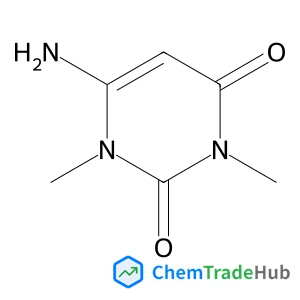
6-amino-1,3-dimethyl-1,2,3,4-tetrahydropyrimidine-2,4-dione
CAS Number:
6642-31-5
Molecular Formula:
C6H9N3O2
Recommended Suppliers





Disclaimer
This page provides academic journal information for reference and research purposes only. We are not affiliated with any journal publishers and do not handle publication submissions. For publication-related inquiries, please contact the respective journal publishers directly.
If you notice any inaccuracies in the information displayed, please contact us at support@chemtradehub.com. We will promptly review and address your concerns.