












A sustainable biotechnological process for the efficient synthesis of kojibiose
Literature Information
Publication Date
2014-01-07
DOI
10.1039/C3GC42246A
Impact Factor
10.182
Authors
Marina Díez-Municio, Antonia Montilla, F. Javier Moreno, Miguel Herrero
View Original
Abstract
This work reports the optimization of a cost-effective and scalable process for the enzymatic synthesis of kojibiose (2-O-α-D-glucopyranosyl-α-D-glucose) from readily available and low-cost substrates such as sucrose and lactose. This biotechnological process is based on the dextransucrase-catalysed initial synthesis of a galactosyl-derivative of kojibiose (4-O-β-D-galactopyranosyl-kojibiose) followed by the removal of residual monosaccharides using a Saccharomyces cerevisiae yeast treatment, and a thorough hydrolysis step with Kluyveromyces lactis β-galactosidase. Depending on the final purification stage, i.e. extension of the yeast treatment or the use of preparative liquid chromatography, the purity of the produced kojibiose ranged from 65% to ≥99%, respectively. The moderately high yield achieved (38%, in weight respect to the initial amount of lactose) using this affordable synthesis process could expand the potential applications of kojibiose according to the bioactive properties that have been associated with this disaccharide, so far limited by its low availability.
Related Literature
The quest for rationalizing the magnetism in purely organic semiquinone-bridged bisdithiazolyl molecular magnets
Mercè Deumal
2016-06-23
Paper
DOI: 10.1039/C6CP02699K
The role of alkoxy radicals in the heterogeneous reaction of two structural isomers of dimethylsuccinic acid
Chiu Tung Cheng, Kevin R. Wilson
2015-08-27
Paper
DOI: 10.1039/C5CP03791C
Unravelling the mechanisms of reactive oxygen species formation in nanohybrid systems of porphyrins and enriched (6,5) single-walled carbon nanotubes for photosensitization
Camila S. Monteiro, Daniele C. Ferreira, Gustavo A. M. Sáfar, Rafael N. Gontijo, Cristiano Fantini, Dayse C. S. Martins, Ynara M. Idemori, Maurício V. B. Pinheiro, Klaus Krambrock
2016-07-05
Paper
DOI: 10.1039/C6CP03366K
Carbon and proton Overhauser DNP from MD simulations and ab initio calculations: TEMPOL in acetone
Sami Emre Küçük, Timur Biktagirov, Deniz Sezer
2015-08-25
Paper
DOI: 10.1039/C5CP04405G
Illuminating solid gas storage in confined spaces – methane hydrate formation in porous model carbons
Lars Borchardt, Winfried Nickel, Mirian Casco, Irena Senkovska, Volodymyr Bon, Dirk Wallacher, Nico Grimm, Simon Krause, Joaquín Silvestre-Albero
2016-07-07
Paper
DOI: 10.1039/C6CP03993F
Alkali metal ion induced cube shaped mesoporous hematite particles for improved magnetic properties and efficient degradation of water pollutants
Mouni Roy, Milan Kanti Naskar
2016-07-01
Paper
DOI: 10.1039/C6CP02442D
Photoionization access to cyclodextrin-encapsulated resveratrol phenoxy radicals and their repair by ascorbate across the phase boundary
Christoph Kerzig, Martin Goez
2016-06-24
Paper
DOI: 10.1039/C6CP03742A
Water adsorption in SAPO-34: elucidating the role of local heterogeneities and defects using dispersion-corrected DFT calculations
2015-08-28
Paper
DOI: 10.1039/C5CP04189A
A molecular theory for optimal blue energy extraction by electrical double layer expansion
Alejandro Gallegos, Diannan Lu, Zheng Liu, Jianzhong Wu
2015-08-19
Paper
DOI: 10.1039/C5CP03514G
Anomalous system-size dependence of electrolytic cells with an electrified oil–water interface
Niels Boon, René van Roij
2015-08-27
Paper
DOI: 10.1039/C5CP02945G
You might also like
Compound Q&A
What precautions should be taken when handling 4-Methyl-6-(trifluoromethyl)quinoline (CAS: 40716-16-3)?
When handling 4-Methyl-6-(trifluoromethyl)quinoline (CAS: 40716-16-3), safety go...
40716-16-34-Methyl-6-(trifluor...
Compound Q&A
What is 4-(3,5-Difluorophenyl)aniline (CAS: 405058-00-6)?
4-(3,5-Difluorophenyl)aniline is an aromatic organic compound with the CAS numbe...
405058-00-64-(3,5-Difluoropheny...
Compound Q&A
How is 5-{[4-(Trifluoromethyl)phenyl]sulfanyl}-1,2,3-thiadiazole-4-carboxylic acid (CAS: 338982-07-3) typically synthesized?
5-{[4-(Trifluoromethyl)phenyl]sulfanyl}-1,2,3-thiadiazole-4-carboxylic acid can ...
338982-07-35-{[4-(Trifluorometh...
Compound Q&A
What is the market or research trend for 4-Benzylaniline hydrochloride (CAS: 6317-57-3)?
The market for 4-Benzylaniline hydrochloride (CAS: 6317-57-3) is steadily growin...
6317-57-34-Benzylaniline hydr...
Compound Q&A
Is [3-(Diethylsulfamoyl)phenyl]boronic acid (CAS: 871329-58-7) safe?
[3-(Diethylsulfamoyl)phenyl]boronic acid is generally considered safe when handl...
871329-58-7[3-(Diethylsulfamoyl...
Compound Q&A
What are the main uses of 3-Bromo-2,5-dimethoxyaniline (CAS: 115929-62-9)?
3-Bromo-2,5-dimethoxyaniline is mainly used in the pharmaceutical and chemical i...
115929-62-93-Bromo-2,5-dimethox...
Compound Q&A
What regulatory guidelines apply to N-Methyl-1-(5-methyl-1H-indol-3-yl)methanamine (CAS: 915922-67-7)?
N-Methyl-1-(5-methyl-1H-indol-3-yl)methanamine (CAS: 915922-67-7) is subject to ...
915922-67-7N-Methyl-1-(5-methyl...
Compound Q&A
What industries use Carbamic acid, N-[(5S)-5,6-diamino-6-oxohexyl]-, 1,1-dimethylethyl ester (CAS: 24828-96-4)?
This compound is primarily used in the pharmaceutical industry for the synthesis...
24828-96-4Carbamic acid, N-[(5...
Compound Q&A
How should 2-Methyl-2-propanyl [(1S,3R)-3-aminocyclohexyl]carbamate (CAS: 1298101-47-9) be stored?
2-Methyl-2-propanyl [(1S,3R)-3-aminocyclohexyl]carbamate (CAS: 1298101-47-9) sho...
1298101-47-92-Methyl-2-propanyl ...
Compound Q&A
What industries use Ethyl 2-bromo-4,4,4-trifluorobutanoate (CAS: 367-33-9)?
Ethyl 2-bromo-4,4,4-trifluorobutanoate (CAS: 367-33-9) is utilized in the pharma...
367-33-9Ethyl 2-bromo-4,4,4-...
Source Journal
Green Chemistry

CiteScore:
16.1
Self-citation Rate:
7.5%
Articles per Year:
944
Green Chemistry provides a unique forum for the publication of innovative research on the development of alternative green and sustainable technologies. The scope of Green Chemistry is based on, but not limited to, the definition proposed by Anastas and Warner (Green Chemistry: Theory and Practice, P T Anastas and J C Warner, Oxford University Press, Oxford, 1998). Green chemistry is the utilisation of a set of principles that reduces or eliminates the use or generation of hazardous substances in the design, manufacture and application of chemical products. Green Chemistry is at the frontiers of this continuously-evolving interdisciplinary science and publishes research that attempts to reduce the environmental impact of the chemical enterprise by developing a technology base that is inherently non-toxic to living things and the environment. Submissions on all aspects of research relating to the endeavour are welcome. The journal publishes original and significant cutting-edge research that is likely to be of wide general appeal. To be published, work must present a significant advance in green chemistry. Papers must contain a comparison with existing methods and demonstrate advantages over those methods before publication can be considered. For more information please see this Editorial. Coverage includes the following, but is not limited to: Design (e.g. biomimicry, design for degradation/recycling/reduced toxicity…) Reagents & Feedstocks (e.g. renewables, CO2, solvents, auxiliary agents, waste utilization…) Synthesis (e.g. organic, inorganic, synthetic biology…) Catalysis (e.g. homogeneous, heterogeneous, enzyme, whole cell…) Process (e.g. process design, intensification, separations, recycling, efficiency…) Energy (e.g. renewable energy, fuels, photovoltaics, fuel cells, energy storage, energy carriers…) Applications (e.g. electronics, dyes, consumer products, coatings, pharmaceuticals, preservatives, building materials, chemicals for industry/agriculture/mining…) Impact (e.g. safety, metrics, LCA, sustainability, (eco)toxicology…) Green chemistry is, by definition, a continuously-evolving frontier. Therefore, the inclusion of a particular material or technology does not, of itself, guarantee that a paper is suitable for the journal. To be suitable, the novel advance should have the potential for reduced environmental impact relative to the state of the art. Green Chemistry does not normally deal with research associated with 'end-of-pipe' or remediation issues.
Recommended Compounds
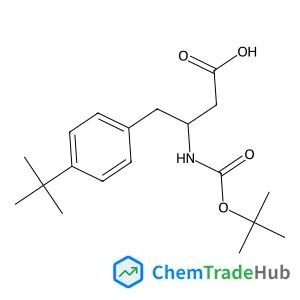
(S)-3-((tert-Butoxycarbonyl)amino)-4-(4-(tert-butyl)phenyl)butanoic acid
CAS Number:
403661-85-8
Molecular Formula:
C19H29NO4
Recommended Suppliers







Disclaimer
This page provides academic journal information for reference and research purposes only. We are not affiliated with any journal publishers and do not handle publication submissions. For publication-related inquiries, please contact the respective journal publishers directly.
If you notice any inaccuracies in the information displayed, please contact us at support@chemtradehub.com. We will promptly review and address your concerns.