












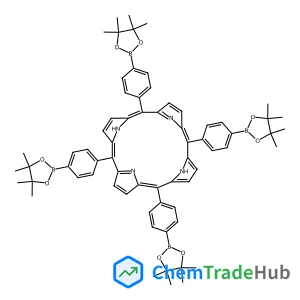
5,10,15,20-tetrakis(4-boronic acid pinacol ester phenyl) porphyrin
CAS Number:
1332748-00-1
Molecular Formula:
C68H74B4N4O8
José González-Rivera, Ignacio R. Galindo-Esquivel, Massimo Onor, Emilia Bramanti, Iginio Longo, Carlo Ferrari
Zeolite Beta, modified with some salts of alkali and alkaline earth metals (K, Zn, Sn), was tested in the hydrothermal heterogeneous catalytic decomposition of microcrystalline cellulose. The reactions were microwave-assisted, where the microwaves were issued by an in situ coaxial applicator. Zeolites were subjected to an ion-exchange process which determines the loss of crystallinity in the following order: Sn-Beta-IE > K-Beta > Zn-Beta > acid form H-Beta. The interaction between zeolites and microwaves was studied by irradiating zeolite powder under constant power and the heating response was in the following order: K-Beta > NH4-Beta > Sn-Beta-IE ≈ Zn-Beta > H-Beta > alumina. These results show that the nature of the counterion strongly affects the absorption of microwaves. The catalytic activity of the different systems on the cellulose decomposition was studied, and resulted in the following order: H-Beta > K-Beta > Zn-Beta > Sn-Beta-IE > alumina, when the reaction medium contained 5 mM HCl. The most active catalyst was the acid zeolite Beta and the identified product distribution under the investigated conditions was (mol yield %): levulinic acid (22.3), glucose (12.1), lactic acid (4.1), formic acid (6.6), 5-(hydroxymethyl) furfural (14.6), acetic acid (15.2) and furfuraldehyde (3.1). The effect of temperature, time and the heterogeneous catalyst reuse (H-Beta) on the yields of different products was investigated. The use of MW radiation with a coaxial applicator instead of conventional heating gave clear advantages in the decrease of the reaction time (45 min) and in terms of yield enhancement (78.6% under the best conditions).
Mathias Strauss, Carlos Alberto Rodrigues Costa, Cátia Crispilho Corrêa
DOI: 10.1039/C9CP05717J
Yusuke Morino, Hisaya Hara, Ken-ichi Bando, Sakurako Ono, Akihito Imanishi, Yugo Okada, Hiroyuki Matsui, Takafumi Uemura, Jun Takeya
DOI: 10.1039/D0CP00149J
Haidy Metwally, Vincent Lemaur, Jérôme Cornil, Julien De Winter, Lars Konermann, Pascal Gerbaux
DOI: 10.1039/C9CP06391A
Fei Yao, Nan Gong, Wenhui Fang, Zhiwei Men
DOI: 10.1039/C9CP05886A
Susu Zhong, Kaifang Huang, Song Luo, Shuheng Dong, Lili Duan
DOI: 10.1039/C9CP06459A
Albin Antony, Poornesh P., I. V. Kityk, K. Ozga, J. Jedryka, G. Myronchuk, Suresh D. Kulkarni, Ganesh Sanjeev, Vikash Chandra Petwal, Vijay Pal Verma, Jishnu Dwivedi
DOI: 10.1039/C9CP06323D
Ruiqi Zhao, Yu Wang, Xinglong Gong
DOI: 10.1039/C9CP06314E
N-(4-Methoxybenzyl)-2-pyridinamine (CAS: 52818-63-0) is increasingly being used ...
When handling Ethyl 4-(2-chlorophenyl)-1,3-thiazole-2-carboxylate, appropriate p...
Diethyldiselane (CAS: 628-39-7) is classified under the Globally Harmonized Syst...
The market for oxocopper (CAS: 12053-18-8) is primarily driven by its use in cat...
The market for 5-{[(2-Methyl-2-propanyl)oxy]carbonyl}-5-azaspiro[2.4]heptane-7-c...
2-(1-Pyrrolidinyl)-4-pyridinamine is a chemical compound with the CAS number 359...
2-(3-Pyridinyl)-1-azabicyclo[2.2.2]octane (CAS: 91556-75-1) is a crystalline sol...
(S)-Alpha-allyl-proline hydrochloride is usually synthesized via a Wittig reacti...
3-Methyl-1,2-oxazole-5-carboxylic acid (CAS: 4857-42-5) is an organic compound w...
Lys-SMCC-DM1 is synthesized via a multi-step process involving the coupling of S...

Green Chemistry provides a unique forum for the publication of innovative research on the development of alternative green and sustainable technologies. The scope of Green Chemistry is based on, but not limited to, the definition proposed by Anastas and Warner (Green Chemistry: Theory and Practice, P T Anastas and J C Warner, Oxford University Press, Oxford, 1998). Green chemistry is the utilisation of a set of principles that reduces or eliminates the use or generation of hazardous substances in the design, manufacture and application of chemical products. Green Chemistry is at the frontiers of this continuously-evolving interdisciplinary science and publishes research that attempts to reduce the environmental impact of the chemical enterprise by developing a technology base that is inherently non-toxic to living things and the environment. Submissions on all aspects of research relating to the endeavour are welcome. The journal publishes original and significant cutting-edge research that is likely to be of wide general appeal. To be published, work must present a significant advance in green chemistry. Papers must contain a comparison with existing methods and demonstrate advantages over those methods before publication can be considered. For more information please see this Editorial. Coverage includes the following, but is not limited to: Design (e.g. biomimicry, design for degradation/recycling/reduced toxicity…) Reagents & Feedstocks (e.g. renewables, CO2, solvents, auxiliary agents, waste utilization…) Synthesis (e.g. organic, inorganic, synthetic biology…) Catalysis (e.g. homogeneous, heterogeneous, enzyme, whole cell…) Process (e.g. process design, intensification, separations, recycling, efficiency…) Energy (e.g. renewable energy, fuels, photovoltaics, fuel cells, energy storage, energy carriers…) Applications (e.g. electronics, dyes, consumer products, coatings, pharmaceuticals, preservatives, building materials, chemicals for industry/agriculture/mining…) Impact (e.g. safety, metrics, LCA, sustainability, (eco)toxicology…) Green chemistry is, by definition, a continuously-evolving frontier. Therefore, the inclusion of a particular material or technology does not, of itself, guarantee that a paper is suitable for the journal. To be suitable, the novel advance should have the potential for reduced environmental impact relative to the state of the art. Green Chemistry does not normally deal with research associated with 'end-of-pipe' or remediation issues.
![6-Bromo-3-ethyl-3H-imidazo[4,5-b]pyridine structure](https://static.chemtradehub.com/structs/103/1033202-59-3-2a8f.webp "6-Bromo-3-ethyl-3H-imidazo[4,5-b]pyridine structure")




