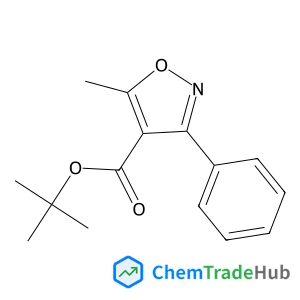
2-Methyl-2-propanyl 5-methyl-3-phenyl-1,2-oxazole-4-carboxylate
CAS Number:
211429-79-7
Molecular Formula:
C15H17NO3
Ying Yang, Yang Ren, Chengjun Sun, Shijie Hao
Novel nickel based mesoporous carbons are firstly in situ fabricated via pyrolysis of CTAB-chitosan-nickel supramolecular aggregates, which are pre-constructed by CTAB-directed self-assembly of 8-quinolinol modified chitosan and nickel acetate under basic conditions. This facile route fabrication method renders smart and homogeneously dispersed Ni nanoparticles (NPs) on the mesoporous carbonaceous framework without using any stabilizer and additional reductant, verified by high-energy X-ray diffraction, TEM, X-ray absorption fine structure, N2 adsorption/desorption and Raman spectroscopy. Moreover, it is found that the morphology of Ni NPs, the textural property of carbonaceous supports, and the corresponding catalytic performance towards 4-nitrophenol reduction vary with the pyrolysis temperature. It is suggested that the nickel based mesoporous carbon pyrolyzed at 750 °C (Ni/MC-750) simultaneously possessing uniform spherical Ni NPs (24.5 nm) and bottle-neck mesopores exhibits the largest activity factor of 20.9 s−1 g−1 of any nickel catalysts.
Zhong-hua Cui, Abhinav Gupta, Miklos Kertesz
DOI: 10.1039/C5CP03759J
Naoko Kono, Takeshi Furukawa, Hajime Tanuma, Jun Matsumoto, Haruo Shiromaru, Toshiyuki Azuma, Kaveh Najafian, Maria Susanne Pettersson, Bertil Dynefors, Klavs Hansen
DOI: 10.1039/C5CP02549D
Nikita L. La Cruz, Danna Qasim, Heather Abbott-Lyon, Claire Pirim, Aaron D. McKee, Thomas Orlando, Maheen Gull, Danny Lindsay, Matthew A. Pasek
DOI: 10.1039/C6CP00836D
Binghui Ge, Qing Jie, Udara Saparamadu, Weishu Liu, Zhifeng Ren
DOI: 10.1039/C6CP03944H
Chong Qiao, Aihua Wang, Jinping Zhang, Songyou Wang, Wan-Sheng Su, Yu Jia
DOI: 10.1039/C6CP03655D
Jerzy Gorecki, Joanna N. Gorecka, Hiroshi Ueno, Kenichi Yoshikawa
DOI: 10.1039/C6CP03860C
Inmaculada García Cuesta, Barnaby Pownall, Stefano Pelloni, Alfredo M. Sánchez de Merás
DOI: 10.1039/C5CP03732H
Demian Marchione, Martin R. S. McCoustra
DOI: 10.1039/C6CP01787H
Arkamita Bandyopadhyay
DOI: 10.1039/C6CP03181A
Marat A. Ziganshin, Nadezhda S. Gubina, Alexander V. Gerasimov, Valery V. Gorbatchuk, Sufia A. Ziganshina, Anton P. Chuklanov, Anastas A. Bukharaev
DOI: 10.1039/C5CP03309H
When handling 4-Methyl-6-(trifluoromethyl)quinoline (CAS: 40716-16-3), safety go...
4-(3,5-Difluorophenyl)aniline is an aromatic organic compound with the CAS numbe...
5-{[4-(Trifluoromethyl)phenyl]sulfanyl}-1,2,3-thiadiazole-4-carboxylic acid can ...
The market for 4-Benzylaniline hydrochloride (CAS: 6317-57-3) is steadily growin...
[3-(Diethylsulfamoyl)phenyl]boronic acid is generally considered safe when handl...
3-Bromo-2,5-dimethoxyaniline is mainly used in the pharmaceutical and chemical i...
N-Methyl-1-(5-methyl-1H-indol-3-yl)methanamine (CAS: 915922-67-7) is subject to ...
This compound is primarily used in the pharmaceutical industry for the synthesis...
2-Methyl-2-propanyl [(1S,3R)-3-aminocyclohexyl]carbamate (CAS: 1298101-47-9) sho...
Ethyl 2-bromo-4,4,4-trifluorobutanoate (CAS: 367-33-9) is utilized in the pharma...

Green Chemistry provides a unique forum for the publication of innovative research on the development of alternative green and sustainable technologies. The scope of Green Chemistry is based on, but not limited to, the definition proposed by Anastas and Warner (Green Chemistry: Theory and Practice, P T Anastas and J C Warner, Oxford University Press, Oxford, 1998). Green chemistry is the utilisation of a set of principles that reduces or eliminates the use or generation of hazardous substances in the design, manufacture and application of chemical products. Green Chemistry is at the frontiers of this continuously-evolving interdisciplinary science and publishes research that attempts to reduce the environmental impact of the chemical enterprise by developing a technology base that is inherently non-toxic to living things and the environment. Submissions on all aspects of research relating to the endeavour are welcome. The journal publishes original and significant cutting-edge research that is likely to be of wide general appeal. To be published, work must present a significant advance in green chemistry. Papers must contain a comparison with existing methods and demonstrate advantages over those methods before publication can be considered. For more information please see this Editorial. Coverage includes the following, but is not limited to: Design (e.g. biomimicry, design for degradation/recycling/reduced toxicity…) Reagents & Feedstocks (e.g. renewables, CO2, solvents, auxiliary agents, waste utilization…) Synthesis (e.g. organic, inorganic, synthetic biology…) Catalysis (e.g. homogeneous, heterogeneous, enzyme, whole cell…) Process (e.g. process design, intensification, separations, recycling, efficiency…) Energy (e.g. renewable energy, fuels, photovoltaics, fuel cells, energy storage, energy carriers…) Applications (e.g. electronics, dyes, consumer products, coatings, pharmaceuticals, preservatives, building materials, chemicals for industry/agriculture/mining…) Impact (e.g. safety, metrics, LCA, sustainability, (eco)toxicology…) Green chemistry is, by definition, a continuously-evolving frontier. Therefore, the inclusion of a particular material or technology does not, of itself, guarantee that a paper is suitable for the journal. To be suitable, the novel advance should have the potential for reduced environmental impact relative to the state of the art. Green Chemistry does not normally deal with research associated with 'end-of-pipe' or remediation issues.
![[3-(2,6-Dichlorophenyl)-5-isopropyl-1,2-oxazol-4-yl]methanol structure](https://static.chemtradehub.com/structs/278/278597-30-1-5c79.webp "[3-(2,6-Dichlorophenyl)-5-isopropyl-1,2-oxazol-4-yl]methanol structure")