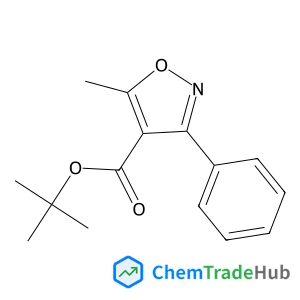
2-Methyl-2-propanyl 5-methyl-3-phenyl-1,2-oxazole-4-carboxylate
CAS Number:
211429-79-7
Molecular Formula:
C15H17NO3
Mohd Azri Ab Rani, Nadine Borduas, Victoria Colquhoun, Robert Hanley, Henry Johnson, Solène Larger, Paul D. Lickiss, Veronica Llopis-Mestre, Selina Luu, Martin Mogstad, Philipp Oczipka, James R. Sherwood, Tom Welton, Jun-Yi Xing
The potential use of volatile methylsiloxanes (VMSs) as solvents for chemicals synthesis has been explored. Assessment of the environmental impact of these VMS solvents is made and found to be significantly lower than those of the non-polar organic solvents that they have the potential to replace. The polarities of the VMSs, as expressed by empirical polarity measurements, and miscibilities with other liquids are found to be similar to those of alkane solvents. Finally, some uses of VMSs as solvents for both organic and inorganic transformations are described. The VMSs provide environmentally more sustainable (greener) alternatives to the nonpolar solvents that they have the potential to replace.
L. Vereecken, W. J. Bloss
DOI: 10.1039/C5CP03862F
Patrick Kölle, Igor Pugliesi, Heinz Langhals, Roland Wilcken, Andreas J. Esterbauer, Regina de Vivie-Riedle, Eberhard Riedle
DOI: 10.1039/C5CP02981C
J. H. K. Pfisterer, P. S. Deimel, R. G. Acres, M. Fritton, P. Feulner, J. V. Barth, F. Allegretti
DOI: 10.1039/C6CP02541B
A. Zaharia, F.-X. Perrin, M. Teodorescu, A.-L. Radu, T.-V. Iordache, A.-M. Florea, D. Donescu, A. Sarbu
DOI: 10.1039/C5CP04395F
Mercè Deumal
DOI: 10.1039/C6CP02699K
Rafał Orłowski, Marzena Banasiewicz, Guillaume Clermont, Frédéric Castet, Rashid Nazir, Mireille Blanchard-Desce, Daniel T. Gryko
DOI: 10.1039/C5CP03523F
Ross H. McKenzie
DOI: 10.1039/C5CP02239H
Bertrand Siboulet, Jean-François Dufrêche
DOI: 10.1039/C5CP03818A
Christoph Kerzig, Martin Goez
DOI: 10.1039/C6CP03742A
Camila S. Monteiro, Daniele C. Ferreira, Gustavo A. M. Sáfar, Rafael N. Gontijo, Cristiano Fantini, Dayse C. S. Martins, Ynara M. Idemori, Maurício V. B. Pinheiro, Klaus Krambrock
DOI: 10.1039/C6CP03366K
When handling 4-Methyl-6-(trifluoromethyl)quinoline (CAS: 40716-16-3), safety go...
4-(3,5-Difluorophenyl)aniline is an aromatic organic compound with the CAS numbe...
5-{[4-(Trifluoromethyl)phenyl]sulfanyl}-1,2,3-thiadiazole-4-carboxylic acid can ...
The market for 4-Benzylaniline hydrochloride (CAS: 6317-57-3) is steadily growin...
[3-(Diethylsulfamoyl)phenyl]boronic acid is generally considered safe when handl...
3-Bromo-2,5-dimethoxyaniline is mainly used in the pharmaceutical and chemical i...
N-Methyl-1-(5-methyl-1H-indol-3-yl)methanamine (CAS: 915922-67-7) is subject to ...
This compound is primarily used in the pharmaceutical industry for the synthesis...
2-Methyl-2-propanyl [(1S,3R)-3-aminocyclohexyl]carbamate (CAS: 1298101-47-9) sho...
Ethyl 2-bromo-4,4,4-trifluorobutanoate (CAS: 367-33-9) is utilized in the pharma...

Green Chemistry provides a unique forum for the publication of innovative research on the development of alternative green and sustainable technologies. The scope of Green Chemistry is based on, but not limited to, the definition proposed by Anastas and Warner (Green Chemistry: Theory and Practice, P T Anastas and J C Warner, Oxford University Press, Oxford, 1998). Green chemistry is the utilisation of a set of principles that reduces or eliminates the use or generation of hazardous substances in the design, manufacture and application of chemical products. Green Chemistry is at the frontiers of this continuously-evolving interdisciplinary science and publishes research that attempts to reduce the environmental impact of the chemical enterprise by developing a technology base that is inherently non-toxic to living things and the environment. Submissions on all aspects of research relating to the endeavour are welcome. The journal publishes original and significant cutting-edge research that is likely to be of wide general appeal. To be published, work must present a significant advance in green chemistry. Papers must contain a comparison with existing methods and demonstrate advantages over those methods before publication can be considered. For more information please see this Editorial. Coverage includes the following, but is not limited to: Design (e.g. biomimicry, design for degradation/recycling/reduced toxicity…) Reagents & Feedstocks (e.g. renewables, CO2, solvents, auxiliary agents, waste utilization…) Synthesis (e.g. organic, inorganic, synthetic biology…) Catalysis (e.g. homogeneous, heterogeneous, enzyme, whole cell…) Process (e.g. process design, intensification, separations, recycling, efficiency…) Energy (e.g. renewable energy, fuels, photovoltaics, fuel cells, energy storage, energy carriers…) Applications (e.g. electronics, dyes, consumer products, coatings, pharmaceuticals, preservatives, building materials, chemicals for industry/agriculture/mining…) Impact (e.g. safety, metrics, LCA, sustainability, (eco)toxicology…) Green chemistry is, by definition, a continuously-evolving frontier. Therefore, the inclusion of a particular material or technology does not, of itself, guarantee that a paper is suitable for the journal. To be suitable, the novel advance should have the potential for reduced environmental impact relative to the state of the art. Green Chemistry does not normally deal with research associated with 'end-of-pipe' or remediation issues.