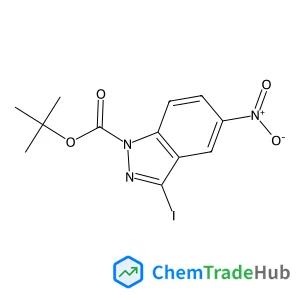
Tert-butyl 3-iodo-5-nitro-1H-indazole-1-carboxylate
CAS Number:
459133-69-8
Molecular Formula:
C12H12IN3O4
Krzysztof Skowerski, Jacek Białecki, Andrzej Tracz, Tomasz K. Olszewski
A range of environmentally conservative solvents was evaluated for application in olefin metathesis. Different commercially available and most frequently applied ruthenium catalysts were employed. The data obtained can be used as a guide to facilitate replacement of environmentally detrimental chlorinated or aromatic solvents with greener reaction media in order to make applications of olefin metathesis in both industry and academia more environmentally benign and sustainable processes.
Samira Abbasi-Moayed, Hamed Golmohammadi, Arafeh Bigdeli
DOI: 10.1039/C8AN00637G
Jeremy A. Nowak, Robert J. Weber
DOI: 10.1039/C9AN90049G
Saurav Kayal, Mintu Halder
DOI: 10.1039/C9AN00516A
Pengfei Zhang, Zhixuan Huang, Yiwen Ma, Yang Li, Naqash Ali, Qifeng Li, Da Chen
DOI: 10.1039/C9AN00050J
Xiaoyan Hu, Xinru Wang, Zipan Ge, Le Zhang, Yaru Zhou, Jingya Li, Linfeng Bu, Hengan Wu, Pan Li
DOI: 10.1039/C9AN00251K
Sonia Freddi, Giovanni Drera, Stefania Pagliara, Andrea Goldoni, Luigi Sangaletti
DOI: 10.1039/C9AN00551J
Tianjiao Huang, Richard Lee, Dawn S. Hui, James L. Edwards
DOI: 10.1039/C8AN00490K
Varnika Prakash, Raul D. Rodriguez, Ammar Al-Hamry, Anna Lipovka, Elena Dorozhko, Oleksandr Selyshchev, Bing Ma, Shweta Sharma, Surinder K. Mehta, Ashutosh Mukherjee, Dietrich R. T. Zahn, Olfa Kanoun, Evgeniya Sheremet
DOI: 10.1039/C8AN02495B
Hamdi Joda, Geoffrey Stone, Sylvia Daunert, Sapna Deo
DOI: 10.1039/C8AN00047F
N-(4-Methoxybenzyl)-2-pyridinamine (CAS: 52818-63-0) is increasingly being used ...
When handling Ethyl 4-(2-chlorophenyl)-1,3-thiazole-2-carboxylate, appropriate p...
Diethyldiselane (CAS: 628-39-7) is classified under the Globally Harmonized Syst...
The market for oxocopper (CAS: 12053-18-8) is primarily driven by its use in cat...
The market for 5-{[(2-Methyl-2-propanyl)oxy]carbonyl}-5-azaspiro[2.4]heptane-7-c...
2-(1-Pyrrolidinyl)-4-pyridinamine is a chemical compound with the CAS number 359...
2-(3-Pyridinyl)-1-azabicyclo[2.2.2]octane (CAS: 91556-75-1) is a crystalline sol...
(S)-Alpha-allyl-proline hydrochloride is usually synthesized via a Wittig reacti...
3-Methyl-1,2-oxazole-5-carboxylic acid (CAS: 4857-42-5) is an organic compound w...
Lys-SMCC-DM1 is synthesized via a multi-step process involving the coupling of S...

Green Chemistry provides a unique forum for the publication of innovative research on the development of alternative green and sustainable technologies. The scope of Green Chemistry is based on, but not limited to, the definition proposed by Anastas and Warner (Green Chemistry: Theory and Practice, P T Anastas and J C Warner, Oxford University Press, Oxford, 1998). Green chemistry is the utilisation of a set of principles that reduces or eliminates the use or generation of hazardous substances in the design, manufacture and application of chemical products. Green Chemistry is at the frontiers of this continuously-evolving interdisciplinary science and publishes research that attempts to reduce the environmental impact of the chemical enterprise by developing a technology base that is inherently non-toxic to living things and the environment. Submissions on all aspects of research relating to the endeavour are welcome. The journal publishes original and significant cutting-edge research that is likely to be of wide general appeal. To be published, work must present a significant advance in green chemistry. Papers must contain a comparison with existing methods and demonstrate advantages over those methods before publication can be considered. For more information please see this Editorial. Coverage includes the following, but is not limited to: Design (e.g. biomimicry, design for degradation/recycling/reduced toxicity…) Reagents & Feedstocks (e.g. renewables, CO2, solvents, auxiliary agents, waste utilization…) Synthesis (e.g. organic, inorganic, synthetic biology…) Catalysis (e.g. homogeneous, heterogeneous, enzyme, whole cell…) Process (e.g. process design, intensification, separations, recycling, efficiency…) Energy (e.g. renewable energy, fuels, photovoltaics, fuel cells, energy storage, energy carriers…) Applications (e.g. electronics, dyes, consumer products, coatings, pharmaceuticals, preservatives, building materials, chemicals for industry/agriculture/mining…) Impact (e.g. safety, metrics, LCA, sustainability, (eco)toxicology…) Green chemistry is, by definition, a continuously-evolving frontier. Therefore, the inclusion of a particular material or technology does not, of itself, guarantee that a paper is suitable for the journal. To be suitable, the novel advance should have the potential for reduced environmental impact relative to the state of the art. Green Chemistry does not normally deal with research associated with 'end-of-pipe' or remediation issues.
![Imidazo[1,2-c]pyrimidine structure](https://static.chemtradehub.com/structs/274/274-78-2-8b4c.webp "Imidazo[1,2-c]pyrimidine structure")
![N-{3-[Benzyl(methyl)amino]propyl}-9-chloro-5,6,7,8-tetrahydro-2-acridinecarboxamide structure](https://static.chemtradehub.com/structs/142/1426944-49-1-1e4c.webp "N-{3-[Benzyl(methyl)amino]propyl}-9-chloro-5,6,7,8-tetrahydro-2-acridinecarboxamide structure")
![6-Bromo-3-ethyl-3H-imidazo[4,5-b]pyridine structure](https://static.chemtradehub.com/structs/103/1033202-59-3-2a8f.webp "6-Bromo-3-ethyl-3H-imidazo[4,5-b]pyridine structure")