












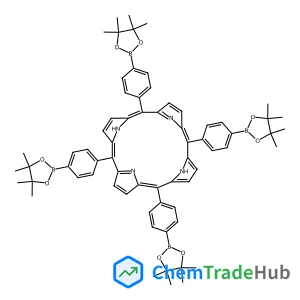
5,10,15,20-tetrakis(4-boronic acid pinacol ester phenyl) porphyrin
CAS Number:
1332748-00-1
Molecular Formula:
C68H74B4N4O8
Zillillah, Toh Ann Ngu, Zhi Li
A novel, active, and recyclable magnetic nano-size solid acid catalyst was developed for the high-yielding transformation of waste grease to biodiesel (fatty acid methyl esters, FAMEs) via simultaneous esterification of free fatty acids (FFAs) and transesterification of triglycerides with methanol in one pot. The core–shell structured magnetic nanoparticles (MNPs) HPW–PGMA–MNPs consist of iron oxide MNPs as the core, poly(glycidyl methacrylate) (PGMA) as the shell, and phosphotungstic acid (HPW) as the surface acid group. They were conveniently prepared in a 93% yield from PGMA–MNPs via phosphonation with Na2HPO4 and subsequent treatment with Na2WO4·2H2O under acidic conditions, allowing for in situ formation of HPW on the particle surface with a high acidity of 1.13 mmol g−1 and a particle size of 90 nm. The catalyst was fully characterized by EDX, FT-IR, FESEM, TEM, and VSM. It demonstrated a much better catalytic performance for the transesterification of triacetin and for the one-pot transformation of grease to biodiesel than commercially available solid acid catalysts such as Amberlyst 15, Purolite CT-275, and zeolite. One-pot transformation of grease (21.3 wt% FFAs) with methanol using HPW–PGMA–MNPs (4 wt%) gave a 98% FAME yield after 24 h, with 96% conversion for the esterification and >98% conversion for the transesterification. HPW–PGMA–MNPs were easily separated from the reaction mixture under a magnetic field and efficiently reused for further cycles of transformation, retaining 95% productivity in the 10th reaction cycle. Thus, the developed magnetic nano-size solid acid catalyst is potentially useful for the green and economic production of biodiesel from waste grease.
Jerzy Gorecki, Joanna N. Gorecka, Hiroshi Ueno, Kenichi Yoshikawa
DOI: 10.1039/C6CP03860C
Niloy Kundu, Debasis Banik, Arpita Roy, Jagannath Kuchlyan, Nilmoni Sarkar
DOI: 10.1039/C5CP03906A
Viktoriya Poterya, Dana Nachtigallová, Jozef Lengyel, Michal Fárník
DOI: 10.1039/C5CP04485E
Shahin Sowlati-Hashjin, Stacey D. Wetmore
DOI: 10.1039/C5CP04250J
Niranjan V. Ilawe, Alexandra E. Raeber, Reinhard Schweitzer-Stenner, Siobhan E. Toal, Bryan M. Wong
DOI: 10.1039/C5CP03646A
David Eisenberg, Wowa Stroek, Norbert J. Geels, Stefania Tanase, Marilena Ferbinteanu, Simon J. Teat, Pierre Mettraux, Ning Yan, Gadi Rothenberg
DOI: 10.1039/C6CP04132A
Sherdil Khan, Maximiliano J. M. Zapata, Marcelo B. Pereira, Renato V. Gonçalves, Lukas Strizik, Jairton Dupont, Marcos J. L. Santos, Sérgio R. Teixeira
DOI: 10.1039/C5CP03645C
Binghui Ge, Qing Jie, Udara Saparamadu, Weishu Liu, Zhifeng Ren
DOI: 10.1039/C6CP03944H
Duccio Fanelli, Stefano Angioletti-Uberti
DOI: 10.1039/C6CP01179A
L. Chaal, V. Vivier, B. Tribollet, J. Gamby
DOI: 10.1039/C6CP03042D
When handling 4-Methyl-6-(trifluoromethyl)quinoline (CAS: 40716-16-3), safety go...
4-(3,5-Difluorophenyl)aniline is an aromatic organic compound with the CAS numbe...
5-{[4-(Trifluoromethyl)phenyl]sulfanyl}-1,2,3-thiadiazole-4-carboxylic acid can ...
The market for 4-Benzylaniline hydrochloride (CAS: 6317-57-3) is steadily growin...
[3-(Diethylsulfamoyl)phenyl]boronic acid is generally considered safe when handl...
3-Bromo-2,5-dimethoxyaniline is mainly used in the pharmaceutical and chemical i...
N-Methyl-1-(5-methyl-1H-indol-3-yl)methanamine (CAS: 915922-67-7) is subject to ...
This compound is primarily used in the pharmaceutical industry for the synthesis...
2-Methyl-2-propanyl [(1S,3R)-3-aminocyclohexyl]carbamate (CAS: 1298101-47-9) sho...
Ethyl 2-bromo-4,4,4-trifluorobutanoate (CAS: 367-33-9) is utilized in the pharma...

Green Chemistry provides a unique forum for the publication of innovative research on the development of alternative green and sustainable technologies. The scope of Green Chemistry is based on, but not limited to, the definition proposed by Anastas and Warner (Green Chemistry: Theory and Practice, P T Anastas and J C Warner, Oxford University Press, Oxford, 1998). Green chemistry is the utilisation of a set of principles that reduces or eliminates the use or generation of hazardous substances in the design, manufacture and application of chemical products. Green Chemistry is at the frontiers of this continuously-evolving interdisciplinary science and publishes research that attempts to reduce the environmental impact of the chemical enterprise by developing a technology base that is inherently non-toxic to living things and the environment. Submissions on all aspects of research relating to the endeavour are welcome. The journal publishes original and significant cutting-edge research that is likely to be of wide general appeal. To be published, work must present a significant advance in green chemistry. Papers must contain a comparison with existing methods and demonstrate advantages over those methods before publication can be considered. For more information please see this Editorial. Coverage includes the following, but is not limited to: Design (e.g. biomimicry, design for degradation/recycling/reduced toxicity…) Reagents & Feedstocks (e.g. renewables, CO2, solvents, auxiliary agents, waste utilization…) Synthesis (e.g. organic, inorganic, synthetic biology…) Catalysis (e.g. homogeneous, heterogeneous, enzyme, whole cell…) Process (e.g. process design, intensification, separations, recycling, efficiency…) Energy (e.g. renewable energy, fuels, photovoltaics, fuel cells, energy storage, energy carriers…) Applications (e.g. electronics, dyes, consumer products, coatings, pharmaceuticals, preservatives, building materials, chemicals for industry/agriculture/mining…) Impact (e.g. safety, metrics, LCA, sustainability, (eco)toxicology…) Green chemistry is, by definition, a continuously-evolving frontier. Therefore, the inclusion of a particular material or technology does not, of itself, guarantee that a paper is suitable for the journal. To be suitable, the novel advance should have the potential for reduced environmental impact relative to the state of the art. Green Chemistry does not normally deal with research associated with 'end-of-pipe' or remediation issues.
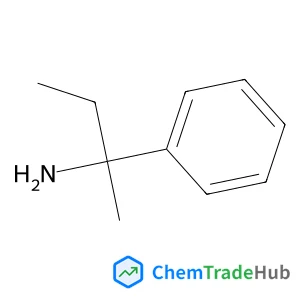
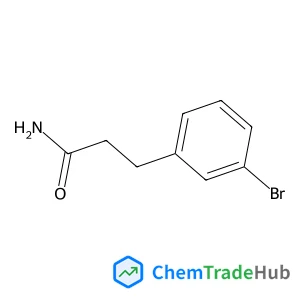
![6-Bromo-3-ethyl-3H-imidazo[4,5-b]pyridine structure](https://static.chemtradehub.com/structs/103/1033202-59-3-2a8f.webp "6-Bromo-3-ethyl-3H-imidazo[4,5-b]pyridine structure")
![N-{3-[Benzyl(methyl)amino]propyl}-9-chloro-5,6,7,8-tetrahydro-2-acridinecarboxamide structure](https://static.chemtradehub.com/structs/142/1426944-49-1-1e4c.webp "N-{3-[Benzyl(methyl)amino]propyl}-9-chloro-5,6,7,8-tetrahydro-2-acridinecarboxamide structure")




