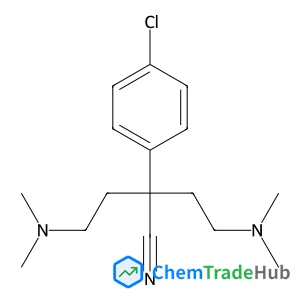
2-(4-Chlorophenyl)-4-(dimethylamino)-2-(2-(dimethylamino)ethyl)butanenitrile
CAS Number:
1246816-57-8
Molecular Formula:
C16H24ClN3
Rahul A. Watile, Srijit Biswas, Joseph S. M. Samec
A highly efficient one-step copper(I)-catalyzed method for the synthesis of α-sulfenylated carbonyl compounds from propargylic alcohols and aryl thiols in aqueous media is described. A variety of α-sulfenylated carbonyl compounds can be synthesized in good to excellent yields. The catalyst has been successfully recycled up to 4 times without any loss of activity in an aqueous medium.
Xiaomei Liu, Shuang Liu, Gaolin Liang
DOI: 10.1039/C6AN00110F
Thaddeus Mostowtt, Jonathan Munoz, Bruce McCord
DOI: 10.1039/C9AN01309A
Cunyu Yan, Jason W. Schmidberger, Fabio Parmeggiani, Shaneela A. Hussain, Nicholas J. Turner, Sabine L. Flitsch, Perdita Barran
DOI: 10.1039/C6AN00617E
Datong Wu, Fei Pan, Gao-Chao Fan, Ziming Zhu, Li Gao, Yongxin Tao, Yong Kong
DOI: 10.1039/C9AN01692A
Zoe M. Smith, Emily Kerr, Egan H. Doeven, Neil W. Barnett, Paul S. Donnelly, Stephen J. Haswell, Paul S. Francis
DOI: 10.1039/C6AN00141F
Pei Liang, Caiyan Kang, Enjian Yang, Xiaoxiao Ge, Dan Du, Yuehe Lin
DOI: 10.1039/C5AN02656C
Pengxiang Wang, Luyan Wang, Mei Ding, Meishan Pei, Wenjuan Guo
DOI: 10.1039/C9AN01288E
Eduardo Paredes, Claude Vidaud, Emilie Avazeri, Anthony Nonell, Hélène Isnard, Frédéric Chartier, Carole Bresson
DOI: 10.1039/C9AN01081E
Magdalena Matczuk, Joanna Legat, Andrei R. Timerbaev, Maciej Jarosz
DOI: 10.1039/C6AN00276E
Ting-Hang Liu, Shu-Shen Cheng, Huey-Ling You, Mel S. Lee
DOI: 10.1039/C9AN90087J
When handling 4-(2-Furylmethyl)thiomorpholine 1,1-dioxide (CAS: 79206-94-3), it ...
When handling 4-Chloro-N-[2-(4-morpholinyl)ethyl]benzamide (CAS: 71320-77-9), it...
Waste containing this compound (CAS: 62921-74-8) should be handled according to ...
Waste containing (S)-Methyl 2-amino-3-cyclohexylpropanoate should be collected i...
This compound can be synthesized using a multi-step process involving the conjug...
There are several alternatives to (2E)-3-(3,4-Dichlorophenyl)acrylic acid in syn...
Ethyl 6-(2-nitrophenyl)imidazo[2,1-b][1,3]thiazole-3-carboxylate (CAS: 925437-84...
Waste containing 2-(1,3-Thiazol-2-yl)ethanamine (CAS: 18453-07-1) should be coll...
Methyl 5-iodo-2-methylbenzoate can be synthesized through the iodination of meth...
5-Chloro[1,2,4]triazolo[1,5-a]pyridine is commonly synthesized via the condensat...

Green Chemistry provides a unique forum for the publication of innovative research on the development of alternative green and sustainable technologies. The scope of Green Chemistry is based on, but not limited to, the definition proposed by Anastas and Warner (Green Chemistry: Theory and Practice, P T Anastas and J C Warner, Oxford University Press, Oxford, 1998). Green chemistry is the utilisation of a set of principles that reduces or eliminates the use or generation of hazardous substances in the design, manufacture and application of chemical products. Green Chemistry is at the frontiers of this continuously-evolving interdisciplinary science and publishes research that attempts to reduce the environmental impact of the chemical enterprise by developing a technology base that is inherently non-toxic to living things and the environment. Submissions on all aspects of research relating to the endeavour are welcome. The journal publishes original and significant cutting-edge research that is likely to be of wide general appeal. To be published, work must present a significant advance in green chemistry. Papers must contain a comparison with existing methods and demonstrate advantages over those methods before publication can be considered. For more information please see this Editorial. Coverage includes the following, but is not limited to: Design (e.g. biomimicry, design for degradation/recycling/reduced toxicity…) Reagents & Feedstocks (e.g. renewables, CO2, solvents, auxiliary agents, waste utilization…) Synthesis (e.g. organic, inorganic, synthetic biology…) Catalysis (e.g. homogeneous, heterogeneous, enzyme, whole cell…) Process (e.g. process design, intensification, separations, recycling, efficiency…) Energy (e.g. renewable energy, fuels, photovoltaics, fuel cells, energy storage, energy carriers…) Applications (e.g. electronics, dyes, consumer products, coatings, pharmaceuticals, preservatives, building materials, chemicals for industry/agriculture/mining…) Impact (e.g. safety, metrics, LCA, sustainability, (eco)toxicology…) Green chemistry is, by definition, a continuously-evolving frontier. Therefore, the inclusion of a particular material or technology does not, of itself, guarantee that a paper is suitable for the journal. To be suitable, the novel advance should have the potential for reduced environmental impact relative to the state of the art. Green Chemistry does not normally deal with research associated with 'end-of-pipe' or remediation issues.
![5-Methyl-4,5,6,7-tetrahydropyrazolo[1,5-a]pyrazin-2-amine structure](https://static.chemtradehub.com/structs/122/1227210-33-4-8d64.webp "5-Methyl-4,5,6,7-tetrahydropyrazolo[1,5-a]pyrazin-2-amine structure")