


Photocatalysis on supported gold and silver nanoparticles under ultraviolet and visible light irradiation
Literature Information
Publication Date
2013-05-10
DOI
10.1039/C3GC40450A
Impact Factor
10.182
Authors
Sarina Sarina, Eric R. Waclawik, Huaiyong Zhu
View Original
Abstract
Studies of the optical properties and catalytic capabilities of noble metal nanoparticles (NPs), such as gold (Au) and silver (Ag), have formed the basis for the very recent fast expansion of the field of green photocatalysis: photocatalysis utilizing visible and ultraviolet light, a major part of the solar spectrum. The reason for this growth is the recognition that the localised surface plasmon resonance (LSPR) effect of Au NPs and Ag NPs can couple the light flux to the conduction electrons of metal NPs, and the excited electrons and enhanced electric fields in close proximity to the NPs can contribute to converting the solar energy to chemical energy by photon-driven photocatalytic reactions. Previously the LSPR effect of noble metal NPs was utilized almost exclusively to improve the performance of semiconductor photocatalysts (for example, TiO2 and Ag halides), but recently, a conceptual breakthrough was made: studies on light driven reactions catalysed by NPs of Au or Ag on photocatalytically inactive supports (insulating solids with a very wide band gap) have demonstrated that these materials are a class of efficient photocatalysts working by mechanisms distinct from those of semiconducting photocatalysts. There are several reasons for the significant photocatalytic activity of Au and Ag NPs. (1) The conduction electrons of the particles gain the irradiation energy, resulting in high energy electrons at the NP surface which is desirable for activating molecules on the particles for chemical reactions. (2) In such a photocatalysis system, both light harvesting and the catalysing reaction take place on the nanoparticle, and so charge transfer between the NPs and support is not a prerequisite. (3) The density of the conduction electrons at the NP surface is much higher than that at the surface of any semiconductor, and these electrons can drive the reactions on the catalysts. (4) The metal NPs have much better affinity than semiconductors to many reactants, especially organic molecules. Recent progress in photocatalysis using Au and Ag NPs on insulator supports is reviewed. We focus on the mechanism differences between insulator and semiconductor-supported Au and Ag NPs when applied in photocatalytic processes, and the influence of important factors, light intensity and wavelength, in particular estimations of light irradiation contribution, by calculating the apparent activation energies of photo reactions and thermal reactions.
Recommended Journals

Critical Reviews in Solid State and Materials Sciences

Bioorganic & Medicinal Chemistry Letters

Bioorganic & Medicinal Chemistry

Journal of Chemical Sciences

Journal of the Indian Institute of Science

Electroanalysis

Journal of Asian Natural Products Research

Cellulose

NDT & E International

Biocatalysis and Biotransformation
Related Literature
Group 9 [Cp*MIII] complex-catalyzed C–H olefination of arenes in water at room temperature: a study on the catalytic activity
Hailong Zhang, Zhongzhen Yang, Jinxing Liu, Xinling Yu, Qiantao Wang, Yong Wu
2019-02-12
Research Article
DOI: 10.1039/C8QO01407H
The impact of interplay between electronic and steric effects on the synthesis and the linear and non-linear optical properties of diketopyrrolopyrrole bearing benzofuran moieties
Anna Purc, Beata Koszarna, Irina Iachina, Daniel H. Friese, Mariusz Tasior, Krzysztof Sobczyk, Tomasz Pędziński, Jonathan Brewer, Daniel T. Gryko
2017-02-07
Research Article
DOI: 10.1039/C6QO00869K
Three-component bis-heterocycliation for synthesis of 2-aminobenzo[4,5]thieno[3,2-d]thiazoles
Huawen Huang, Zhonghua Qu, Xiaochen Ji, Guo-Jun Deng
2019-02-26
Research Article
DOI: 10.1039/C8QO01365A
Silver-catalyzed geminal aminofluorination of diazoketones with anilines and N-fluorobenzenesulphonimide
Jun Huang, Linyong Li, Haoguo Chen, Tiebo Xiao, Yuwei He, Lei Zhou
2017-01-12
Research Article
DOI: 10.1039/C6QO00813E
Copper and silver benzoate and aryl complexes and their implications for oxidative decarboxylative coupling reactions
Andreas Baur, Katelyn A. Bustin, Ellen Aguilera, Jeffrey L. Petersen, Jessica M. Hoover
2017-01-04
Research Article
DOI: 10.1039/C6QO00678G
A general synthesis of unnatural α-amino acids by iron-catalysed olefin–olefin coupling via generated radicals
Nadezhda V. Stoletova, Vladislav I. Kovalev, Tat'yana F. Savel'yeva, Victor I. Maleev
2019-02-18
Research Article
DOI: 10.1039/C9QO00108E
Dimerization of substituted 4-aryl-1,3-diacetylenes – quantum chemical calculations and kinetic studies
Alexandra Janiszewski, Jonas Fax, Gebhard Haberhauer
2019-02-26
Research Article
DOI: 10.1039/C9QO00119K
Mechanistic studies for dirhodium-catalyzed chemoselective oxidative amination of alkynyl-tethered sulfamates
Dong Pan, Yin Wei
2019-02-19
Research Article
DOI: 10.1039/C9QO00050J
You might also like
Compound Q&A
What precautions should be taken when handling 4-Methyl-6-(trifluoromethyl)quinoline (CAS: 40716-16-3)?
When handling 4-Methyl-6-(trifluoromethyl)quinoline (CAS: 40716-16-3), safety go...
40716-16-34-Methyl-6-(trifluor...
Compound Q&A
What is 4-(3,5-Difluorophenyl)aniline (CAS: 405058-00-6)?
4-(3,5-Difluorophenyl)aniline is an aromatic organic compound with the CAS numbe...
405058-00-64-(3,5-Difluoropheny...
Compound Q&A
How is 5-{[4-(Trifluoromethyl)phenyl]sulfanyl}-1,2,3-thiadiazole-4-carboxylic acid (CAS: 338982-07-3) typically synthesized?
5-{[4-(Trifluoromethyl)phenyl]sulfanyl}-1,2,3-thiadiazole-4-carboxylic acid can ...
338982-07-35-{[4-(Trifluorometh...
Compound Q&A
What is the market or research trend for 4-Benzylaniline hydrochloride (CAS: 6317-57-3)?
The market for 4-Benzylaniline hydrochloride (CAS: 6317-57-3) is steadily growin...
6317-57-34-Benzylaniline hydr...
Compound Q&A
Is [3-(Diethylsulfamoyl)phenyl]boronic acid (CAS: 871329-58-7) safe?
[3-(Diethylsulfamoyl)phenyl]boronic acid is generally considered safe when handl...
871329-58-7[3-(Diethylsulfamoyl...
Compound Q&A
What are the main uses of 3-Bromo-2,5-dimethoxyaniline (CAS: 115929-62-9)?
3-Bromo-2,5-dimethoxyaniline is mainly used in the pharmaceutical and chemical i...
115929-62-93-Bromo-2,5-dimethox...
Compound Q&A
What regulatory guidelines apply to N-Methyl-1-(5-methyl-1H-indol-3-yl)methanamine (CAS: 915922-67-7)?
N-Methyl-1-(5-methyl-1H-indol-3-yl)methanamine (CAS: 915922-67-7) is subject to ...
915922-67-7N-Methyl-1-(5-methyl...
Compound Q&A
What industries use Carbamic acid, N-[(5S)-5,6-diamino-6-oxohexyl]-, 1,1-dimethylethyl ester (CAS: 24828-96-4)?
This compound is primarily used in the pharmaceutical industry for the synthesis...
24828-96-4Carbamic acid, N-[(5...
Compound Q&A
How should 2-Methyl-2-propanyl [(1S,3R)-3-aminocyclohexyl]carbamate (CAS: 1298101-47-9) be stored?
2-Methyl-2-propanyl [(1S,3R)-3-aminocyclohexyl]carbamate (CAS: 1298101-47-9) sho...
1298101-47-92-Methyl-2-propanyl ...
Compound Q&A
What industries use Ethyl 2-bromo-4,4,4-trifluorobutanoate (CAS: 367-33-9)?
Ethyl 2-bromo-4,4,4-trifluorobutanoate (CAS: 367-33-9) is utilized in the pharma...
367-33-9Ethyl 2-bromo-4,4,4-...
Source Journal
Green Chemistry

CiteScore:
16.1
Self-citation Rate:
7.5%
Articles per Year:
944
Green Chemistry provides a unique forum for the publication of innovative research on the development of alternative green and sustainable technologies. The scope of Green Chemistry is based on, but not limited to, the definition proposed by Anastas and Warner (Green Chemistry: Theory and Practice, P T Anastas and J C Warner, Oxford University Press, Oxford, 1998). Green chemistry is the utilisation of a set of principles that reduces or eliminates the use or generation of hazardous substances in the design, manufacture and application of chemical products. Green Chemistry is at the frontiers of this continuously-evolving interdisciplinary science and publishes research that attempts to reduce the environmental impact of the chemical enterprise by developing a technology base that is inherently non-toxic to living things and the environment. Submissions on all aspects of research relating to the endeavour are welcome. The journal publishes original and significant cutting-edge research that is likely to be of wide general appeal. To be published, work must present a significant advance in green chemistry. Papers must contain a comparison with existing methods and demonstrate advantages over those methods before publication can be considered. For more information please see this Editorial. Coverage includes the following, but is not limited to: Design (e.g. biomimicry, design for degradation/recycling/reduced toxicity…) Reagents & Feedstocks (e.g. renewables, CO2, solvents, auxiliary agents, waste utilization…) Synthesis (e.g. organic, inorganic, synthetic biology…) Catalysis (e.g. homogeneous, heterogeneous, enzyme, whole cell…) Process (e.g. process design, intensification, separations, recycling, efficiency…) Energy (e.g. renewable energy, fuels, photovoltaics, fuel cells, energy storage, energy carriers…) Applications (e.g. electronics, dyes, consumer products, coatings, pharmaceuticals, preservatives, building materials, chemicals for industry/agriculture/mining…) Impact (e.g. safety, metrics, LCA, sustainability, (eco)toxicology…) Green chemistry is, by definition, a continuously-evolving frontier. Therefore, the inclusion of a particular material or technology does not, of itself, guarantee that a paper is suitable for the journal. To be suitable, the novel advance should have the potential for reduced environmental impact relative to the state of the art. Green Chemistry does not normally deal with research associated with 'end-of-pipe' or remediation issues.
Recommended Compounds
![2,4-Dichloro-6-isopropyl-5H-pyrrolo[3,4-d]pyrimidin-7(6H)-one structure](https://static.chemtradehub.com/structs/107/1079649-94-7-ad4a.webp "2,4-Dichloro-6-isopropyl-5H-pyrrolo[3,4-d]pyrimidin-7(6H)-one structure")
2,4-Dichloro-6-isopropyl-5H-pyrrolo[3,4-d]pyrimidin-7(6H)-one
CAS Number:
1079649-94-7
Molecular Formula:
C9H9Cl2N3O
![6,7-Dihydro-5H-pyrrolo[1,2-a]imidazole-6-carboxylic acid structure](https://static.chemtradehub.com/structs/136/1369160-12-2-6524.webp "6,7-Dihydro-5H-pyrrolo[1,2-a]imidazole-6-carboxylic acid structure")
6,7-Dihydro-5H-pyrrolo[1,2-a]imidazole-6-carboxylic acid
CAS Number:
1369160-12-2
Molecular Formula:
C7H8N2O2
![2-[(5Z,8Z,11Z,14Z)-5,8,11,14-Icosatetraen-1-yloxy]-1,3-propanediol structure](https://static.chemtradehub.com/structs/222/222723-55-9-0348.webp "2-[(5Z,8Z,11Z,14Z)-5,8,11,14-Icosatetraen-1-yloxy]-1,3-propanediol structure")
2-[(5Z,8Z,11Z,14Z)-5,8,11,14-Icosatetraen-1-yloxy]-1,3-propanediol
CAS Number:
222723-55-9
Molecular Formula:
C23H40O3
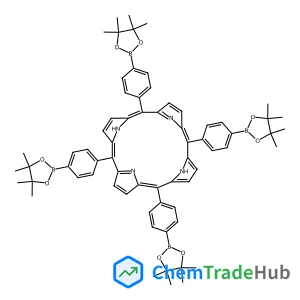
5,10,15,20-tetrakis(4-boronic acid pinacol ester phenyl) porphyrin
CAS Number:
1332748-00-1
Molecular Formula:
C68H74B4N4O8
Recommended Suppliers





Disclaimer
This page provides academic journal information for reference and research purposes only. We are not affiliated with any journal publishers and do not handle publication submissions. For publication-related inquiries, please contact the respective journal publishers directly.
If you notice any inaccuracies in the information displayed, please contact us at support@chemtradehub.com. We will promptly review and address your concerns.