












A general synthesis of unnatural α-amino acids by iron-catalysed olefin–olefin coupling via generated radicals
Literature Information
Publication Date
2019-02-18
DOI
10.1039/C9QO00108E
Impact Factor
5.281
Authors
Nadezhda V. Stoletova, Vladislav I. Kovalev, Tat'yana F. Savel'yeva, Victor I. Maleev
View Original
Abstract
Herein, we report an efficient and practical protocol for the asymmetric synthesis of unnatural α-amino acids (AAs) with γ-tertiary and quaternary carbon centres via selective intermolecular iron-catalysed olefin–olefin coupling of a chiral Ni(II) complex of dehydroalanine Schiff base 2 ((S)-BPB-Ni-Δ-Ala) with different olefins. In all successful reactions, diastereomeric nickel complexes were typically obtained in a ratio of up to dr > 20 : 1. The desired products were isolated in 42–93% yields (18 examples). Exemplarily, the three Ni(II) complexes obtained were decomposed with aqueous HCl and the target unnatural α-amino acids were isolated with excellent enantioselectivities and yields of up to 83%. The chiral auxiliary (BPB = 2-(N-benzylprolyl)aminobenzophenone) was readily recycled and reused for the synthesis of the starting chiral Ni(II) complex 2. The developed protocol provided a facile access to the analogues of glutamic acid, leucine and phosphinothricin.
Recommended Journals
Related Literature
Pressure-induced emission band separation of the hybridized local and charge transfer excited state in a TPE-based crystal
Xuedan Liu, Aisen Li, Weiqing Xu, Zhiyong Ma, Xinru Jia
2018-04-28
Paper
DOI: 10.1039/C8CP02096E
Effects of 1-hexanol on C12E10 micelles: a molecular simulations and light scattering study
Sampsa Vierros, Maria Sammalkorpi
2018-01-31
Paper
DOI: 10.1039/C7CP07511A
Influence of the hydrogen-bond interactions on the excited-state dynamics of a push–pull azobenzene dye: the case of Methyl Orange
Christoph Nançoz, Giuseppe Licari, Joseph S. Beckwith, Magnus Soederberg, Bogdan Dereka, Arnulf Rosspeintner, Oleksandr Yushchenko, Romain Letrun, Sabine Richert, Bernhard Lang, Eric Vauthey
2018-02-15
Paper
DOI: 10.1039/C7CP08390D
Room temperature chiral reorganization of interfacial assembly of achiral double-decker phthalocyanine
Xiqian Wang, Chenxi Liu, Yuying Jiang, Chiming Wang, Tianyu Wang, Ming Bai, Jianzhuang Jiang
2018-02-14
Paper
DOI: 10.1039/C7CP08647D
Performance of PELDOR, RIDME, SIFTER, and DQC in measuring distances in trityl based bi- and triradicals: exchange coupling, pseudosecular coupling and multi-spin effects
Andreas Meyer, Jean Jacques Jassoy, Sebastian Spicher, Andreas Berndhäuser, Olav Schiemann
2018-05-01
Paper
DOI: 10.1039/C8CP01276H
Unexpected protonation state of Glu197 discovered from simulations of tacrine in butyrylcholinesterase
Xiao Wan, Yuan Yao, Lei Fang, Junjun Liu
2018-05-08
Paper
DOI: 10.1039/C8CP01566J
Use multiscale simulation to explore the effects of the homodimerizations between different conformation states on the activation and allosteric pathway for the μ-opioid receptor
Xi Zhang, Yuan Yuan, Longrong Wang, Yanzhi Guo, Menglong Li, Chuan Li, Xuemei Pu
2018-04-19
Paper
DOI: 10.1039/C8CP02016G
Singlet–triplet energy gaps and the degree of diradical character in binuclear copper molecular magnets characterized by spin-flip density functional theory
Natalie Orms, Anna I. Krylov
2018-01-22
Paper
DOI: 10.1039/C7CP07356A
Facile synthesis of yolk shell Mn2O3@Mn5O8 as an effective catalyst for peroxymonosulfate activation
Aimal Khan, Shuhua Zou, Ting Wang, Jerosha Ifthikar, Ali Jawad, Zhuwei Liao, Ajmal Shahzad, Audrey Ngambia, Zhuqi Chen
2018-04-18
Paper
DOI: 10.1039/C8CP02080A
Ammonolysis of ketene as a potential source of acetamide in the troposphere: a quantum chemical investigation
Saptarshi Sarkar, Subhasish Mallick, Pradeep Kumar, Biman Bandyopadhyay
2018-04-25
Paper
DOI: 10.1039/C8CP01650J
You might also like
Compound Q&A
What precautions should be taken when handling 4-Methyl-6-(trifluoromethyl)quinoline (CAS: 40716-16-3)?
When handling 4-Methyl-6-(trifluoromethyl)quinoline (CAS: 40716-16-3), safety go...
40716-16-34-Methyl-6-(trifluor...
Compound Q&A
What is 4-(3,5-Difluorophenyl)aniline (CAS: 405058-00-6)?
4-(3,5-Difluorophenyl)aniline is an aromatic organic compound with the CAS numbe...
405058-00-64-(3,5-Difluoropheny...
Compound Q&A
How is 5-{[4-(Trifluoromethyl)phenyl]sulfanyl}-1,2,3-thiadiazole-4-carboxylic acid (CAS: 338982-07-3) typically synthesized?
5-{[4-(Trifluoromethyl)phenyl]sulfanyl}-1,2,3-thiadiazole-4-carboxylic acid can ...
338982-07-35-{[4-(Trifluorometh...
Compound Q&A
What is the market or research trend for 4-Benzylaniline hydrochloride (CAS: 6317-57-3)?
The market for 4-Benzylaniline hydrochloride (CAS: 6317-57-3) is steadily growin...
6317-57-34-Benzylaniline hydr...
Compound Q&A
Is [3-(Diethylsulfamoyl)phenyl]boronic acid (CAS: 871329-58-7) safe?
[3-(Diethylsulfamoyl)phenyl]boronic acid is generally considered safe when handl...
871329-58-7[3-(Diethylsulfamoyl...
Compound Q&A
What are the main uses of 3-Bromo-2,5-dimethoxyaniline (CAS: 115929-62-9)?
3-Bromo-2,5-dimethoxyaniline is mainly used in the pharmaceutical and chemical i...
115929-62-93-Bromo-2,5-dimethox...
Compound Q&A
What regulatory guidelines apply to N-Methyl-1-(5-methyl-1H-indol-3-yl)methanamine (CAS: 915922-67-7)?
N-Methyl-1-(5-methyl-1H-indol-3-yl)methanamine (CAS: 915922-67-7) is subject to ...
915922-67-7N-Methyl-1-(5-methyl...
Compound Q&A
What industries use Carbamic acid, N-[(5S)-5,6-diamino-6-oxohexyl]-, 1,1-dimethylethyl ester (CAS: 24828-96-4)?
This compound is primarily used in the pharmaceutical industry for the synthesis...
24828-96-4Carbamic acid, N-[(5...
Compound Q&A
How should 2-Methyl-2-propanyl [(1S,3R)-3-aminocyclohexyl]carbamate (CAS: 1298101-47-9) be stored?
2-Methyl-2-propanyl [(1S,3R)-3-aminocyclohexyl]carbamate (CAS: 1298101-47-9) sho...
1298101-47-92-Methyl-2-propanyl ...
Compound Q&A
What industries use Ethyl 2-bromo-4,4,4-trifluorobutanoate (CAS: 367-33-9)?
Ethyl 2-bromo-4,4,4-trifluorobutanoate (CAS: 367-33-9) is utilized in the pharma...
367-33-9Ethyl 2-bromo-4,4,4-...
Source Journal
Organic Chemistry Frontiers

CiteScore:
7.8
Self-citation Rate:
8.7%
Articles per Year:
724
Organic Chemistry Frontiers publishes high-quality research from across organic chemistry. Emphases are placed on studies that make significant contributions to the field of organic chemistry by reporting either new or significantly improved protocols or methodologies. Topics include, but are not limited to the following: Organic synthesis Development of synthetic methodologies Catalysis Natural products Functional organic materials Supramolecular and macromolecular chemistry Physical and computational organic chemistry
Recommended Compounds
![[3-(2,6-Dichlorophenyl)-5-isopropyl-1,2-oxazol-4-yl]methanol structure](https://static.chemtradehub.com/structs/278/278597-30-1-5c79.webp "[3-(2,6-Dichlorophenyl)-5-isopropyl-1,2-oxazol-4-yl]methanol structure")
[3-(2,6-Dichlorophenyl)-5-isopropyl-1,2-oxazol-4-yl]methanol
CAS Number:
278597-30-1
Molecular Formula:
C13H13Cl2NO2
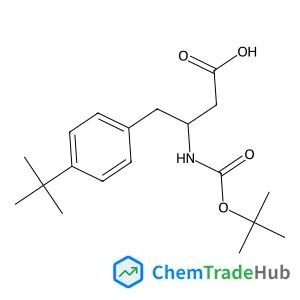
(S)-3-((tert-Butoxycarbonyl)amino)-4-(4-(tert-butyl)phenyl)butanoic acid
CAS Number:
403661-85-8
Molecular Formula:
C19H29NO4
![Methyl 3-({2'-[(E)-(hydroxyhydrazono)methyl]-4-biphenylyl}methyl)-2-oxo-2,3-dihydro-1H-benzimidazole-4-carboxylate structure](https://static.chemtradehub.com/structs/149/1499167-72-4-034a.webp "Methyl 3-({2'-[(E)-(hydroxyhydrazono)methyl]-4-biphenylyl}methyl)-2-oxo-2,3-dihydro-1H-benzimidazole-4-carboxylate structure")
Methyl 3-({2'-[(E)-(hydroxyhydrazono)methyl]-4-biphenylyl}methyl)-2-oxo-2,3-dihydro-1H-benzimidazole-4-carboxylate
CAS Number:
1499167-72-4
Molecular Formula:
C23H20N4O4
![N-{3-[Benzyl(methyl)amino]propyl}-9-chloro-5,6,7,8-tetrahydro-2-acridinecarboxamide structure](https://static.chemtradehub.com/structs/142/1426944-49-1-1e4c.webp "N-{3-[Benzyl(methyl)amino]propyl}-9-chloro-5,6,7,8-tetrahydro-2-acridinecarboxamide structure")
N-{3-[Benzyl(methyl)amino]propyl}-9-chloro-5,6,7,8-tetrahydro-2-acridinecarboxamide
CAS Number:
1426944-49-1
Molecular Formula:
C25H28ClN3O
Recommended Suppliers








Disclaimer
This page provides academic journal information for reference and research purposes only. We are not affiliated with any journal publishers and do not handle publication submissions. For publication-related inquiries, please contact the respective journal publishers directly.
If you notice any inaccuracies in the information displayed, please contact us at support@chemtradehub.com. We will promptly review and address your concerns.