












Selective oxidation of dimethyl ether to methyl formate over trifunctional MoO3–SnO2catalyst under mild conditions
Literature Information
Publication Date
2013-03-19
DOI
10.1039/C3GC40279G
Impact Factor
10.182
Authors
Qingde Zhang, Yizhuo Han, Yisheng Tan
View Original
Abstract
Dimethyl ether oxidation was conducted over MoO3–SnO2 catalysts prepared from different Sn salt precursors. Over the MoO3–SnO2 catalyst prepared from SnCl4, methyl formate selectivity reached 94.1% at 433 K without the formation of COx. The performance of the catalyst was determined by the existence form of MoO3 and the different surface bonding of Mo and O of the catalyst.
Related Literature
From glucose to enantiopure morpholino β-amino acid: a new tool for stabilizing γ-turns in peptides
Raffaella Bucci, Alessandro Contini, Francesca Clerici, Sara Pellegrino, Maria Luisa Gelmi
2019-02-12
Research Article
DOI: 10.1039/C8QO01116H
Donor- and acceptor-functionalized dibenzo[a,e]pentalenes: modulation of the electronic band gap
D. C. Grenz, G. Schnakenburg, B. Esser
2016-09-27
Research Article
DOI: 10.1039/C6QO00487C
Pentadecaphenylenes: synthesis, self-assembly and complexation with fullerene C60
M. Jalilur Rahman, Hideyuki Shimizu, Masashi Hasegawa, Masahiko Iyoda
2017-04-17
Research Article
DOI: 10.1039/C7QO00258K
Rotational isomerism of the amide units in rotaxanes based on a cyclic tetraamide and secondary ammonium ions
Yukari Okuma, Toshihiro Tsukamoto, Takayuki Inagaki, Shinobu Miyagawa, Masaki Kimura, Masaya Naito, Hikaru Takaya, Tsuneomi Kawasaki, Yuji Tokunaga
2019-02-20
Research Article
DOI: 10.1039/C9QO00096H
An efficient synthesis of fluoro-neplanocin A analogs using electrophilic fluorination and palladium-catalyzed dehydrosilylation
Dnyandev B. Jarhad, Min Hwan Jang, Young Sup Shin, Hong-Rae Kim, Young Eum Hyun, Ji-seong Yoon, Lak Shin Jeong
2019-02-12
Research Article
DOI: 10.1039/C9QO00099B
Aqueous MCRs of quaternary ammoniums, N-substituted formamides and sodium disulfide towards aryl thioamides
Zhou Zhou, Jin-Tao Yu, Yongnan Zhou, Yan Jiang, Jiang Cheng
2016-12-19
Research Article
DOI: 10.1039/C6QO00670A
Temperature-induced large amplitude conformational change in the complex of oxatub[4]arene revealed via rotaxane synthesis
Dong-Hao Li, Liu-Pan Yang, Hongxin Chai, Fei Jia, Hua Ke, Wei Jiang
2019-02-21
Research Article
DOI: 10.1039/C9QO00159J
Mechanistic insights into intermolecular cyclization of ring-fused benzocyclobutenols with alkynes catalyzed by [{Ir(OMe)COD}2]
Yang Zhao, Ping Wang, Yun Gao, Chen Zhu, Wei Liu, Yong Wang
2019-02-04
Research Article
DOI: 10.1039/C8QO01371C
Expedient synthesis of a symmetric cycloheptyne-Co2(CO)6 complex for orthogonal Huisgen cycloadditions
Morgan Cormier, Eric Fouquet, Philippe Hermange
2019-02-28
Research Article
DOI: 10.1039/C9QO00086K
You might also like
Compound Q&A
What precautions should be taken when handling 4-Methyl-6-(trifluoromethyl)quinoline (CAS: 40716-16-3)?
When handling 4-Methyl-6-(trifluoromethyl)quinoline (CAS: 40716-16-3), safety go...
40716-16-34-Methyl-6-(trifluor...
Compound Q&A
What is 4-(3,5-Difluorophenyl)aniline (CAS: 405058-00-6)?
4-(3,5-Difluorophenyl)aniline is an aromatic organic compound with the CAS numbe...
405058-00-64-(3,5-Difluoropheny...
Compound Q&A
How is 5-{[4-(Trifluoromethyl)phenyl]sulfanyl}-1,2,3-thiadiazole-4-carboxylic acid (CAS: 338982-07-3) typically synthesized?
5-{[4-(Trifluoromethyl)phenyl]sulfanyl}-1,2,3-thiadiazole-4-carboxylic acid can ...
338982-07-35-{[4-(Trifluorometh...
Compound Q&A
What is the market or research trend for 4-Benzylaniline hydrochloride (CAS: 6317-57-3)?
The market for 4-Benzylaniline hydrochloride (CAS: 6317-57-3) is steadily growin...
6317-57-34-Benzylaniline hydr...
Compound Q&A
Is [3-(Diethylsulfamoyl)phenyl]boronic acid (CAS: 871329-58-7) safe?
[3-(Diethylsulfamoyl)phenyl]boronic acid is generally considered safe when handl...
871329-58-7[3-(Diethylsulfamoyl...
Compound Q&A
What are the main uses of 3-Bromo-2,5-dimethoxyaniline (CAS: 115929-62-9)?
3-Bromo-2,5-dimethoxyaniline is mainly used in the pharmaceutical and chemical i...
115929-62-93-Bromo-2,5-dimethox...
Compound Q&A
What regulatory guidelines apply to N-Methyl-1-(5-methyl-1H-indol-3-yl)methanamine (CAS: 915922-67-7)?
N-Methyl-1-(5-methyl-1H-indol-3-yl)methanamine (CAS: 915922-67-7) is subject to ...
915922-67-7N-Methyl-1-(5-methyl...
Compound Q&A
What industries use Carbamic acid, N-[(5S)-5,6-diamino-6-oxohexyl]-, 1,1-dimethylethyl ester (CAS: 24828-96-4)?
This compound is primarily used in the pharmaceutical industry for the synthesis...
24828-96-4Carbamic acid, N-[(5...
Compound Q&A
How should 2-Methyl-2-propanyl [(1S,3R)-3-aminocyclohexyl]carbamate (CAS: 1298101-47-9) be stored?
2-Methyl-2-propanyl [(1S,3R)-3-aminocyclohexyl]carbamate (CAS: 1298101-47-9) sho...
1298101-47-92-Methyl-2-propanyl ...
Compound Q&A
What industries use Ethyl 2-bromo-4,4,4-trifluorobutanoate (CAS: 367-33-9)?
Ethyl 2-bromo-4,4,4-trifluorobutanoate (CAS: 367-33-9) is utilized in the pharma...
367-33-9Ethyl 2-bromo-4,4,4-...
Source Journal
Green Chemistry

CiteScore:
16.1
Self-citation Rate:
7.5%
Articles per Year:
944
Green Chemistry provides a unique forum for the publication of innovative research on the development of alternative green and sustainable technologies. The scope of Green Chemistry is based on, but not limited to, the definition proposed by Anastas and Warner (Green Chemistry: Theory and Practice, P T Anastas and J C Warner, Oxford University Press, Oxford, 1998). Green chemistry is the utilisation of a set of principles that reduces or eliminates the use or generation of hazardous substances in the design, manufacture and application of chemical products. Green Chemistry is at the frontiers of this continuously-evolving interdisciplinary science and publishes research that attempts to reduce the environmental impact of the chemical enterprise by developing a technology base that is inherently non-toxic to living things and the environment. Submissions on all aspects of research relating to the endeavour are welcome. The journal publishes original and significant cutting-edge research that is likely to be of wide general appeal. To be published, work must present a significant advance in green chemistry. Papers must contain a comparison with existing methods and demonstrate advantages over those methods before publication can be considered. For more information please see this Editorial. Coverage includes the following, but is not limited to: Design (e.g. biomimicry, design for degradation/recycling/reduced toxicity…) Reagents & Feedstocks (e.g. renewables, CO2, solvents, auxiliary agents, waste utilization…) Synthesis (e.g. organic, inorganic, synthetic biology…) Catalysis (e.g. homogeneous, heterogeneous, enzyme, whole cell…) Process (e.g. process design, intensification, separations, recycling, efficiency…) Energy (e.g. renewable energy, fuels, photovoltaics, fuel cells, energy storage, energy carriers…) Applications (e.g. electronics, dyes, consumer products, coatings, pharmaceuticals, preservatives, building materials, chemicals for industry/agriculture/mining…) Impact (e.g. safety, metrics, LCA, sustainability, (eco)toxicology…) Green chemistry is, by definition, a continuously-evolving frontier. Therefore, the inclusion of a particular material or technology does not, of itself, guarantee that a paper is suitable for the journal. To be suitable, the novel advance should have the potential for reduced environmental impact relative to the state of the art. Green Chemistry does not normally deal with research associated with 'end-of-pipe' or remediation issues.
Recommended Compounds
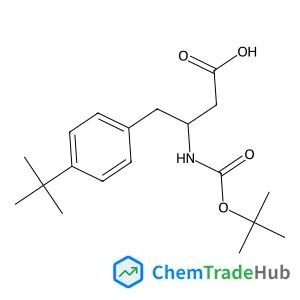
(S)-3-((tert-Butoxycarbonyl)amino)-4-(4-(tert-butyl)phenyl)butanoic acid
CAS Number:
403661-85-8
Molecular Formula:
C19H29NO4

Recommended Suppliers





Disclaimer
This page provides academic journal information for reference and research purposes only. We are not affiliated with any journal publishers and do not handle publication submissions. For publication-related inquiries, please contact the respective journal publishers directly.
If you notice any inaccuracies in the information displayed, please contact us at support@chemtradehub.com. We will promptly review and address your concerns.