












An efficient synthesis of fluoro-neplanocin A analogs using electrophilic fluorination and palladium-catalyzed dehydrosilylation
Literature Information
Publication Date
2019-02-12
DOI
10.1039/C9QO00099B
Impact Factor
5.281
Authors
Dnyandev B. Jarhad, Min Hwan Jang, Young Sup Shin, Hong-Rae Kim, Young Eum Hyun, Ji-seong Yoon, Lak Shin Jeong
View Original
Abstract
Neplanocin A analogs have attracted attention in the fields of biological and medicinal chemistry due to their potent and broad-spectrum antiviral and antitumor activities. To further explore their potential as therapeutic agents, an alternative and efficient synthesis of fluoro-neplanocin A analogs has been developed by employing stereoselective electrophilic fluorination and palladium-catalyzed dehydrosilylation as key steps. With respect to previous syntheses, the present synthetic methodology provides easy access to key intermediates that could contribute to expanding further the structure–activity relationship studies of neplanocin A analogs.
Related Literature
Backbone-extended pyrrolidinepeptide nucleic acids (bepPNA): design, synthesis and DNA/RNA binding studies
T. Govindaraju, Vaijayanti A. Kumar
2004-12-02
Communication
DOI: 10.1039/B413542C
Indaphyrin, a meso-tetraphenylsecochlorin-derived chromophore incorporating o-phenyl-to-β-linkages
Jason R. McCarthy, Michael A. Hyland, Christian Brückner
2003-06-18
Communication
DOI: 10.1039/B304647H
Synthesis and optical properties of metallo-supramolecular polymers
Parameswar K. Iyer, J. Benjamin Beck, Christoph Weder, Stuart J. Rowan
2004-12-10
Communication
DOI: 10.1039/B410734A
Novel heteroditopic chelate for self-assembled gadolinium(iii) complex with high relaxivity
Robert Ruloff, Gerard van Koten, André E. Merbach
2004-02-26
Communication
DOI: 10.1039/B400169A
Catalytic reduction of nitro-group terminated monolayers by Ag nanoparticles; a novel strategy for site-selective patterning of organic monolayers
Yeoung Uk Seo, Seung Joon Lee, Kwan Kim
2004-02-23
Communication
DOI: 10.1039/B400635F
Molecular satellite dishes: attaching parabolic and planar arenes to heterofullerenes
Frank Hauke, Stefan Atalick, Dirk M. Guldi, James Mack, Lawrence T. Scott, Andreas Hirsch
2004-02-23
Communication
DOI: 10.1039/B316139K
Pre-organization induced synthesis of a crossed alkene-bridged nisin Z DE-ring mimic by ring-closing metathesis
Nourdin Ghalit, Dirk T. S. Rijkers, Johan Kemmink, Cees Versluis, Rob M. J. Liskamp
2004-12-02
Communication
DOI: 10.1039/B415555F
Fluorescence enhancement of a signaling system in the simultaneous presence of transition and alkali metal ions: a potential AND logic gate
Bamaprasad Bag, Parimal K. Bharadwaj
2004-12-03
Communication
DOI: 10.1039/B413274B
The nature of paramagnetic species in nitrogen doped TiO2 active in visible light photocatalysis
Stefano Livraghi, Annamaria Votta, Maria Cristina Paganini, Elio Giamello
2004-12-02
Communication
DOI: 10.1039/B413548B
You might also like
Compound Q&A
What precautions should be taken when handling 4-Methyl-6-(trifluoromethyl)quinoline (CAS: 40716-16-3)?
When handling 4-Methyl-6-(trifluoromethyl)quinoline (CAS: 40716-16-3), safety go...
40716-16-34-Methyl-6-(trifluor...
Compound Q&A
What is 4-(3,5-Difluorophenyl)aniline (CAS: 405058-00-6)?
4-(3,5-Difluorophenyl)aniline is an aromatic organic compound with the CAS numbe...
405058-00-64-(3,5-Difluoropheny...
Compound Q&A
How is 5-{[4-(Trifluoromethyl)phenyl]sulfanyl}-1,2,3-thiadiazole-4-carboxylic acid (CAS: 338982-07-3) typically synthesized?
5-{[4-(Trifluoromethyl)phenyl]sulfanyl}-1,2,3-thiadiazole-4-carboxylic acid can ...
338982-07-35-{[4-(Trifluorometh...
Compound Q&A
What is the market or research trend for 4-Benzylaniline hydrochloride (CAS: 6317-57-3)?
The market for 4-Benzylaniline hydrochloride (CAS: 6317-57-3) is steadily growin...
6317-57-34-Benzylaniline hydr...
Compound Q&A
Is [3-(Diethylsulfamoyl)phenyl]boronic acid (CAS: 871329-58-7) safe?
[3-(Diethylsulfamoyl)phenyl]boronic acid is generally considered safe when handl...
871329-58-7[3-(Diethylsulfamoyl...
Compound Q&A
What are the main uses of 3-Bromo-2,5-dimethoxyaniline (CAS: 115929-62-9)?
3-Bromo-2,5-dimethoxyaniline is mainly used in the pharmaceutical and chemical i...
115929-62-93-Bromo-2,5-dimethox...
Compound Q&A
What regulatory guidelines apply to N-Methyl-1-(5-methyl-1H-indol-3-yl)methanamine (CAS: 915922-67-7)?
N-Methyl-1-(5-methyl-1H-indol-3-yl)methanamine (CAS: 915922-67-7) is subject to ...
915922-67-7N-Methyl-1-(5-methyl...
Compound Q&A
What industries use Carbamic acid, N-[(5S)-5,6-diamino-6-oxohexyl]-, 1,1-dimethylethyl ester (CAS: 24828-96-4)?
This compound is primarily used in the pharmaceutical industry for the synthesis...
24828-96-4Carbamic acid, N-[(5...
Compound Q&A
How should 2-Methyl-2-propanyl [(1S,3R)-3-aminocyclohexyl]carbamate (CAS: 1298101-47-9) be stored?
2-Methyl-2-propanyl [(1S,3R)-3-aminocyclohexyl]carbamate (CAS: 1298101-47-9) sho...
1298101-47-92-Methyl-2-propanyl ...
Compound Q&A
What industries use Ethyl 2-bromo-4,4,4-trifluorobutanoate (CAS: 367-33-9)?
Ethyl 2-bromo-4,4,4-trifluorobutanoate (CAS: 367-33-9) is utilized in the pharma...
367-33-9Ethyl 2-bromo-4,4,4-...
Source Journal
Organic Chemistry Frontiers

CiteScore:
7.8
Self-citation Rate:
8.7%
Articles per Year:
724
Organic Chemistry Frontiers publishes high-quality research from across organic chemistry. Emphases are placed on studies that make significant contributions to the field of organic chemistry by reporting either new or significantly improved protocols or methodologies. Topics include, but are not limited to the following: Organic synthesis Development of synthetic methodologies Catalysis Natural products Functional organic materials Supramolecular and macromolecular chemistry Physical and computational organic chemistry
Recommended Compounds
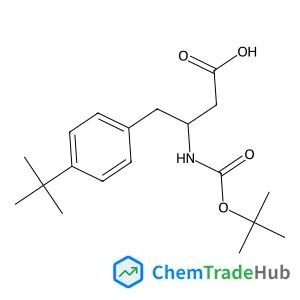
(S)-3-((tert-Butoxycarbonyl)amino)-4-(4-(tert-butyl)phenyl)butanoic acid
CAS Number:
403661-85-8
Molecular Formula:
C19H29NO4
Recommended Suppliers





Disclaimer
This page provides academic journal information for reference and research purposes only. We are not affiliated with any journal publishers and do not handle publication submissions. For publication-related inquiries, please contact the respective journal publishers directly.
If you notice any inaccuracies in the information displayed, please contact us at support@chemtradehub.com. We will promptly review and address your concerns.