












Photophoretic separation of single-walled carbon nanotubes: a novel approach to selective chiral sorting
Literature Information
Publication Date
2014-01-28
DOI
10.1039/C3CP54812K
Impact Factor
3.676
Authors
Christopher Woods, Heinrich Hoerber
View Original
Abstract
For over two decades single-walled carbon nanotubes (SWCNTs) have been used in a broad range of electronic and optical applications, however the selective chiral sorting of SWCNTs with guaranteed optoelectronics characteristics is imperative to the industrial realization of such applications. In this paper we provide the results of modeling an optical sorting method that utilizes the inherent opto-electronic properties of the SWCNTs, thus guaranteeing the properties of the extracted populations. Utilizing the resonant transfer of photonic momentum, we simulate chiral sorting of two chiral populations in an aqueous environment based on the frequency dependent optical absorption properties of the nanotubes. We show that photonic sorting is not only feasible, but may be up to faster than density gradient centrifugation techniques. Our simulations investigate the effects of laser power, temperature and orientation. We find that 96% purity can be achieved in less than 12 minutes by operating at 9 × 10⁷ W m−2 (20 mW in a 20 μm chamber) at elevated temperatures.
Related Literature
A label-free fluorescent adenosine triphosphate biosensor via overhanging aptamer-triggered enzyme protection and target recycling amplification
Zhaoyin Wang, Jian Zhao, Zhihui Dai
2016-05-12
Communication
DOI: 10.1039/C6AN00816J
Fabrication of magnetic trimetallic metal–organic frameworks for the rapid removal of tetracycline from water
Rui Xiao, Hassan Idris Abdu, Liping Wei, Tieying Wang, Shuhui Huo, Jing Chen
2020-01-25
Paper
DOI: 10.1039/C9AN02481F
Fluorescence turn-off-on for highly selective detection of serum l-cysteine based on AuNCs-AuNPs ensembles
Zhiwei Li
2020-02-17
Paper
DOI: 10.1039/C9AN02495F
An array of individually addressable micro-needles for mapping pH distributions
Claudio Zuliani, Fu Siong Ng, Andrea Alenda, Amir Eftekhar, Nicholas S. Peters, Christofer Toumazou
2016-05-11
Paper
DOI: 10.1039/C6AN00639F
A paper-based colorimetric assay system for sensitive cysteine detection using a fluorescent probe
Xiaoya Ma
2020-01-15
Paper
DOI: 10.1039/C9AN02271F
A multi-responsive turn-on flurogenic probe to sense Zn2+, Cd2+ and Pb2+: left-right-center emission signal swing
Soham Samanta, Barun Kumar Datta, Madhurima Boral, Abhijit Nandan, Gopal Das
2016-05-10
Paper
DOI: 10.1039/C6AN00657D
A ratiometric fluorescence nanosensor for highly selective and sensitive detection of selenite
Linfeng Chen, Xike Tian, Yuan Zhao, Yong Li, Chao Yang, Zhaoxin Zhou
2016-05-19
Paper
DOI: 10.1039/C6AN00740F
Characterization of the furin cleavage motif for HIV-1 trimeric envelope glycoprotein by intact LC-MS analysis
Nicole A. Schneck, Vera B. Ivleva, Cindy X. Cai, Jonathan W. Cooper, Q. Paula Lei
2020-01-02
Communication
DOI: 10.1039/C9AN02098E
Integrated microsystems for the in situ genetic detection of dengue virus in whole blood using direct sample preparation and isothermal amplification
Hyun Jin Yoo, Changyoon Baek, Min-Ho Lee, Junhong Min
2020-01-29
Paper
DOI: 10.1039/C9AN02435B
A high-resolution method to assess cell multinucleation with cytoplasm-localized fluorescent probes
Qinghua Cui, Hui Meng, Fangfang Lai, Shufang Wang, Xiang Zhang, Xiaoguang Chen, Dali Yin
2016-05-19
Communication
DOI: 10.1039/C6AN00613B
You might also like
Compound Q&A
What precautions should be taken when handling lithium chloride hydrate (1:1:1) (CAS: 16712-20-2)?
When handling lithium chloride hydrate (1:1:1) (CAS: 16712-20-2), it is importan...
16712-20-2Lithium chloride hyd...
Compound Q&A
Is 4-(4H-1,2,4-Triazol-4-yl)piperidine (CAS: 690261-92-8) safe?
4-(4H-1,2,4-Triazol-4-yl)piperidine is generally considered safe for use in phar...
690261-92-84-(4H-1,2,4-Triazol-...
Compound Q&A
How should waste containing 1,3-Thiazole-2-carboxamide (CAS: 16733-85-0) be handled?
Waste containing 1,3-Thiazole-2-carboxamide (CAS: 16733-85-0) should be collecte...
16733-85-01,3-Thiazole-2-carbo...
Compound Q&A
What regulatory guidelines apply to 5-(Difluoromethyl)-2-fluorobenzonitrile (CAS: 934175-58-3)?
5-(Difluoromethyl)-2-fluorobenzonitrile (CAS: 934175-58-3) is subject to regulat...
934175-58-35-(Difluoromethyl)-2...
Compound Q&A
How is Methyl 3-acetamido-2-thiophenecarboxylate (CAS: 22288-79-5) typically synthesized?
Methyl 3-acetamido-2-thiophenecarboxylate can be synthesized by the reaction of ...
22288-79-5Methyl 3-acetamido-2...
Compound Q&A
What is 4-Isoquinolinecarbonitrile (CAS: 34846-65-6)?
4-Isoquinolinecarbonitrile is a chemical compound with the CAS number 34846-65-6...
34846-65-64-Isoquinolinecarbon...
Compound Q&A
How should Methyl 1H-1,2,3-triazole-4-carboxylate (CAS: 877309-59-6) be stored?
Store Methyl 1H-1,2,3-triazole-4-carboxylate (CAS: 877309-59-6) in a cool, dry p...
877309-59-6Methyl 1H-1,2,3-tria...
Compound Q&A
What regulatory guidelines apply to 6-Bromo[1,3]thiazolo[5,4-b]pyridin-2-amine (CAS: 1160791-13-8)?
6-Bromo[1,3]thiazolo[5,4-b]pyridin-2-amine (CAS: 1160791-13-8) is subject to the...
1160791-13-86-Bromo[1,3]thiazolo...
Compound Q&A
Is (2S,3S)-2-Ammonio-3-(3,4-dihydroxyphenyl)-3-hydroxypropanoate (CAS: 23651-95-8) safe?
(2S,3S)-2-Ammonio-3-(3,4-dihydroxyphenyl)-3-hydroxypropanoate (CAS: 23651-95-8) ...
23651-95-8(2S,3S)-2-Ammonio-3-...
Compound Q&A
What are the physical and chemical properties of 7-bromo-3-methyl-3,4-dihydroquinazolin-4-one (CAS: 1293987-84-4)?
7-Bromo-3-methyl-3,4-dihydroquinazolin-4-one is a solid with a crystalline form....
1293987-84-47-bromo-3-methyl-3,4...
Source Journal
Physical Chemistry Chemical Physics

CiteScore:
5.5
Self-citation Rate:
10.3%
Articles per Year:
3036
Physical Chemistry Chemical Physics (PCCP) is an international journal co-owned by 19 physical chemistry and physics societies from around the world. This journal publishes original, cutting-edge research in physical chemistry, chemical physics and biophysical chemistry. To be suitable for publication in PCCP, articles must include significant innovation and/or insight into physical chemistry; this is the most important criterion that reviewers and Editors will judge against when evaluating submissions. The journal has a broad scope and welcomes contributions spanning experiment, theory, computation and data science. Topical coverage includes spectroscopy, dynamics, kinetics, statistical mechanics, thermodynamics, electrochemistry, catalysis, surface science, quantum mechanics, quantum computing and machine learning. Interdisciplinary research areas such as polymers and soft matter, materials, nanoscience, energy, surfaces/interfaces, and biophysical chemistry are welcomed if they demonstrate significant innovation and/or insight into physical chemistry. Joined experimental/theoretical studies are particularly appreciated when complementary and based on up-to-date approaches.
Recommended Compounds
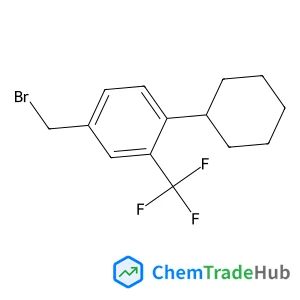
4-(Bromomethyl)-1-cyclohexyl-2-(trifluoromethyl)benzene
CAS Number:
800381-60-6
Molecular Formula:
C14H16BrF3
Recommended Suppliers






Disclaimer
This page provides academic journal information for reference and research purposes only. We are not affiliated with any journal publishers and do not handle publication submissions. For publication-related inquiries, please contact the respective journal publishers directly.
If you notice any inaccuracies in the information displayed, please contact us at support@chemtradehub.com. We will promptly review and address your concerns.