












Atomic electron affinities and the role of symmetry between electron addition and subtraction in a corrected Koopmans approach
Literature Information
Publication Date
2014-01-02
DOI
10.1039/C3CP54528H
Impact Factor
3.676
Authors
F. De Proft, P. Geerlings, D. J. Tozer
View Original
Abstract
The essential aspects of zero-temperature grand-canonical ensemble density-functional theory are reviewed in the context of spin-density-functional theory and are used to highlight the assumption of symmetry between electron addition and subtraction that underlies the corrected Koopmans approach of Tozer and De Proft (TDP) for computing electron affinities. The issue of symmetry is then investigated in a systematic study of atomic electron affinities, comparing TDP affinities with those from a conventional Koopmans evaluation and electronic energy differences. Although it cannot compete with affinities determined from energy differences, the TDP expression yields results that are a significant improvement over those from the conventional Koopmans expression. Key insight into the results from both expressions is provided by an analysis of plots of the electronic energy as a function of the number of electrons, which highlight the extent of symmetry between addition and subtraction. The accuracy of the TDP affinities is closely related to the nature of the orbitals involved in the electron addition and subtraction, being particularly poor in cases where there is a change in principal quantum number, but relatively accurate within a single manifold of orbitals. The analysis is then extended to a consideration of the ground state Mulliken electronegativity and chemical hardness. The findings further emphasize the key role of symmetry in determining the quality of the results.
Recommended Journals
Related Literature
Preparation and application of molecularly imprinted polymers for the selective extraction of naringin and genistein from herbal medicines
Zhimin Luo, Aiping Xiao, Guoning Chen, Qi Guo, Chun Chang, Aiguo Zeng, Qiang Fu
2019-08-28
Paper
DOI: 10.1039/C9AY01503E
An electrochemical immunosensing system on patterned electrodes for immunoglobulin E detection
Seung Jun Oh, Jun Ki Ahn, Hun Park, Yesol Song, Seong Jung Kwon, Hang-Beum Shin
2019-07-29
Communication
DOI: 10.1039/C9AY01257E
Molecular brass: Cu4Zn4, a ligand protected superatom cluster
Kerstin Freitag, Hung Banh, Christian Gemel, Rüdiger W. Seidel, Samia Kahlal, Jean-Yves Saillard, Roland A. Fischer
2014-06-19
Communication
DOI: 10.1039/C4CC03401E
Development and prospects of microfluidic platforms for sperm inspection
2019-08-13
Minireview
DOI: 10.1039/C9AY01641D
Facile synthesis of yolk–shell structured Si–C nanocomposites as anodes for lithium-ion batteries
Lei Pan, Haibin Wang, Dacheng Gao, Shengyang Chen, Lei Tan, Lei Li
2014-04-14
Communication
DOI: 10.1039/C4CC01728E
Lab on paper: assay of beta-lactam pharmaceuticals by redox titration
Mercy W. Maina, Phelix Makoto Were, Jamie L. Luther, Sarah L. Bliese, Nils Oberhof, Doaa Aldulaimi, Marya Lieberman
2019-09-02
Paper
DOI: 10.1039/C9AY01547G
A new analytical method for the determination of beta-blockers and one metabolite in the influents and effluents of three urban wastewater treatment plants
Gabriel-Lucian Radu, Roxana Scutariu
2019-08-13
Paper
DOI: 10.1039/C9AY01597C
Composition-tailored ZnMgO nanoparticles for electron transport layers of highly efficient and bright InP-based quantum dot light emitting diodes
Hyungsuk Moon, Woosuk Lee, Jungwoo Kim, Daehee Lee, Soonmin Cha, Sangyeon Shin
2019-10-16
Communication
DOI: 10.1039/C9CC06882A
You might also like
Compound Q&A
What are the main uses of 1H-Indazole-6-carbonitrile (CAS: 141290-59-7)?
1H-Indazole-6-carbonitrile finds applications in pharmaceuticals, where it serve...
141290-59-71H-Indazole-6-carbon...
Compound Q&A
How should waste containing Dioctyl (2E)-2-butenedioate (CAS: 2997-85-5) be handled?
Waste containing Dioctyl (2E)-2-butenedioate (CAS: 2997-85-5) should be collecte...
2997-85-5Dioctyl (2E)-2-buten...
Compound Q&A
What industries use Sodium [(1,2-benzoxazol-3-ylmethyl)sulfonyl]azanide (CAS: 68291-98-5)?
Sodium [(1,2-benzoxazol-3-ylmethyl)sulfonyl]azanide is primarily used in pharmac...
68291-98-5Sodium [(1,2-benzoxa...
Compound Q&A
Are there alternatives to Dimethyl 4-(4,4,5,5-tetramethyl-1,3,2-dioxaborolan-2-yl)-2,6-pyridinedicarboxylate (CAS: 741709-66-0) in synthesis?
Dimethyl 4-(4,4,5,5-tetramethyl-1,3,2-dioxaborolan-2-yl)-2,6-pyridinedicarboxyla...
741709-66-0Dimethyl 4-(4,4,5,5-...
Compound Q&A
How should waste containing 2-Fluoro-6-hydrazinopyridine (CAS: 80714-39-2) be handled?
Waste containing 2-Fluoro-6-hydrazinopyridine (CAS: 80714-39-2) should be manage...
80714-39-22-Fluoro-6-hydrazino...
Compound Q&A
What is 6-Formyl-2-pyridinecarboxylic acid (CAS: 499214-11-8)?
6-Formyl-2-pyridinecarboxylic acid is an organic compound with the molecular for...
499214-11-86-Formyl-2-pyridinec...
Compound Q&A
What is the market or research trend for 3-(3,4-dimethoxyphenyl)-2,5-dimethyl-N-(2-morpholin-4-ylethyl)pyrazolo[1,5-a]pyrimidin-7-amine (CAS: 900874-91-1)?
Research trends for this compound indicate a focus on its potential applications...
900874-91-13-(3,4-dimethoxyphen...
Compound Q&A
How is 9H-Tribenzo[b,d,f]azepine (CAS: 29875-73-8) typically synthesized?
9H-Tribenzo[b,d,f]azepine is typically synthesized via a multi-step process invo...
29875-73-89H-Tribenzo[b,d,f]az...
Compound Q&A
How is 1-Cyclopropyl-7-ethoxy-6-fluoro-8-methoxy-4-oxo-1,4-dihydro-3-quinolinecarboxylic acid (CAS: 1797982-51-4) typically synthesized?
1-Cyclopropyl-7-ethoxy-6-fluoro-8-methoxy-4-oxo-1,4-dihydro-3-quinolinecarboxyli...
1797982-51-41-Cyclopropyl-7-etho...
Compound Q&A
How should waste containing Methyl 3-oxo-1,2,3,4-tetrahydro-6-quinoxalinecarboxylate (CAS: 671820-52-3) be handled?
Waste containing Methyl 3-oxo-1,2,3,4-tetrahydro-6-quinoxalinecarboxylate (CAS: ...
671820-52-3Methyl 3-oxo-1,2,3,4...
Source Journal
Physical Chemistry Chemical Physics

CiteScore:
5.5
Self-citation Rate:
10.3%
Articles per Year:
3036
Physical Chemistry Chemical Physics (PCCP) is an international journal co-owned by 19 physical chemistry and physics societies from around the world. This journal publishes original, cutting-edge research in physical chemistry, chemical physics and biophysical chemistry. To be suitable for publication in PCCP, articles must include significant innovation and/or insight into physical chemistry; this is the most important criterion that reviewers and Editors will judge against when evaluating submissions. The journal has a broad scope and welcomes contributions spanning experiment, theory, computation and data science. Topical coverage includes spectroscopy, dynamics, kinetics, statistical mechanics, thermodynamics, electrochemistry, catalysis, surface science, quantum mechanics, quantum computing and machine learning. Interdisciplinary research areas such as polymers and soft matter, materials, nanoscience, energy, surfaces/interfaces, and biophysical chemistry are welcomed if they demonstrate significant innovation and/or insight into physical chemistry. Joined experimental/theoretical studies are particularly appreciated when complementary and based on up-to-date approaches.
Recommended Compounds


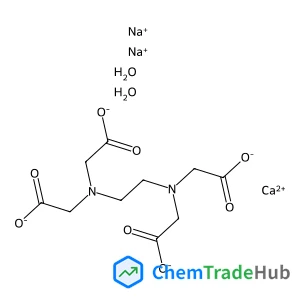
EthylenediaminetetraaceticacidcalciumDisodiumsalthydrate
CAS Number:
23411-34-9
Molecular Formula:
C10H16CaN2Na2O10
Recommended Suppliers





Disclaimer
This page provides academic journal information for reference and research purposes only. We are not affiliated with any journal publishers and do not handle publication submissions. For publication-related inquiries, please contact the respective journal publishers directly.
If you notice any inaccuracies in the information displayed, please contact us at support@chemtradehub.com. We will promptly review and address your concerns.