













Ionization-induced π → H site-switching in phenol–CH4 complexes studied using IR dip spectroscopy
Literature Information
Publication Date
2013-11-13
DOI
10.1039/C3CP53533A
Impact Factor
3.676
Authors
Mitsuhiko Miyazaki, Akihiro Takeda, Matthias Schmies, Makoto Sakai, Kentaro Misawa, Shun-ichi Ishiuchi, François Michels, Klaus Müller-Dethlefs, Otto Dopfer, Masaaki Fujii
View Original
Abstract
IR spectra of phenol–CH4 complexes generated in a supersonic expansion were measured before and after photoionization. The IR spectrum before ionization shows the free OH stretching vibration (νOH) and the structure of neutral phenol–CH4 in the electronic ground state (S0) is assigned to a π-bound geometry, in which the CH4 ligand is located above the phenol ring. The IR spectrum after ionization to the cationic ground state (D0) exhibits a red shifted νOH band assigned to a hydrogen-bonded cationic structure, in which the CH4 ligand binds to the phenolic OH group. In contrast to phenol–Ar/Kr, the observed ionization-induced π → H migration has unity yield for CH4. This difference is attributed to intracluster vibrational energy redistribution processes.
Related Literature
Correction: Analysis of computational models for an accurate study of electronic excitations in GFP
Tobias Schwabe, Maarten T. P. Beerepoot, Jacob Kongsted
2015-12-15
Correction
DOI: 10.1039/C5CP90225H
Fe– and Co–P4-embedded graphenes as electrocatalysts for the oxygen reduction reaction: theoretical insights
Liyan Feng, Yuejie Liu, Jingxiang Zhao
2015-10-22
Paper
DOI: 10.1039/C5CP05551B
Structure–barrier property relationship of biodegradable poly(butylene succinate) and poly[(butylene succinate)-co-(butylene adipate)] nanocomposites: influence of the rigid amorphous fraction
J. Soulestin, M. Sclavons
2015-10-13
Paper
DOI: 10.1039/C5CP04969E
Ab initio variational predictions for understanding highly congested spectra: rovibrational assignment of 108 new methane sub-bands in the icosad range (6280–7800 cm−1)
Michaël Rey, Vladimir G. Tyuterev
2015-11-12
Paper
DOI: 10.1039/C5CP05265C
A comparative first principles study on trivalent ion incorporated SSZ-13 zeolites
Cui Wen, Lu Geng, Lina Han, Jiancheng Wang, Liping Chang, Dejin Kong, Jianwen Liu
2015-10-07
Paper
DOI: 10.1039/C5CP04788A
Equilibrium and dynamical properties of polymer chains in random medium filled with randomly distributed nano-sized fillers
Chao-Yang Li, Meng-Bo Luo, Jian-Hua Huang, Hong Li
2015-11-06
Paper
DOI: 10.1039/C5CP06189J
Mechanistic insights into nitrogen fixation by nitrogenase enzymes
Y. Wang, K. Chan
2015-09-09
Paper
DOI: 10.1039/C5CP04034E
Correction: Electronic and magnetic properties of DUT-8(Ni)
Kai Trepte, Sebastian Schwalbe, Gotthard Seifert
2015-12-14
Correction
DOI: 10.1039/C5CP90227D
Design and characterisation of bodipy sensitizers for dye-sensitized NiO solar cells
Jean-François Lefebvre, Fiona A. Black, E. Stephen Davies, Tönu Pullerits, Christopher J. Wood, Karel Zidek
2015-11-27
Paper
DOI: 10.1039/C5CP05177K
You might also like
Compound Q&A
How should waste containing 6-Chloro-5-(2'-hydroxy-3'-methoxy-4-biphenylyl)-3-(3-methoxyphenyl)-1H-pyrrolo[3,2-d]pyrimidine-2,4(3H,5H)-dione (CAS: 1346607-05-3) be handled?
Waste containing 6-Chloro-5-(2'-hydroxy-3'-methoxy-4-biphenylyl)-3-(3-methoxyphe...
1346607-05-36-Chloro-5-(2'-hydro...
Compound Q&A
What are the main uses of (3alpha,5alpha)-3-Hydroxypregnane-11,20-dione (CAS: 23930-19-0)?
(3alpha,5alpha)-3-Hydroxypregnane-11,20-dione is primarily used in the pharmaceu...
23930-19-0(3alpha,5alpha)-3-Hy...
Compound Q&A
What is the market or research trend for 4-Amino-6-chloro-2-pyridinecarboxylic acid (CAS: 546141-56-4)?
The market for 4-Amino-6-chloro-2-pyridinecarboxylic acid (CAS: 546141-56-4) is ...
546141-56-44-Amino-6-chloro-2-p...
Compound Q&A
Are there alternatives to (2-Benzoylethyl)trimethylammonium chloride (CAS: 24472-88-6) in synthesis?
Alternatives to (2-Benzoylethyl)trimethylammonium chloride (CAS: 24472-88-6) in ...
24472-88-6(2-Benzoylethyl)trim...
Compound Q&A
Is N-[4-Nitro-3-(trifluoromethyl)phenyl]acetamide (CAS: 393-12-4) safe?
N-[4-Nitro-3-(trifluoromethyl)phenyl]acetamide (CAS: 393-12-4) is generally safe...
393-12-4N-[4-Nitro-3-(triflu...
Compound Q&A
Are there alternatives to [(4R,5R,6S)-5-hydroxy-10-imino-3,7-dioxa-1,9-diazatricyclo[6.4.0.02,6]dodeca-8,11-dien-4-yl]methyl dihydrogen phosphate (CAS: 39679-56-6) in synthesis?
Alternative reagents such as other phosphates or similar functional groups can b...
39679-56-6[(4R,5R,6S)-5-hydrox...
Compound Q&A
Are there alternatives to N,N'-Bis(3-aminopropyl)-1,3-propanediamine (CAS: 4605-14-5) in synthesis?
There are alternatives to N,N'-Bis(3-aminopropyl)-1,3-propanediamine (CAS: 4605-...
4605-14-5N,N'-Bis(3-aminoprop...
Compound Q&A
What precautions should be taken when handling Aluminium trihexadecanoate (CAS: 555-35-1)?
When handling Aluminium trihexadecanoate, it is important to use appropriate per...
555-35-1Aluminium trihexadec...
Compound Q&A
What is (1,1-Dioxido-3-oxo-1,2-benzothiazol-2(3H)-yl)acetic acid (CAS: 52188-11-1)?
(1,1-Dioxido-3-oxo-1,2-benzothiazol-2(3H)-yl)acetic acid is a chemical compound ...
52188-11-1(1,1-Dioxido-3-oxo-1...
Compound Q&A
Are there alternatives to 5,5-dimethyloxolan-2-one (CAS: 3123-97-5) in synthesis?
Several alternatives to 5,5-dimethyloxolan-2-one (CAS: 3123-97-5) can be used in...
3123-97-55,5-dimethyloxolan-2...
Source Journal
Physical Chemistry Chemical Physics

CiteScore:
5.5
Self-citation Rate:
10.3%
Articles per Year:
3036
Physical Chemistry Chemical Physics (PCCP) is an international journal co-owned by 19 physical chemistry and physics societies from around the world. This journal publishes original, cutting-edge research in physical chemistry, chemical physics and biophysical chemistry. To be suitable for publication in PCCP, articles must include significant innovation and/or insight into physical chemistry; this is the most important criterion that reviewers and Editors will judge against when evaluating submissions. The journal has a broad scope and welcomes contributions spanning experiment, theory, computation and data science. Topical coverage includes spectroscopy, dynamics, kinetics, statistical mechanics, thermodynamics, electrochemistry, catalysis, surface science, quantum mechanics, quantum computing and machine learning. Interdisciplinary research areas such as polymers and soft matter, materials, nanoscience, energy, surfaces/interfaces, and biophysical chemistry are welcomed if they demonstrate significant innovation and/or insight into physical chemistry. Joined experimental/theoretical studies are particularly appreciated when complementary and based on up-to-date approaches.
Recommended Compounds

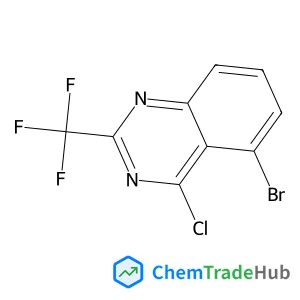
5-Bromo-4-chloro-2-(trifluoromethyl)quinazoline
CAS Number:
2089311-03-3
Molecular Formula:
C9H3BrClF3N2
![1-(2-Chlorophenyl)-6-[(2S)-3,3,3-trifluoro-2-methylpropyl]-1,7-dihydro-4H-pyrazolo[3,4-d]pyrimidin-4-one structure](https://static.chemtradehub.com/structs/794/794568-91-5-0c34.webp "1-(2-Chlorophenyl)-6-[(2S)-3,3,3-trifluoro-2-methylpropyl]-1,7-dihydro-4H-pyrazolo[3,4-d]pyrimidin-4-one structure")
1-(2-Chlorophenyl)-6-[(2S)-3,3,3-trifluoro-2-methylpropyl]-1,7-dihydro-4H-pyrazolo[3,4-d]pyrimidin-4-one
CAS Number:
794568-91-5
Molecular Formula:
C15H12ClF3N4O
Recommended Suppliers







Disclaimer
This page provides academic journal information for reference and research purposes only. We are not affiliated with any journal publishers and do not handle publication submissions. For publication-related inquiries, please contact the respective journal publishers directly.
If you notice any inaccuracies in the information displayed, please contact us at support@chemtradehub.com. We will promptly review and address your concerns.