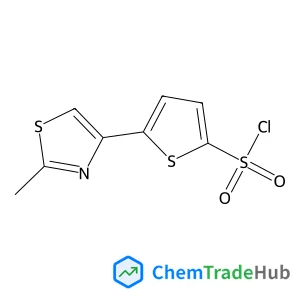
5-(2-Methyl-1,3-thiazol-4-yl)-2-thiophenesulfonyl chloride
CAS Number:
215434-25-6
Molecular Formula:
C8H6ClNO2S3
Myoung Hee Yun, Ji Hoon Jang, Kyung Min Kim, Hee-eun Song, Jeong Chul Lee, Jin Young Kim
Hybrid solar cells, based on organic and inorganic semiconductors, are a promising way to enhance the efficiency of solar cells because they make better use of the solar spectrum and are straightforward to fabricate. We report on a new hybrid solar cell comprised of hydrogenated amorphous silicon (a-Si:H), [6,6]-phenyl-C71-butyric acid methyl ester ([71]PCBM), and poly-3,4-ethylenedioxythiophene poly styrenesulfonate (PEDOT:PSS). The properties of these PEDOT:PSS/a-Si:H/[71]PCBM devices were studied as a function of the thickness of the a-Si:H layer. It was observed that the open circuit voltage and the short circuit current density of the device depended on the thickness of the a-Si:H layer. Under simulated one sun AM 1.5 global illumination (100 mW cm−2), a power conversion efficiency of 2.84% was achieved in a device comprised of a 274 nm-thick layer of a-Si:H; this is the best performance achieved to date for a hybrid solar cell made of amorphous Si and organic materials.
Juan Corchado-García, Luis E. Betancourt, Carlos A. Vélez, Sanjaya D. Senanayake, Dario Stacchiola, Kotaro Sasaki, Maxime J.-F. Guinel, Yunyun Zhou, Chin Li Cheung, Carlos R. Cabrera
DOI: 10.1039/C5CP04813C
Ruvini Dharmadasa, I. M. Dharmadasa, Thad Druffel
DOI: 10.1039/C5CP01652E
Priya Bhasi, Zanele P. Nhlabatsi, Sanyasi Sitha
DOI: 10.1039/C5CP05190H
Jun Eon Jin, Jae-Hyun Lee, Jun Hee Choi, Ho-Kyun Jang, Junhong Na, Dongmok Whang, Do-Hyun Kim, Gyu Tae Kim
DOI: 10.1039/C5CP03139G
M. Radtke, A. Ignaszak
DOI: 10.1039/C5CP05060J
Cina Foroutan-Nejad, Zahra Badri
DOI: 10.1039/C5CP05777A
DOI: 10.1039/C5CP04613K
Zhenni Wan, Robert B. Darling, M. P. Anantram
DOI: 10.1039/C5CP04755B
Waste containing 6-Chloro-5-(2'-hydroxy-3'-methoxy-4-biphenylyl)-3-(3-methoxyphe...
(3alpha,5alpha)-3-Hydroxypregnane-11,20-dione is primarily used in the pharmaceu...
The market for 4-Amino-6-chloro-2-pyridinecarboxylic acid (CAS: 546141-56-4) is ...
Alternatives to (2-Benzoylethyl)trimethylammonium chloride (CAS: 24472-88-6) in ...
N-[4-Nitro-3-(trifluoromethyl)phenyl]acetamide (CAS: 393-12-4) is generally safe...
Alternative reagents such as other phosphates or similar functional groups can b...
There are alternatives to N,N'-Bis(3-aminopropyl)-1,3-propanediamine (CAS: 4605-...
When handling Aluminium trihexadecanoate, it is important to use appropriate per...
(1,1-Dioxido-3-oxo-1,2-benzothiazol-2(3H)-yl)acetic acid is a chemical compound ...
Several alternatives to 5,5-dimethyloxolan-2-one (CAS: 3123-97-5) can be used in...

Physical Chemistry Chemical Physics (PCCP) is an international journal co-owned by 19 physical chemistry and physics societies from around the world. This journal publishes original, cutting-edge research in physical chemistry, chemical physics and biophysical chemistry. To be suitable for publication in PCCP, articles must include significant innovation and/or insight into physical chemistry; this is the most important criterion that reviewers and Editors will judge against when evaluating submissions. The journal has a broad scope and welcomes contributions spanning experiment, theory, computation and data science. Topical coverage includes spectroscopy, dynamics, kinetics, statistical mechanics, thermodynamics, electrochemistry, catalysis, surface science, quantum mechanics, quantum computing and machine learning. Interdisciplinary research areas such as polymers and soft matter, materials, nanoscience, energy, surfaces/interfaces, and biophysical chemistry are welcomed if they demonstrate significant innovation and/or insight into physical chemistry. Joined experimental/theoretical studies are particularly appreciated when complementary and based on up-to-date approaches.