












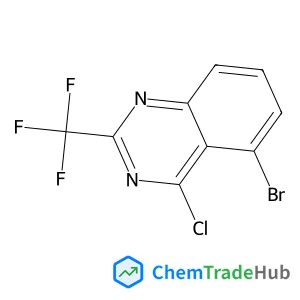
5-Bromo-4-chloro-2-(trifluoromethyl)quinazoline
CAS Number:
2089311-03-3
Molecular Formula:
C9H3BrClF3N2
James N. Bull, Christopher W. West, Jan R. R. Verlet
Photoelectron velocity-map imaging and electronic structure calculations have been used to study the temporary anion (resonance) dynamics of the closed-shell site-specific deprotonated tetracene anion (C18H11−) in the hv = 3.26 eV (380 nm) to 4.13 eV (300 nm) range. In accord with a recent frequency-, angle-, and time-resolved photoelectron imaging study on a related but open-shell polyaromatic radical anion (Chem. Sci., 2015, 6, 1578–1589), population of π*-resonances situated in the detachment continuum efficiently recover the ground electronic state of the anion through ultrafast non-adiabatic dynamics, followed by characteristic statistical electron loss (thermionic emission). The combined electron yield of direct photodetachment and autodetachment from the optically-accessed resonances in C18H11− is several orders of magnitude smaller than thermionic emission from the ground electronic electronic state in the photon energy range studied. This result implies a resilience to prompt photoejection from UV radiation, and the ability of neutral PAH-like species to capture a free electron and form a long-lived molecular anion that ultimately decays by thermionic emission on a millisecond timescale. The attachment mechanism applies to polyaromatic species that cannot support dipole-bound states, and may provide an additional route to forming anions in astrochemical environments.
Alexey A. Festa, Olga A. Storozhenko, Leonid G. Voskressensky
DOI: 10.1039/D3CS00366C
DOI: 10.1039/D3CS00194F
Jinmin Miao, Jiajun Dong, Yiming Miao, Yunpeng Bai, Zihan Qu, Brenson A. Jassim, Bo Huang, Quyen Nguyen, Yuan Ma, Allison A. Murray, Jinyue Li
DOI: 10.1039/D3SC04541B
Jun-Jie Fang, Zheng Liu, Yang-Lin Shen, Yun-Peng Xie, Xing Lu
DOI: 10.1039/D3SC04682F
Dameng Yang, Nicholas J. Turner
DOI: 10.1039/D3CS00391D
Yonghua Liu
DOI: 10.1039/D3SC04688E
Mohammad Rafiee, Dylan J. Abrams, Luana Cardinale, Zachary Goss, Shannon S. Stahl
DOI: 10.1039/D2CS00706A
Rahul Dev Mukhopadhyay
DOI: 10.1039/D3CS00692A
Waste containing 6-Chloro-5-(2'-hydroxy-3'-methoxy-4-biphenylyl)-3-(3-methoxyphe...
(3alpha,5alpha)-3-Hydroxypregnane-11,20-dione is primarily used in the pharmaceu...
The market for 4-Amino-6-chloro-2-pyridinecarboxylic acid (CAS: 546141-56-4) is ...
Alternatives to (2-Benzoylethyl)trimethylammonium chloride (CAS: 24472-88-6) in ...
N-[4-Nitro-3-(trifluoromethyl)phenyl]acetamide (CAS: 393-12-4) is generally safe...
Alternative reagents such as other phosphates or similar functional groups can b...
There are alternatives to N,N'-Bis(3-aminopropyl)-1,3-propanediamine (CAS: 4605-...
When handling Aluminium trihexadecanoate, it is important to use appropriate per...
(1,1-Dioxido-3-oxo-1,2-benzothiazol-2(3H)-yl)acetic acid is a chemical compound ...
Several alternatives to 5,5-dimethyloxolan-2-one (CAS: 3123-97-5) can be used in...

Physical Chemistry Chemical Physics (PCCP) is an international journal co-owned by 19 physical chemistry and physics societies from around the world. This journal publishes original, cutting-edge research in physical chemistry, chemical physics and biophysical chemistry. To be suitable for publication in PCCP, articles must include significant innovation and/or insight into physical chemistry; this is the most important criterion that reviewers and Editors will judge against when evaluating submissions. The journal has a broad scope and welcomes contributions spanning experiment, theory, computation and data science. Topical coverage includes spectroscopy, dynamics, kinetics, statistical mechanics, thermodynamics, electrochemistry, catalysis, surface science, quantum mechanics, quantum computing and machine learning. Interdisciplinary research areas such as polymers and soft matter, materials, nanoscience, energy, surfaces/interfaces, and biophysical chemistry are welcomed if they demonstrate significant innovation and/or insight into physical chemistry. Joined experimental/theoretical studies are particularly appreciated when complementary and based on up-to-date approaches.
![2-morpholino-2-[2-(trifluoromethyl)pyrimidin-5-yl]ethanamine structure](https://static.chemtradehub.com/structs/119/1192570-20-9-2810.webp "2-morpholino-2-[2-(trifluoromethyl)pyrimidin-5-yl]ethanamine structure")





