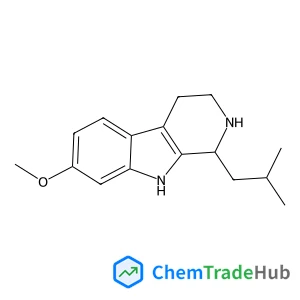
1-Isobutyl-7-methoxy-2,3,4,9-tetrahydro-1H-beta-carboline
CAS Number:
175975-76-5
Molecular Formula:
C16H22N2O
Yamilet Rodríguez-Lazcano, Belén Maté, Víctor J. Herrero, Rafael Escribano, Óscar Gálvez
Carbon dioxide and ammonia are two of the most abundant species in astrophysical media, where they can react in the solid phase under certain conditions. This contribution presents a study of this reaction both in the presence of water and for anhydrous samples. It is shown that after deposition at 15 K, the reaction can start by warming the deposit, and the process continues on up to a temperature of 220 K. Reaction products are studied using infrared spectroscopy and mass spectrometry. For anhydrous samples, a 2 : 1 stoichiometry mixture of NH3 : CO2 gives the highest yield of products. The reaction is favored when a small amount of water is present, which enables ammonia and carbon dioxide molecules to collide within the pores and channels of the amorphous water solid. Large concentration of water, on the other hand, hampers such collisions. The main reaction product is found to be ammonium carbamate, but also carbamic acid is formed, and, in the presence of water, ammonium bicarbonate is produced as well. Theoretical calculations are carried out to provide the basis for the assignment of the spectra. Some of the experiments presented in this contribution consist of the generation of a compact water ice matrix where the carbamate and ammonium ions are embedded. If such a system was found in astrophysical media, it is shown that the ammonium ion could not be detected, whereas two infrared features of the carbamate ion in the 1040 to 1115 cm−1 (9 to 9.6 μm) region could enable the observation of this species.
Per Wiklund, Jan Bergman
DOI: 10.1039/B209505J
Yu Wang, Chenlong Wei, Ruyun Tang, Haosheng Zhan, Jing Lin, Zhenhua Liu, Weihua Tao, Zhongxue Fang
DOI: 10.1039/C8OB01749B
Hideto Miyabe, Kayoko Fujii, Takeaki Naito
DOI: 10.1039/B208823A
R. Schettini, C. Costabile, G. Della Sala, J. Buirey, M. Tosolini, P. Tecilla, M. C. Vaccaro, I. Bruno, F. De Riccardis, I. Izzo
DOI: 10.1039/C8OB01522H
Gregory Bar, Andrew F. Parsons, C. Barry Thomas
DOI: 10.1039/B209123B
Michal März, Michal Kohout, Tomáš Neveselý, Josef Chudoba, Dorota Prukała, Stanislaw Niziński, Marek Sikorski, Gotard Burdziński, Radek Cibulka
DOI: 10.1039/C8OB01822G
Edda E. Neuteboom, Edwin H. A. Beckers, Stefan C. J. Meskers, E. W. Meijer, René A. J. Janssen
DOI: 10.1039/B208824J
Samuel D. Griggs, Nathan Thompson, Daniel T. Tape, Marie Fabre, Paul A. Clarke
DOI: 10.1039/C8OB90117A
Daniel T. Gryko, Beata Koszarna
DOI: 10.1039/B208950E
N-(4-Methoxybenzyl)-2-pyridinamine (CAS: 52818-63-0) is increasingly being used ...
When handling Ethyl 4-(2-chlorophenyl)-1,3-thiazole-2-carboxylate, appropriate p...
Diethyldiselane (CAS: 628-39-7) is classified under the Globally Harmonized Syst...
The market for oxocopper (CAS: 12053-18-8) is primarily driven by its use in cat...
The market for 5-{[(2-Methyl-2-propanyl)oxy]carbonyl}-5-azaspiro[2.4]heptane-7-c...
2-(1-Pyrrolidinyl)-4-pyridinamine is a chemical compound with the CAS number 359...
2-(3-Pyridinyl)-1-azabicyclo[2.2.2]octane (CAS: 91556-75-1) is a crystalline sol...
(S)-Alpha-allyl-proline hydrochloride is usually synthesized via a Wittig reacti...
3-Methyl-1,2-oxazole-5-carboxylic acid (CAS: 4857-42-5) is an organic compound w...
Lys-SMCC-DM1 is synthesized via a multi-step process involving the coupling of S...

Physical Chemistry Chemical Physics (PCCP) is an international journal co-owned by 19 physical chemistry and physics societies from around the world. This journal publishes original, cutting-edge research in physical chemistry, chemical physics and biophysical chemistry. To be suitable for publication in PCCP, articles must include significant innovation and/or insight into physical chemistry; this is the most important criterion that reviewers and Editors will judge against when evaluating submissions. The journal has a broad scope and welcomes contributions spanning experiment, theory, computation and data science. Topical coverage includes spectroscopy, dynamics, kinetics, statistical mechanics, thermodynamics, electrochemistry, catalysis, surface science, quantum mechanics, quantum computing and machine learning. Interdisciplinary research areas such as polymers and soft matter, materials, nanoscience, energy, surfaces/interfaces, and biophysical chemistry are welcomed if they demonstrate significant innovation and/or insight into physical chemistry. Joined experimental/theoretical studies are particularly appreciated when complementary and based on up-to-date approaches.
![1-{3-[4-Amino-3-(4-phenoxyphenyl)-1H-pyrazolo[3,4-d]pyrimidin-1-yl]-1-piperidinyl}-2,3-dihydroxy-1-propanone structure](https://static.chemtradehub.com/structs/122/1226872-27-0-e037.webp "1-{3-[4-Amino-3-(4-phenoxyphenyl)-1H-pyrazolo[3,4-d]pyrimidin-1-yl]-1-piperidinyl}-2,3-dihydroxy-1-propanone structure")