












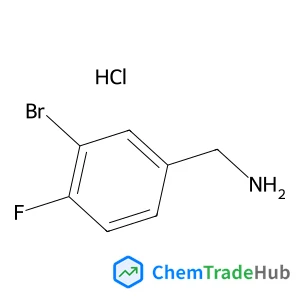
1-(3-Bromo-4-fluorophenyl)methanamine hydrochloride (1:1)
CAS Number:
202865-68-7
Molecular Formula:
C7H8BrClFN
Lars Borchardt, Martin Oschatz, Silvia Paasch, Stefan Kaskel, Eike Brunner
Electrochemical double-layer capacitors (EDLCs or supercapacitors) are of special potential interest with respect to energy storage. Nearly all EDLCs make use of porous carbons as electrode materials. Further tuning of their performance in EDLC applications requires a better understanding of their properties. In particular, the understanding of the interactions between carbon-based materials and electrolyte solutions is of fundamental interest with respect to future applications. Since the capacitance of carbon-based electrode materials is known to depend on the pore size, we have studied different porous carbon materials of well-defined, variable pore size loaded with 1 M TEABF4 in acetonitrile or with pure acetonitrile using solid-state magic angle spinning (MAS) 1H, 11B, and 13C NMR spectroscopy.
Wenming Wu, Kieu The Loan Trinh, Nae Yoon Lee
DOI: 10.1039/C2AN35077G
Alicia D. Powers, Bi Liu, Andrew G. Lee, Sean P. Palecek
DOI: 10.1039/C2AN35464K
Hanye Zheng, Kefeng Xu, Linguang Luo, Yibiao Song, Zhenyu Lin, Longhua Guo, Bin Qiu, Guonan Chen
DOI: 10.1039/C3AN01194A
Anna Kisiel, Honorata Marcisz, Agata Michalska, Krzysztof Maksymiuk
DOI: 10.1039/B510868C
Xichuan Wei, Haizhu Zhang, Ming Niu, Dingkun Zhang
DOI: 10.1039/C9AY01310E
Michaela Meyns, Sebastian Primpke, Gunnar Gerdts
DOI: 10.1039/C9AY01193E
Xiaoqing Zhu, Lianglan Wu, Divyesh C. Mungra, Sijing Xia, Jin Zhu
DOI: 10.1039/C2AN35074B
Lingzhi Cao, Guangshun Wang, Wenjia Ji, Hailiang Nie, Chunliu Yang, Xiaoling Zhang
DOI: 10.1039/C9AY01555H
Jia-Ming Liu, Li-ping Lin, Xin-Xing Wang, Shao-Qin Lin, Wen-Lian Cai, Li-Hong Zhang, Zhi-Yong Zheng
DOI: 10.1039/C2AN35130G
When considering alternatives to 1-(4-Chlorophenyl)-N-hydroxymethanimine (CAS: 3...
This compound should be stored in a cool, dry place away from direct sunlight. I...
3-(4-Bromophenyl)-5-(2-fluorophenyl)-1,2,4-oxadiazole is synthesized through a m...
5-Chloro-2-(4-chlorophenyl)-4-methyl-6-[3-(1-piperidinyl)propoxy]pyrimidine (CAS...
2-Chloro-4-(difluoromethoxy)pyridine is used in the pharmaceutical industry for ...
3-Chloro-6-methylpyridazine (CAS: 1121-79-5) is classified under the Globally Ha...
Several alternatives can be used in the synthesis of Methyl 4,5-dimethyl-2-nitro...
Alternatives to (2E,2'E)-3,3'-(1,4-Phenylene)bisacrylaldehyde include other acry...
3-Amino-5-chloropyridin-2-ol hydrochloride is an organic compound with the CAS n...
When handling 6,7-Difluoro-2,3-dihydro-4H-chromen-4-one, it is essential to wear...

Physical Chemistry Chemical Physics (PCCP) is an international journal co-owned by 19 physical chemistry and physics societies from around the world. This journal publishes original, cutting-edge research in physical chemistry, chemical physics and biophysical chemistry. To be suitable for publication in PCCP, articles must include significant innovation and/or insight into physical chemistry; this is the most important criterion that reviewers and Editors will judge against when evaluating submissions. The journal has a broad scope and welcomes contributions spanning experiment, theory, computation and data science. Topical coverage includes spectroscopy, dynamics, kinetics, statistical mechanics, thermodynamics, electrochemistry, catalysis, surface science, quantum mechanics, quantum computing and machine learning. Interdisciplinary research areas such as polymers and soft matter, materials, nanoscience, energy, surfaces/interfaces, and biophysical chemistry are welcomed if they demonstrate significant innovation and/or insight into physical chemistry. Joined experimental/theoretical studies are particularly appreciated when complementary and based on up-to-date approaches.
![[4-(Isobutyrylamino)phenyl]boronic acid structure](https://static.chemtradehub.com/structs/874/874219-50-8-6ab5.webp "[4-(Isobutyrylamino)phenyl]boronic acid structure")



