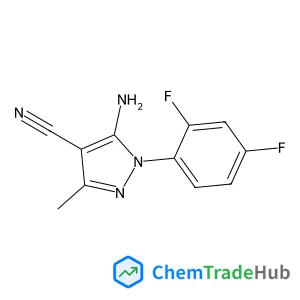
5-Amino-1-(2,4-difluorophenyl)-3-methyl-1H-pyrazole-4-carbonitrile
CAS Number:
1020057-92-4
Molecular Formula:
C11H8F2N4
Anna Kisiel, Honorata Marcisz, Agata Michalska, Krzysztof Maksymiuk
A novel construction of solution free (pseudo)reference electrodes, compatible with all-solid-state potentiometric indicator electrodes, has been proposed. These electrodes use conducting polymers (CP): polypyrrole (PPy) or poly(3,4-ethylenedioxythiophene) (PEDOT). Two different arrangements have been tested: solely based on CP and those where the CP phase is covered with a poly(vinyl chloride) based outer membrane of tailored composition. The former arrangement was designed to suppress or compensate cation- and anion-exchange, using mobile perchlorate ions and poly(4-styrenesulfonate) or dodecylbenzenesulfonate anions as immobilized dopants. The following systems were used: (i) polypyrrole layers doped simultaneously by two kinds of anions, both mobile and immobilized in the polymer layer; (ii) bilayers of polypyrrole with anion exchanging inner layer and cation-exchanging outer layer; (iii) polypyrrole doped by surfactant dodecylbenzenesulfonate ions, which inhibit ion exchange on the polymer/solution interface. For the above systems, recorded potentials have been found to be practically independent of electrolyte concentration. The best results, profound stability of potentials, have been obtained for poly(3,4-ethylenedioxythiophene) or polypyrrole doped by poly(4-styrenesulfonate) anions covered by a poly(vinyl chloride) based membrane, containing both anion- and cation- exchangers as well as solid potassium chloride and silver chloride with metallic silver. Differently to the cases (i)–(iii) these electrodes are much less sensitive to the influence of redox and pH interferences. This arrangement has been also characterized using electrochemical impedance spectroscopy and chronopotentiometry.
DOI: 10.1039/A909729E
Yingqiu Liang
DOI: 10.1039/A909317F
Ming Deng, Fang Guo, Daohong Liao, Yang Li
DOI: 10.1039/C7PY01516J
Antonio Laganà, Alessandro Bolloni, Stefano Crocchianti
DOI: 10.1039/A908781H
Xue Gu, Liuqiao Zhang, Ying Li, Wei Zhang, Jian Zhu, Zhengbiao Zhang
DOI: 10.1039/C7PY02125A
Abeer A. Alzahrani, Mohand Saed, Christopher M. Yakacki, Han Byul Song, Nancy Sowan, Joshua J. Walston, Parag K. Shah, Matthew K. McBride
DOI: 10.1039/C7PY01121K
Rajendran Amarnath Praphakar, Harshavardhan Shakila, Vijayan N. Azger Dusthackeer, Murugan A. Munusamy, Suresh Kumar, Mariappan Rajan
DOI: 10.1039/C8PY90009D
Hermann Vortisch, Benedikt Krämer, Inez Weidinger, Ludger Wöste, Thomas Leisner, Martin Schwell, Helmut Baumgärtel, Eckart Rühl
DOI: 10.1039/A908225E
Ethyl 4-chlorothieno[2,3-b]pyridine-5-carboxylate (CAS: 59713-58-5) can be synth...
5-Methyl-1H-indole-3-carbaldehyde (CAS: 52562-50-2) is subject to various regula...
(1,3-Dimethyl-2,4-dioxo-1,2,3,4-tetrahydro-5-pyrimidinyl)boronic acid is a white...
Waste containing Sulfocostunolide A (CAS: 1016983-51-9) should be handled with c...
When handling Murraxocin (CAS: 88478-44-8), ensure proper personal protective eq...
Formvar (CAS: 63148-64-1) is an alkyd resin characterized by a high molecular we...
(S)-4-benzyl-2-((benzyloxy)methyl)morpholine is generally safe when handled with...
Methyl 1-(5-bromo-2-pyrimidinyl)cyclopropanecarboxylate (CAS: 1447607-69-3) is p...
2-Methyl-1-phenyl-1-propanamine hydrochloride (CAS: 24290-47-9) is generally con...
3-(4-Bromophenyl)-2-methylpropanoic acid is synthesized through a multi-step pro...

Analyst publishes analytical and bioanalytical research that reports premier fundamental discoveries and inventions, and the applications of those discoveries, unconfined by traditional discipline barriers.