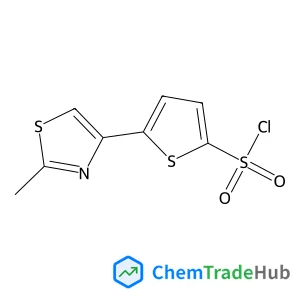
5-(2-Methyl-1,3-thiazol-4-yl)-2-thiophenesulfonyl chloride
CAS Number:
215434-25-6
Molecular Formula:
C8H6ClNO2S3
Xi Zhang, Chang Q. Sun, Hajime Hirao
Gold nanoparticles have been widely used as nanocarriers in gene delivery. However, the binding mechanism between gold nanoparticles and DNA bases remains a puzzle. We performed density functional theory calculations with and without dispersion correction on AuN (N = 13, 55, or 147) nanoparticles in high-symmetry cuboctahedral structures to understand the mechanism of their binding with guanine at the under-coordinated sites. Our study verified that: (i) negative charges transfer from the inner area to the surface of a nanoparticle as a result of the surface quantum trapping effect; and (ii) the valence states shift up toward the Fermi level, and thereby participate more actively in the binding to guanine. These effects are more prominent in a smaller nanoparticle, which has a larger surface-to-volume ratio. Additional fragment orbital analysis revealed that: (i) electron donation from the lone-pair orbital of N to the unoccupied orbital of the Au cluster occurs in all complexes; (ii) π back-donation occurs from the polarized Au dyz orbital to the N py-π* orbital when there is no Au⋯H–N hydrogen bond, and, (iii) depending on the configuration, Au⋯H–N hydrogen bonding can also exist, to which the Au occupied orbital and the H–N unoccupied orbital contribute.
M. Calizzi, F. Venturi, M. Ponthieu, F. Cuevas, V. Morandi, T. Perkisas, S. Bals, L. Pasquini
DOI: 10.1039/C5CP03092G
Robert Richter, David Wolter, Tobias Zimmermann, Lasse Landt, Andre Knecht, Christoph Heidrich, Andrea Merli, Otto Dopfer, Philipp Reiß, Arno Ehresmann, Jens Petersen, Jeremy E. Dahl, Robert M. K. Carlson, Christoph Bostedt, Thomas Möller, Roland Mitric, Torbjörn Rander
DOI: 10.1039/C5CP90213D
Stephan Mohr, Luigi Genovese, Damien Caliste, Paul Boulanger, Stefan Goedecker, Thierry Deutsch
DOI: 10.1039/C5CP00437C
Eliana Maza, Jimena S. Tuninetti, Nikolaos Politakos, Wolfgang Knoll, Sergio Moya, Omar Azzaroni
DOI: 10.1039/C5CP03965G
Tobias Schwabe, Maarten T. P. Beerepoot, Jacob Kongsted
DOI: 10.1039/C5CP90225H
Liyan Feng, Yuejie Liu, Jingxiang Zhao
DOI: 10.1039/C5CP05551B
Yan Wang, Hai Li, Jijun Zhang, Xinyu Yan, Zexiang Chen
DOI: 10.1039/C5CP05336F
Jean-François Lefebvre, Fiona A. Black, E. Stephen Davies, Tönu Pullerits, Christopher J. Wood, Karel Zidek
DOI: 10.1039/C5CP05177K
Waste containing 6-Chloro-5-(2'-hydroxy-3'-methoxy-4-biphenylyl)-3-(3-methoxyphe...
(3alpha,5alpha)-3-Hydroxypregnane-11,20-dione is primarily used in the pharmaceu...
The market for 4-Amino-6-chloro-2-pyridinecarboxylic acid (CAS: 546141-56-4) is ...
Alternatives to (2-Benzoylethyl)trimethylammonium chloride (CAS: 24472-88-6) in ...
N-[4-Nitro-3-(trifluoromethyl)phenyl]acetamide (CAS: 393-12-4) is generally safe...
Alternative reagents such as other phosphates or similar functional groups can b...
There are alternatives to N,N'-Bis(3-aminopropyl)-1,3-propanediamine (CAS: 4605-...
When handling Aluminium trihexadecanoate, it is important to use appropriate per...
(1,1-Dioxido-3-oxo-1,2-benzothiazol-2(3H)-yl)acetic acid is a chemical compound ...
Several alternatives to 5,5-dimethyloxolan-2-one (CAS: 3123-97-5) can be used in...

Physical Chemistry Chemical Physics (PCCP) is an international journal co-owned by 19 physical chemistry and physics societies from around the world. This journal publishes original, cutting-edge research in physical chemistry, chemical physics and biophysical chemistry. To be suitable for publication in PCCP, articles must include significant innovation and/or insight into physical chemistry; this is the most important criterion that reviewers and Editors will judge against when evaluating submissions. The journal has a broad scope and welcomes contributions spanning experiment, theory, computation and data science. Topical coverage includes spectroscopy, dynamics, kinetics, statistical mechanics, thermodynamics, electrochemistry, catalysis, surface science, quantum mechanics, quantum computing and machine learning. Interdisciplinary research areas such as polymers and soft matter, materials, nanoscience, energy, surfaces/interfaces, and biophysical chemistry are welcomed if they demonstrate significant innovation and/or insight into physical chemistry. Joined experimental/theoretical studies are particularly appreciated when complementary and based on up-to-date approaches.
![2-Methyl-2-propanyl [2-(2-oxa-6-azaspiro[3.3]hept-6-yl)ethyl]carbamate structure](https://static.chemtradehub.com/structs/141/1415562-38-7-c0a4.webp "2-Methyl-2-propanyl [2-(2-oxa-6-azaspiro[3.3]hept-6-yl)ethyl]carbamate structure")
![Benzo[b]naphtho[2,1-d]thiophene structure](https://static.chemtradehub.com/structs/239/239-35-0-ff90.webp "Benzo[b]naphtho[2,1-d]thiophene structure")