












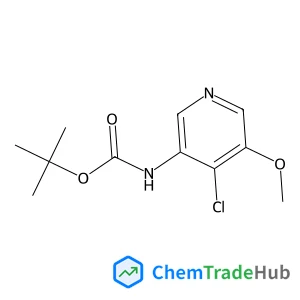
tert-Butyl 4-chloro-5-methoxypyridin-3-ylcarbamate
CAS Number:
1045858-17-0
Molecular Formula:
C11H15ClN2O3
Eliana Maza, Jimena S. Tuninetti, Nikolaos Politakos, Wolfgang Knoll, Sergio Moya, Omar Azzaroni
The layer-by-layer construction of interfacial architectures displaying stimuli-responsive control of mass transport is attracting increasing interest in materials science. In this work, we describe the creation of interfacial architectures displaying pH-dependent ionic transport properties which until now have not been observed in polyelectrolyte multilayers. We describe a novel approach to create pH-controlled ion-rectifying systems employing polyelectrolyte multilayers assembled from a copolymer containing both weakly and strongly charged pendant groups, poly(4-styrenesulfonic acid-co-maleic acid) (PSS-MA), alternately deposited with poly(diallyldimethylammonium chloride) (PDADMAC). The conceptual framework is based on the very contrasting and differential interactions of PSS and MA units with PDADMAC. In our setting, sulfonate groups play a structural role by conferring stability to the multilayer due to the strong electrostatic interactions with the polycations, while the weakly interacting MA groups remain “silent” within the film and then act as on-demand pH-responsive units. When these multilayers are combined with a strong cationic capping layer that repels the passage of cationic probes, a pH-gateable rectified transport of anions is observed. Concomitantly, we also observed that these functional properties are significantly affected when multilayers are subjected to extensive pH cycling as a consequence of irreversible morphological changes taking place in the film. We envision that the synergy derived from combining weak and strong interactions within the same multilayer will play a key role in the construction of new interfacial architectures displaying tailorable ion transport properties.
Yudong Xue
DOI: 10.1039/D3CS00706E
Sungwoon Lee, Liyan Bi, Hao Chen, Dong Lin, Rongchao Mei, Yixuan Wu, Sang-Woo Joo, Jaebum Choo
DOI: 10.1039/D3CS00709J
Helena F. Piedra, Victoria Gebler, Carlos Valdés, Manuel Plaza
DOI: 10.1039/D3SC05263J
Fang He, Shi-Zhang Qiao
DOI: 10.1039/D3CS00445G
J. Nolan McNeill, Jeremy P. Bard, Darren W. Johnson, Michael M. Haley
DOI: 10.1039/D3CS00737E
Virender K. Sharma, Xingmao Ma
DOI: 10.1039/D3CS00627A
Xinke Kong, Lin Ru, Junjun Ge, Yalei Deng, Pan-ke Zhang, Yuanyuan Wang
DOI: 10.1039/D3SC04296K
Albert Poater
DOI: 10.1039/D3CS00725A
Waste containing 6-Chloro-5-(2'-hydroxy-3'-methoxy-4-biphenylyl)-3-(3-methoxyphe...
(3alpha,5alpha)-3-Hydroxypregnane-11,20-dione is primarily used in the pharmaceu...
The market for 4-Amino-6-chloro-2-pyridinecarboxylic acid (CAS: 546141-56-4) is ...
Alternatives to (2-Benzoylethyl)trimethylammonium chloride (CAS: 24472-88-6) in ...
N-[4-Nitro-3-(trifluoromethyl)phenyl]acetamide (CAS: 393-12-4) is generally safe...
Alternative reagents such as other phosphates or similar functional groups can b...
There are alternatives to N,N'-Bis(3-aminopropyl)-1,3-propanediamine (CAS: 4605-...
When handling Aluminium trihexadecanoate, it is important to use appropriate per...
(1,1-Dioxido-3-oxo-1,2-benzothiazol-2(3H)-yl)acetic acid is a chemical compound ...
Several alternatives to 5,5-dimethyloxolan-2-one (CAS: 3123-97-5) can be used in...

Physical Chemistry Chemical Physics (PCCP) is an international journal co-owned by 19 physical chemistry and physics societies from around the world. This journal publishes original, cutting-edge research in physical chemistry, chemical physics and biophysical chemistry. To be suitable for publication in PCCP, articles must include significant innovation and/or insight into physical chemistry; this is the most important criterion that reviewers and Editors will judge against when evaluating submissions. The journal has a broad scope and welcomes contributions spanning experiment, theory, computation and data science. Topical coverage includes spectroscopy, dynamics, kinetics, statistical mechanics, thermodynamics, electrochemistry, catalysis, surface science, quantum mechanics, quantum computing and machine learning. Interdisciplinary research areas such as polymers and soft matter, materials, nanoscience, energy, surfaces/interfaces, and biophysical chemistry are welcomed if they demonstrate significant innovation and/or insight into physical chemistry. Joined experimental/theoretical studies are particularly appreciated when complementary and based on up-to-date approaches.
![Benzo[b]naphtho[2,1-d]thiophene structure](https://static.chemtradehub.com/structs/239/239-35-0-ff90.webp "Benzo[b]naphtho[2,1-d]thiophene structure")
![4-{[4-(Trifluoromethoxy)benzyl]oxy}benzonitrile structure](https://static.chemtradehub.com/structs/103/1036629-63-6-2172.webp "4-{[4-(Trifluoromethoxy)benzyl]oxy}benzonitrile structure")
![1-(2-Chlorophenyl)-6-[(2S)-3,3,3-trifluoro-2-methylpropyl]-1,7-dihydro-4H-pyrazolo[3,4-d]pyrimidin-4-one structure](https://static.chemtradehub.com/structs/794/794568-91-5-0c34.webp "1-(2-Chlorophenyl)-6-[(2S)-3,3,3-trifluoro-2-methylpropyl]-1,7-dihydro-4H-pyrazolo[3,4-d]pyrimidin-4-one structure")





