












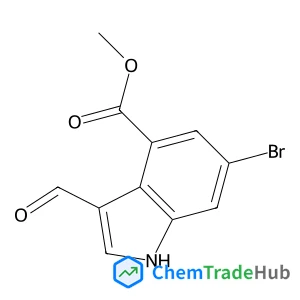
methyl 6-bromo-3-formyl-1H-indole-4-carboxylate
CAS Number:
1353636-63-1
Molecular Formula:
C11H8BrNO3
Kyunghwan Oh, Youngwook P. Seo, Soon Man Hong, Atsushi Takahara, Kyoung Hwan Lee, Yongsok Seo
For the preparation of nanocomposites, we conducted environmentally benign foaming processing on polypropylene (PP) copolymer/clay nanocomposites via a batch process in an autoclave. We investigated the dispersion and the exfoliation of the nanoclay particles. Full exfoliation was achieved by the foamability of the matrix PP copolymer using supercritical carbon dioxide (sc CO2) and subcritical carbon dioxide (sub CO2). More and smaller cells were observed when the clay was blended as heterogeneous nuclei and sc CO2 was used. Small angle X-ray scattering showed that highly dispersed states (exfoliation) of the clay particles were obtained by the foaming process. Since the clay particles provided more nucleating sites for the foaming of the polymer, a well dispersed (or fully exfoliated) nanocomposite exhibited a higher cell density and a smaller cell size at the same clay particle concentration. Expansion of the adsorbed CO2 facilitated the exfoliation of the clay platelets; thus, sc CO2 at lower temperature was more efficient for uniform foaming-cell production. Fully dispersed clay platelets were, however, re-aggregated when subjected to a further melting processing. The reprocessed nanocomposites still had some exfoliated platelets as well as some aggregated intercalates. The dual role of the nanoclay particles as foaming nucleus and a crystallization nucleus was confirmed by cell growth observation and nonisothermal crystallization kinetics analysis. A low foaming temperature and a high saturation pressure were more favorable for obtaining a uniform foam. The PP copolymer was found to be foamed more easily than polypropylene. A small amount of other olefin moieties in the backbone of the polymer facilitated better foamability than the neat polypropylene.
Wen Lu, Ze Yuan, Chunyang Xu, Jiqiang Ning, Yijun Zhong, Ziyang Zhang, Yong Hu
DOI: 10.1039/C8TA10998B
Andrea Marcucci, Francesca Zurlo, Isabella Natali Sora, Stefano Casciardi, Silvia Licoccia, Elisabetta Di Bartolomeo
DOI: 10.1039/C8TA10645B
Ilich A. Ibarra, Peter A. Bayliss, Eduardo Pérez, Sihai Yang, Alexander J. Blake, Harriott Nowell, David R. Allan, Martyn Poliakoff, Martin Schröder
DOI: 10.1039/C1GC15726D
Sachin Kumar, Ghuzanfar Saeed, Nam Hoon Kim
DOI: 10.1039/C8TA00889B
Jane V. Knichal, William J. Gee, Andrew D. Burrows, Paul R. Raithby, Chick C. Wilson
DOI: 10.1039/C5CE01689D
Paz Sebastia-Luna, María C. Gélvez-Rueda, Chris Dreessen, Michele Sessolo, Ferdinand C. Grozema, Francisco Palazon, Henk J. Bolink
DOI: 10.1039/D0TA02237C
Kalani Periyapperuma, Jennifer M. Pringle, Laura Sanchez-Cupido, Maria Forsyth, Cristina Pozo-Gonzalo
DOI: 10.1039/D1GC00361E
Xiao-Yao Dao, Jin-Han Guo, Xiao-Yu Zhang, Shi-Qing Wang, Xiao-Mei Cheng, Wei-Yin Sun
DOI: 10.1039/D0TA10278D
(5-Sulfamoyl-3-pyridinyl)boronic acid is primarily used in chemical synthesis, p...
Benzyl 2-methyl-2-(methylsulfonyl)-4-pentenoate is typically synthesized via est...
When handling 8-Fluoroquinolin-6-ol (CAS: 209353-22-0), it is important to use p...
1,3-Dibromo-5-(2-methyl-2-propanyl)benzene (CAS: 129316-09-2) is a crystalline c...
Ethyl 7-chloro-4-oxo-1-(1,3-thiazol-2-yl)-1,4-dihydro-1,8-naphthyridine-3-carbox...
When handling Delta-7-Avenasterol (CAS: 23290-26-8), it is important to wear app...
Proper handling involves the use of personal protective equipment such as gloves...
When handling 2-Methyl-2-proanyl 4-[(2-aminophenyl)amino]-1-piperidinecarboxylat...
N-Methyl-4-chlorobenzylamine hydrochloride (CAS: 65542-24-7) is a organic compou...
[2-(Dodecyloxy)ethoxy]acetic acid (CAS: 27306-90-7) is generally considered safe...

Physical Chemistry Chemical Physics (PCCP) is an international journal co-owned by 19 physical chemistry and physics societies from around the world. This journal publishes original, cutting-edge research in physical chemistry, chemical physics and biophysical chemistry. To be suitable for publication in PCCP, articles must include significant innovation and/or insight into physical chemistry; this is the most important criterion that reviewers and Editors will judge against when evaluating submissions. The journal has a broad scope and welcomes contributions spanning experiment, theory, computation and data science. Topical coverage includes spectroscopy, dynamics, kinetics, statistical mechanics, thermodynamics, electrochemistry, catalysis, surface science, quantum mechanics, quantum computing and machine learning. Interdisciplinary research areas such as polymers and soft matter, materials, nanoscience, energy, surfaces/interfaces, and biophysical chemistry are welcomed if they demonstrate significant innovation and/or insight into physical chemistry. Joined experimental/theoretical studies are particularly appreciated when complementary and based on up-to-date approaches.
![5,7-Dihydroxy-3-(4-hydroxyphenyl)-6-[(1R,6R)-3-methyl-6-prop-1-en-2-ylcyclohex-2-en-1-yl]chromen-4-one structure](https://static.chemtradehub.com/structs/191/1914963-20-4-2b05.webp "5,7-Dihydroxy-3-(4-hydroxyphenyl)-6-[(1R,6R)-3-methyl-6-prop-1-en-2-ylcyclohex-2-en-1-yl]chromen-4-one structure")
![4,4-Difluoro-2-methyl-1-{[(2-methyl-2-propanyl)oxy]carbonyl}-L-proline structure](https://static.chemtradehub.com/structs/119/1194032-23-9-f426.webp "4,4-Difluoro-2-methyl-1-{[(2-methyl-2-propanyl)oxy]carbonyl}-L-proline structure")
![Bis(N,N''-dimethylpiperazine)tetra[copper(I) iodide] structure](https://static.chemtradehub.com/structs/140/1401708-91-5-2b86.webp "Bis(N,N''-dimethylpiperazine)tetra[copper(I) iodide] structure")




