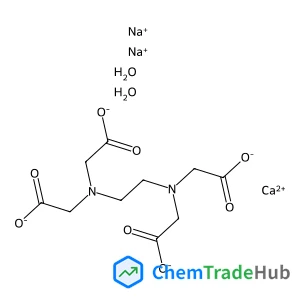
EthylenediaminetetraaceticacidcalciumDisodiumsalthydrate
CAS Number:
23411-34-9
Molecular Formula:
C10H16CaN2Na2O10
Hamdi Ben Yahia, Masahiro Shikano, Hironori Kobayashi, Maxim Avdeev, Samuel Liu, Chris D. Ling
The new compound MnF2−x(OH)x (x ∼ 0.8) was synthesized by a hydrothermal route from a 1 : 1 molar ratio of lithium fluoride and manganese acetate in an excess of water. The crystal structure was determined using the combination of single crystal X-ray and neutron powder diffraction measurements. The magnetic properties of the title compound were characterized by magnetic susceptibility and low-temperature neutron powder diffraction measurements. MnF2−x(OH)x (x ∼ 0.8) crystallizes with orthorhombic symmetry, space group Pnn2 (no. 34), a = 4.7127(18), b = 5.203(2), c = 3.2439(13) Å, V = 79.54(5) Å3 and Z = 2. The crystal structure is a distorted rutile-type with [Mn(F,O)4] infinite edge-sharing chains along the c-direction. The protons are located in the channels and form O–H⋯F bent hydrogen bonds. The magnetic susceptibility measurements indicate an antiferromagnetic ordering at ∼70 K and the neutron powder diffraction measurements at 3 K show that the ferromagnetic chains with spins parallel to the c-axis are antiferromagnetically coupled to each other, similarly to the magnetic structure of tetragonal rutile-type MnF2 with isoelectronic Mn2+. MnF2−x(OH)x (x ∼ 0.8) is expected to be of great interest as a positive electrode for Li cells if the protons could be exchanged for lithium.
Drew F. Parsons, Mathias Boström, Pierandrea Lo Nostro, Barry W. Ninham
DOI: 10.1039/C1CP20538B
Janne Halme
DOI: 10.1039/C1CP21134J
Yongcai Qiu, Xinfeng Zhang, Shihe Yang
DOI: 10.1039/C1CP21148J
Kandadai Srinivasan, Bidyut Baran Saha, Kim Choon Ng, Pradip Dutta, Madhu Prasad
DOI: 10.1039/C1CP20383E
Michael Filatov
DOI: 10.1039/C0CP02450C
Susanna Monti, Ivo Cacelli, Alessandro Ferretti, Giacomo Prampolini, Vincenzo Barone
DOI: 10.1039/C1CP21115C
Shmuel Zilberg, Yehuda Haas
DOI: 10.1039/C1CP20268E
Aurora J. Cruz-Cabeza, Graeme M. Day, William Jones
DOI: 10.1039/C1CP20927B
Eva Mutoro, Christian Hellwig, Bjoern Luerssen, Sebastian Guenther, Jürgen Janek
DOI: 10.1039/C1CP20361D
1H-Indazole-6-carbonitrile finds applications in pharmaceuticals, where it serve...
Waste containing Dioctyl (2E)-2-butenedioate (CAS: 2997-85-5) should be collecte...
Sodium [(1,2-benzoxazol-3-ylmethyl)sulfonyl]azanide is primarily used in pharmac...
Dimethyl 4-(4,4,5,5-tetramethyl-1,3,2-dioxaborolan-2-yl)-2,6-pyridinedicarboxyla...
Waste containing 2-Fluoro-6-hydrazinopyridine (CAS: 80714-39-2) should be manage...
6-Formyl-2-pyridinecarboxylic acid is an organic compound with the molecular for...
Research trends for this compound indicate a focus on its potential applications...
9H-Tribenzo[b,d,f]azepine is typically synthesized via a multi-step process invo...
1-Cyclopropyl-7-ethoxy-6-fluoro-8-methoxy-4-oxo-1,4-dihydro-3-quinolinecarboxyli...
Waste containing Methyl 3-oxo-1,2,3,4-tetrahydro-6-quinoxalinecarboxylate (CAS: ...

Physical Chemistry Chemical Physics (PCCP) is an international journal co-owned by 19 physical chemistry and physics societies from around the world. This journal publishes original, cutting-edge research in physical chemistry, chemical physics and biophysical chemistry. To be suitable for publication in PCCP, articles must include significant innovation and/or insight into physical chemistry; this is the most important criterion that reviewers and Editors will judge against when evaluating submissions. The journal has a broad scope and welcomes contributions spanning experiment, theory, computation and data science. Topical coverage includes spectroscopy, dynamics, kinetics, statistical mechanics, thermodynamics, electrochemistry, catalysis, surface science, quantum mechanics, quantum computing and machine learning. Interdisciplinary research areas such as polymers and soft matter, materials, nanoscience, energy, surfaces/interfaces, and biophysical chemistry are welcomed if they demonstrate significant innovation and/or insight into physical chemistry. Joined experimental/theoretical studies are particularly appreciated when complementary and based on up-to-date approaches.


![N-[(9H-Fluoren-9-ylmethoxy)carbonyl]serine structure](https://static.chemtradehub.com/structs/737/73724-45-5-b0dc.webp "N-[(9H-Fluoren-9-ylmethoxy)carbonyl]serine structure")