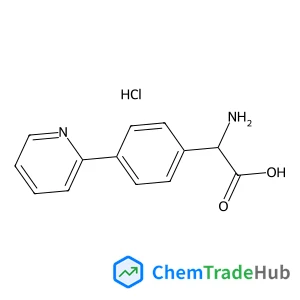
2-Amino-2-(4-(pyridin-2-YL)phenyl)acetic acid hydrochloride
CAS Number:
1135818-89-1
Molecular Formula:
C13H13ClN2O2
Michael L. Klossek, Didier Touraud, Werner Kunz
In this paper we consider clusters in the ternary systems water–benzyl alcohol and ethanol, ethyl lactate or γ-valerolactone as found with the help of dynamic and static light scattering experiments. These ternary mixtures are powerful solvent media and consist only of low-toxic solvents of natural origin. In a recent work we have shown that surfactantless microemulsions are formed in the water–ethanol–n-octanol system. By contrast, in the systems studied here the sizes of the aggregates are too small to be considered as micelles. It can be postulated that the presence of clusters or larger structures as in surfactantless microemulsions is strongly influenced by the most hydrophobic compound. The phenomenon of facilitated hydrotropy is also investigated in the above-mentioned systems. In this context, ethanol is considered as the primary hydrotrope and the more hydrophobic benzyl alcohol as the facilitating secondary hydrotrope. The hydrophobic dye Disperse Red 13 is used as a marker of facilitated hydrotropy. The results suggest that the degree of self-association of eco-solvent has a significant influence on the hydrotropic efficiency of benzyl alcohol.
Katarzyna Redel, Andrzej Kulka, Katarzyna Walczak, Camelia N. Borca, Janina Molenda
DOI: 10.1039/D0TA05556E
Ilich A. Ibarra, Peter A. Bayliss, Eduardo Pérez, Sihai Yang, Alexander J. Blake, Harriott Nowell, David R. Allan, Martyn Poliakoff, Martin Schröder
DOI: 10.1039/C1GC15726D
Pushparathinam Gopinath, Venkatachalam Ramkumar, Kannoth Manheri Muraleedharan
DOI: 10.1039/C4CE01938E
DOI: 10.1039/C9TA12170F
DOI: 10.1039/C5CE02383A
Di Yuan, Zengxi Wei, Peng Han, Chao Yang, Linsong Huang, Zhengxiang Gu, Yu Ding, Jianmin Ma, Gengfeng Zheng
DOI: 10.1039/C9TA04141A
Byeong Geun Kim, Byung-Sung Kim, Dongmok Whang, Heon-Jin Choi, Soon-Mok Choi, Won-Seon Seo, Seong-Min Jeong
DOI: 10.1039/C5CE00974J
Tomáš Pluskal
DOI: 10.1039/C7CS00411G
S. Roscales, A. G. Csákÿ
DOI: 10.1039/C4CS00195H
Jiu Wang, Pawan Kumar, Heng Zhao, Md Golam Kibria, Jinguang Hu
DOI: 10.1039/D1GC02307A
(5-Sulfamoyl-3-pyridinyl)boronic acid is primarily used in chemical synthesis, p...
Benzyl 2-methyl-2-(methylsulfonyl)-4-pentenoate is typically synthesized via est...
When handling 8-Fluoroquinolin-6-ol (CAS: 209353-22-0), it is important to use p...
1,3-Dibromo-5-(2-methyl-2-propanyl)benzene (CAS: 129316-09-2) is a crystalline c...
Ethyl 7-chloro-4-oxo-1-(1,3-thiazol-2-yl)-1,4-dihydro-1,8-naphthyridine-3-carbox...
When handling Delta-7-Avenasterol (CAS: 23290-26-8), it is important to wear app...
Proper handling involves the use of personal protective equipment such as gloves...
When handling 2-Methyl-2-proanyl 4-[(2-aminophenyl)amino]-1-piperidinecarboxylat...
N-Methyl-4-chlorobenzylamine hydrochloride (CAS: 65542-24-7) is a organic compou...
[2-(Dodecyloxy)ethoxy]acetic acid (CAS: 27306-90-7) is generally considered safe...

Physical Chemistry Chemical Physics (PCCP) is an international journal co-owned by 19 physical chemistry and physics societies from around the world. This journal publishes original, cutting-edge research in physical chemistry, chemical physics and biophysical chemistry. To be suitable for publication in PCCP, articles must include significant innovation and/or insight into physical chemistry; this is the most important criterion that reviewers and Editors will judge against when evaluating submissions. The journal has a broad scope and welcomes contributions spanning experiment, theory, computation and data science. Topical coverage includes spectroscopy, dynamics, kinetics, statistical mechanics, thermodynamics, electrochemistry, catalysis, surface science, quantum mechanics, quantum computing and machine learning. Interdisciplinary research areas such as polymers and soft matter, materials, nanoscience, energy, surfaces/interfaces, and biophysical chemistry are welcomed if they demonstrate significant innovation and/or insight into physical chemistry. Joined experimental/theoretical studies are particularly appreciated when complementary and based on up-to-date approaches.
![(3E)-3-[4-Hydroxy-3,5-bis(2-methyl-2-propanyl)benzylidene]dihydro-2(3H)-furanone structure](https://static.chemtradehub.com/structs/102/102271-49-8-cba7.webp "(3E)-3-[4-Hydroxy-3,5-bis(2-methyl-2-propanyl)benzylidene]dihydro-2(3H)-furanone structure")