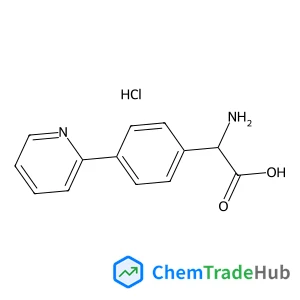
2-Amino-2-(4-(pyridin-2-YL)phenyl)acetic acid hydrochloride
CAS Number:
1135818-89-1
Molecular Formula:
C13H13ClN2O2
Tomáš Pluskal
Humans perceive physical information about the surrounding environment through their senses. This physical information is registered by a collection of highly evolved and finely tuned molecular sensory receptors. A multitude of bioactive, structurally diverse ligands have evolved in nature that bind these molecular receptors. The complex, dynamic interactions between the ligands and the receptors lead to changes in our sensory perception or mood. Here, we review our current knowledge of natural products and their derived analogues that interact specifically with human G protein-coupled receptors, ion channels, and nuclear hormone receptors to modulate the sensations of taste, smell, temperature, pain, and itch, as well as mood and its associated behaviour. We discuss the molecular and structural mechanisms underlying such interactions and highlight cases where subtle differences in natural product chemistry produce drastic changes in functional outcome. We also discuss cases where a single compound triggers complex sensory or behavioural changes in humans through multiple mechanistic targets. Finally, we comment on the therapeutic potential of the reviewed area of research and draw attention to recent technological developments in genomics, metabolomics, and metabolic engineering that allow us to tap the medicinal properties of natural product chemistry without taxing nature.
Dalibor Hršak, Lotte Holmegaard, Anton S. Poulsen, Nanna H. List, Jacob Kongsted, M. Paula Denofrio, Rosa Erra-Balsells, Franco M. Cabrerizo, Ove Christiansen, Peter R. Ogilby
DOI: 10.1039/C5CP00773A
Kada Yesudas, Eluvathingal D. Jemmis, Kotamarthi Bhanuprakash
DOI: 10.1039/C5CP01410G
Mohamed Mohamed Rashad, Abd El-Hakim Taha Kandil, Mikhael Bechelany
DOI: 10.1039/C5CP00319A
Alvira Ayoub Arbab, Kyung Chul Sun, Iftikhar Ali Sahito, Muhammad Bilal Qadir, Sung Hoon Jeong
DOI: 10.1039/C5CP00818B
Jing Ge, Zhigang Geng, Shenlong Jiang, Kaili Fan, Zhenkun Guo, Jiahua Hu, Zongwei Chen
DOI: 10.1039/C5CP00323G
Sergey Ostanin
DOI: 10.1039/C4CP05831C
Masaki Hiratsuka, Ryo Ohmura, Amadeu K. Sum, Saman Alavi, Kenji Yasuoka
DOI: 10.1039/C4CP05732E
Jia-Kai Zhou, Dah-Yen Yang
DOI: 10.1039/C5CP00378D
Jing Zhang, Nan Chen, Zheng Tang, Yang Yu, Qili Hu, Chuanping Feng
DOI: 10.1039/C5CP00817D
S. Niveditha, K. Bhanuprakash
DOI: 10.1039/C5CP01777G
(5-Sulfamoyl-3-pyridinyl)boronic acid is primarily used in chemical synthesis, p...
Benzyl 2-methyl-2-(methylsulfonyl)-4-pentenoate is typically synthesized via est...
When handling 8-Fluoroquinolin-6-ol (CAS: 209353-22-0), it is important to use p...
1,3-Dibromo-5-(2-methyl-2-propanyl)benzene (CAS: 129316-09-2) is a crystalline c...
Ethyl 7-chloro-4-oxo-1-(1,3-thiazol-2-yl)-1,4-dihydro-1,8-naphthyridine-3-carbox...
When handling Delta-7-Avenasterol (CAS: 23290-26-8), it is important to wear app...
Proper handling involves the use of personal protective equipment such as gloves...
When handling 2-Methyl-2-proanyl 4-[(2-aminophenyl)amino]-1-piperidinecarboxylat...
N-Methyl-4-chlorobenzylamine hydrochloride (CAS: 65542-24-7) is a organic compou...
[2-(Dodecyloxy)ethoxy]acetic acid (CAS: 27306-90-7) is generally considered safe...

Chem Soc Rev publishes review articles covering important topics at the forefront of the chemical sciences. Reviews should be of the very highest quality and international impact. We particularly encourage international and multidisciplinary collaborations among our authors. Our scope covers the breadth of the chemical sciences, including interdisciplinary topics where the article has a basis in chemistry. Topics include: Analytical chemistry Biomaterials chemistry Bioorganic/medicinal chemistry Catalysis Chemical Biology Coordination Chemistry Crystal Engineering Energy Sustainable chemistry Green chemistry Inorganic chemistry Inorganic materials Main group chemistry Nanoscience Organic chemistry Organic materials Organometallics Physical chemistry Supramolecular chemistry Synthetic methodology Theoretical and computational chemistry
![Ethanone, 1-[4-chloro-2-(methylthio)-5-pyrimidinyl]- structure](https://static.chemtradehub.com/structs/661/66116-82-3-863e.webp "Ethanone, 1-[4-chloro-2-(methylthio)-5-pyrimidinyl]- structure")
![7-Bromo-5-chloro-1H-pyrazolo[4,3-b]pyridine structure](https://static.chemtradehub.com/structs/135/1351813-70-1-a716.webp "7-Bromo-5-chloro-1H-pyrazolo[4,3-b]pyridine structure")