













Biodegradable polyphosphazenes containing antibiotics: synthesis, characterization, and hydrolytic release behavior
Literature Information
Publication Date
2012-12-21
DOI
10.1039/C2PY21064A
Impact Factor
5.582
Authors
Zhicheng Tian, Yufan Zhang, Xiao Liu, Chen Chen, Mark J. Guiltinan, Harry R. Allcock
View Original
Abstract
Novel polyphosphazenes containing the fluoroquinolone antibiotic substituents, ciprofloxacin or norfloxacin, were synthesized and characterized. Nano/microfibers of several selected polymers were prepared by an electrospinning technique. The sensitivity to hydrolysis, pH behavior, and antibiotic release profile of all the polymers as films and the selected polymers as nano/microfibers were investigated. The hydrolysis release behavior was further studied by an in vitro antibacterial test against E. coli. Protection and deprotection reactions of ciprofloxacin and norfloxacin were carried out before and after polymer synthesis to prevent cross-linking of multi-functional reagents with polymers. No more than 25 mol% of antibiotics can be introduced to poly(dichlorophosphazene) which was synthesized by a thermal ring opening polymerization of hexachlorocyclotriphosphazene. Various amino acid ethyl esters (glycine, alanine, and phenylalanine) were linked to the polymers as co-substituents to increase the solubility as well as to control the rate of antibiotic release. Depending on the polymer compositions, 5–23% weight loss and 4–30% antibiotic release were observed in a six week hydrolysis study at 37 °C. The corresponding nano/microfibers showed a much faster degradation and antibiotics release due to a substantially larger surface area. The in vitro antibacterial tests showed an antibacterial effect as long as ciprofloxacin or norfloxacin was released from the polymers. Meanwhile, all the polymers gave a near-neutral hydrolysis environment with the pH ranging from 5.9 to 6.8.
Recommended Journals
Related Literature
Multifunctional poly(amine-ester)-type hyperbranched polymers: lipase-catalyzed green synthesis, characterization, biocompatibility, drug loading and anticancer activity
Fangli Xu, Jiaren Zhong, Xueqi Qian, Yanyan Li, Xianfu Lin, Qi Wu
2013-03-22
Paper
DOI: 10.1039/C3PY00156C
Light induced molecular release from vesicles based on amphiphilic linear-dendritic block copolymers
Eva Blasco, Jesús del Barrio, Carlos Sánchez-Somolinos, Milagros Piñol, Luis Oriol
2012-12-20
Paper
DOI: 10.1039/C2PY21025H
New insights into radical and cationic polymerizations upon visible light exposure: role of novel photoinitiator systems based on the pyrene chromophore
Mohamad-Ali Tehfe, Frédéric Dumur, Emmanuel Contal, Bernadette Graff, Fabrice Morlet-Savary, Didier Gigmes, Jean-Pierre Fouassier, Jacques Lalevée
2012-12-07
Paper
DOI: 10.1039/C2PY20950K
Synthesis of high-molecular weight block copolymers of norbornene and propylene with methyl methacrylate initiated by a fluorenylamido titanium complex
Ryo Tanaka, Yuushou Nakayama, Takeshi Shiono
2013-05-03
Paper
DOI: 10.1039/C3PY00400G
Fully bio-based poly(l-lactide)-b-poly(ricinoleic acid)-b-poly(l-lactide) triblock copolyesters: investigation of solid-state morphology and thermo-mechanical properties
Benoit Gadenne, Carine Alfos
2013-03-21
Paper
DOI: 10.1039/C3PY00300K
An effect on the side chain position of D–π–A-type conjugated polymers with sp2-hybridized orbitals for organic photovoltaics
Kwan Wook Song, Ho Jun Song, Tae Ho Lee, Soo Won Heo, Doo Kyung Moon
2013-03-12
Paper
DOI: 10.1039/C3PY00195D
A self-healing supramolecular polymer gel with stimuli-responsiveness constructed by crown ether based molecular recognition
Xuzhou Yan, Donghua Xu, Jianzhuang Chen, Mingming Zhang, Bingjie Hu, Yihua Yu, Feihe Huang
2013-03-12
Paper
DOI: 10.1039/C3PY00283G
Nucleophilic thiol-Michael chemistry and hyperbranched (co)polymers: synthesis and ring-opening metathesis (co)polymerization of novel difunctional exo-7-oxanorbornenes with in situ inimer formation
Meina Liu, Beng Hoon Tan, Robert P. Burford, Andrew B. Lowe
2013-04-08
Paper
DOI: 10.1039/C3PY00110E
Hindrance-functionalized π-stacked polymer based on polystyrene with pendent cardo groups for organic electronics
Cheng-Rong Yin, Yuan Han, Lu Li, Shang-Hui Ye, Wei-Wei Mao, Ming-Dong Yi, Hai-Feng Ling, Ling-Hai Xie, Guang-Wei Zhang
2013-02-08
Paper
DOI: 10.1039/C3PY21154A
Dual pH and temperature responsive helical copolymer libraries with pendant chiral leucine moieties
Kamal Bauri, Shashank Pant, Saswati Ghosh Roy, Priyadarsi De
2013-05-07
Paper
DOI: 10.1039/C3PY00434A
You might also like
Compound Q&A
What is 1-(2,4,6-Trifluorophenyl)ethanol (CAS: 1250113-83-7)?
1-(2,4,6-Trifluorophenyl)ethanol is an organic compound with the CAS number 1250...
1250113-83-71-(2,4,6-Trifluoroph...
Compound Q&A
Is 1-(2,4-Dimethoxybenzyl)-4-(hydroxymethyl)-2-pyrrolidinone (CAS: 919111-34-5) safe?
1-(2,4-Dimethoxybenzyl)-4-(hydroxymethyl)-2-pyrrolidinone (CAS: 919111-34-5) is ...
919111-34-51-(2,4-Dimethoxybenz...
Compound Q&A
What are the physical and chemical properties of (7S,15R)-6β,15-Diacetoxy-7α,20-epoxy-7-hydroxykaura-2,16-dien-1-one (CAS: 51419-51-3)?
(7S,15R)-6β,15-Diacetoxy-7α,20-epoxy-7-hydroxykaura-2,16-dien-1-one is a crystal...
51419-51-3(7S,15R)-6β,15-Diace...
Compound Q&A
What regulatory guidelines apply to rac-ethyl (1r,4r)-4-hydroxycyclohexane-1-carboxylate, trans (CAS: 3618-04-0)?
The compound rac-ethyl (1r,4r)-4-hydroxycyclohexane-1-carboxylate, trans (CAS: 3...
3618-04-0rac-ethyl (1r,4r)-4-...
Compound Q&A
What is the market or research trend for 2-(2,4-Difluorophenoxy)-3-nitropyridine (CAS: 175135-62-3)?
The market for 2-(2,4-Difluorophenoxy)-3-nitropyridine (CAS: 175135-62-3) is cur...
175135-62-32-(2,4-Difluoropheno...
Compound Q&A
What are the main uses of 6-Diazo-5-oxo-L-norleucine (CAS: 157-03-9)?
The main uses of 6-Diazo-5-oxo-L-norleucine (CAS: 157-03-9) include research in ...
157-03-96-Diazo-5-oxo-L-norl...
Compound Q&A
What precautions should be taken when handling 2-Aminoethyl-mono-amide-DOTA-tris(tBu ester) (CAS: 173308-19-5)?
When handling 2-Aminoethyl-mono-amide-DOTA-tris(tBu ester) (CAS: 173308-19-5), i...
173308-19-52-Aminoethyl-mono-am...
Compound Q&A
How is 5-Methylimidazo[1,2-a]pyridine-3-carbaldehyde (CAS: 178488-37-4) typically synthesized?
5-Methylimidazo[1,2-a]pyridine-3-carbaldehyde (CAS: 178488-37-4) can be synthesi...
178488-37-45-Methylimidazo[1,2-...
Compound Q&A
Are there alternatives to 2,4,6-Trihydroxyisophthalaldehyde (CAS: 4396-13-8) in synthesis?
There are alternative reagents that can be used in the synthesis of 2,4,6-Trihyd...
4396-13-82,4,6-Trihydroxyisop...
Compound Q&A
What is (2Z)-3-(5-Fluoro-1H-indol-3-yl)-2-sulfanylacrylic acid (CAS: 179461-52-0)?
(2Z)-3-(5-Fluoro-1H-indol-3-yl)-2-sulfanylacrylic acid is a chemical compound wi...
179461-52-0(2Z)-3-(5-Fluoro-1H-...
Source Journal
Polymer Chemistry

CiteScore:
8.6
Self-citation Rate:
7.3%
Articles per Year:
457
Polymer Chemistry welcomes submissions in all areas of polymer science that have a strong focus on macromolecular chemistry. Manuscripts may cover a broad range of fields, yet no direct application focus is required.
Recommended Compounds
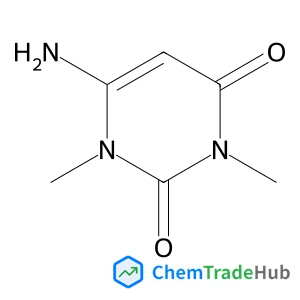
6-amino-1,3-dimethyl-1,2,3,4-tetrahydropyrimidine-2,4-dione
CAS Number:
6642-31-5
Molecular Formula:
C6H9N3O2
Recommended Suppliers




Disclaimer
This page provides academic journal information for reference and research purposes only. We are not affiliated with any journal publishers and do not handle publication submissions. For publication-related inquiries, please contact the respective journal publishers directly.
If you notice any inaccuracies in the information displayed, please contact us at support@chemtradehub.com. We will promptly review and address your concerns.