


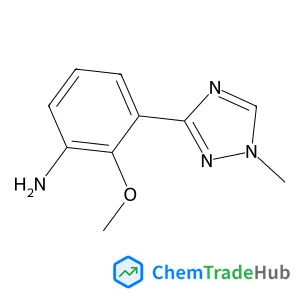
2-Methoxy-3-(1-methyl-1H-1,2,4-triazol-3-yl)aniline
CAS Number:
1609394-10-6
Molecular Formula:
C10H12N4O
David A. Marsh, Megan W. Szyndler, Robert M. Corn, A. S. Borovik
The formation of nanoparticle-polymer composites that can be processed by injection molding from superparamagnetic magnetite (Fe3O4) nanoparticles (MNPs) and the polymerizable molecule styryl acetylacetonate (stacac) is described. The best composites were created by first synthesizing MNPs in the presence of a surfactant followed by replacement with an excess of stacac monomer in a surfactant exchange reaction. Polymerization of the stacac–MNP mixture produced a dense packing of nanoparticles within a polymer matrix, resulting in a magnetic, monolithic material that was characterized with a combination of transmission electron microscopy (TEM), Fourier transform infrared absorption spectroscopy (FTIR), powder X-ray diffraction (XRD) and vibrating sample magnetometry (VSM). The material exhibited superparamagnetic properties similar to pure MNP samples, albeit with a lower total magnetic saturation. An advantage of this polymer-based composite material is its ability to be processed with methods such as mold-casting or microfluidics into a variety of 3-dimensional structures (e.g., toroids) for different electronics applications.

Colloid Journal

Critical Reviews in Solid State and Materials Sciences

Bioorganic & Medicinal Chemistry

Journal of Asian Natural Products Research

Polycyclic Aromatic Compounds

Acta Metallurgica Sinica-English Letters

Bioorganic & Medicinal Chemistry Letters

Biocatalysis and Biotransformation

Main Group Chemistry

Herald of the Russian Academy of Sciences
Serena Margadonna, Yasuhiro Takabayashi, Martin T. McDonald, Karolina Kasperkiewicz, Yoshikazu Mizuguchi, Yoshihiko Takano, Andrew N. Fitch, Emmanuelle Suard, Kosmas Prassides
DOI: 10.1039/B813076K
Yong Shen Chua, Guotao Wu, Weiliang Xu, Wendy Shaw, Abhi Karkamkar, John Linehan, Tricia Smurthwaite, Thomas Autrey
DOI: 10.1039/B812576G
Gregory P. Holland, Janelle E. Jenkins, Melinda S. Creager, Randolph V. Lewis, Jeffery L. Yarger
DOI: 10.1039/B812928B
Yuki Hoshino, Takehiko Ishii
DOI: 10.1039/B811818C
Alan R. Bassindale, Zhihua Liu, Peter G. Taylor, Peter N. Horton, Michael B. Hursthouse
DOI: 10.1039/B808456D
Inge De Cat, Cornelia Röger, Cameron C. Lee, Freek J. M. Hoeben, Maarten J. Pouderoijen, Albertus P. H. J. Schenning, Frank Würthner, Steven De Feyter
DOI: 10.1039/B811961A
Dong-Kwon Lim, In-Jung Kim, Jwa-Min Nam
DOI: 10.1039/B810195G
1H-Indazole-6-carbonitrile finds applications in pharmaceuticals, where it serve...
Waste containing Dioctyl (2E)-2-butenedioate (CAS: 2997-85-5) should be collecte...
Sodium [(1,2-benzoxazol-3-ylmethyl)sulfonyl]azanide is primarily used in pharmac...
Dimethyl 4-(4,4,5,5-tetramethyl-1,3,2-dioxaborolan-2-yl)-2,6-pyridinedicarboxyla...
Waste containing 2-Fluoro-6-hydrazinopyridine (CAS: 80714-39-2) should be manage...
6-Formyl-2-pyridinecarboxylic acid is an organic compound with the molecular for...
Research trends for this compound indicate a focus on its potential applications...
9H-Tribenzo[b,d,f]azepine is typically synthesized via a multi-step process invo...
1-Cyclopropyl-7-ethoxy-6-fluoro-8-methoxy-4-oxo-1,4-dihydro-3-quinolinecarboxyli...
Waste containing Methyl 3-oxo-1,2,3,4-tetrahydro-6-quinoxalinecarboxylate (CAS: ...

Polymer Chemistry welcomes submissions in all areas of polymer science that have a strong focus on macromolecular chemistry. Manuscripts may cover a broad range of fields, yet no direct application focus is required.



![2-Methyl-2-propanyl 4-{2-fluoro-5-[(4-oxo-3,4-dihydro-1-phthalazinyl)methyl]benzoyl}-1-piperazinecarboxylate structure](https://static.chemtradehub.com/structs/763/763114-04-1-65a9.webp "2-Methyl-2-propanyl 4-{2-fluoro-5-[(4-oxo-3,4-dihydro-1-phthalazinyl)methyl]benzoyl}-1-piperazinecarboxylate structure")





